


Key Takeaways
Australia’s online recruitment market looks relatively stable overall, but demand is moving sharply between occupations.
Registered Nurse job advertisements reached approximately 7,425 in the August 2026 three-month average, up 16.1% from August 2025.
General Practitioners and Resident Medical Officers recorded approximately 5,805 advertisements, up 25.7% year on year.
Electrician advertisements increased 18.5%, while Civil Engineering Professionals increased 14.8%.
Drillers, Miners and Shot Firers recorded one of the strongest increases among sizeable occupations, rising 31.7% year on year.
Several major ICT occupations moved in the opposite direction. Software and Applications Programmers fell 19.3%, while Database and Systems Administrators and ICT Security Specialists fell 16.3%.
Strong vacancy growth does not automatically mean an occupation qualifies for employer sponsorship. Employers must assess occupation eligibility, salary, genuine need, Labour Market Testing and the relevant visa pathway separately.
Australia’s skills shortage in 2026 is becoming less uniform.
Jobs and Skills Australia’s August 2026 Internet Vacancy Index shows that total online recruitment demand remains elevated, but some of the strongest growth is now concentrated in healthcare, trades, engineering, construction and resource-related occupations.
At the same time, several major ICT occupations have recorded sizeable year-on-year declines.
For employers, this matters because the headline number does not tell the full story. Recruitment pressure increasingly depends on what role you are hiring for, where the role is located and whether the available local labour supply matches the skills the business actually needs.
What Does the August 2026 IVI Tell Us?
The Internet Vacancy Index, or IVI, is produced by Jobs and Skills Australia and measures newly lodged online job advertisements from major job boards.
The August 2026 dataset shows approximately 215,977 online job advertisements in the Australia-wide three-month average, compared with approximately 214,094 in August 2025.
That is an increase of less than 1% year on year.
On the surface, that looks like a relatively stable hiring market.
The occupation-level data tells a very different story.
Some occupations have increased by 15%, 20% or even 30% over the same period, while others have fallen by similar margins.
This means Australia is not simply experiencing more or less demand. The composition of demand is changing.
A relatively flat national vacancy number can hide substantial workforce pressure at occupation level. Employers should compare their specific occupation and location rather than relying on national labour market headlines.
Healthcare Demand Continues to Accelerate
Healthcare provides some of the clearest evidence of the shift.
Registered Nurses
Registered Nurses recorded approximately:
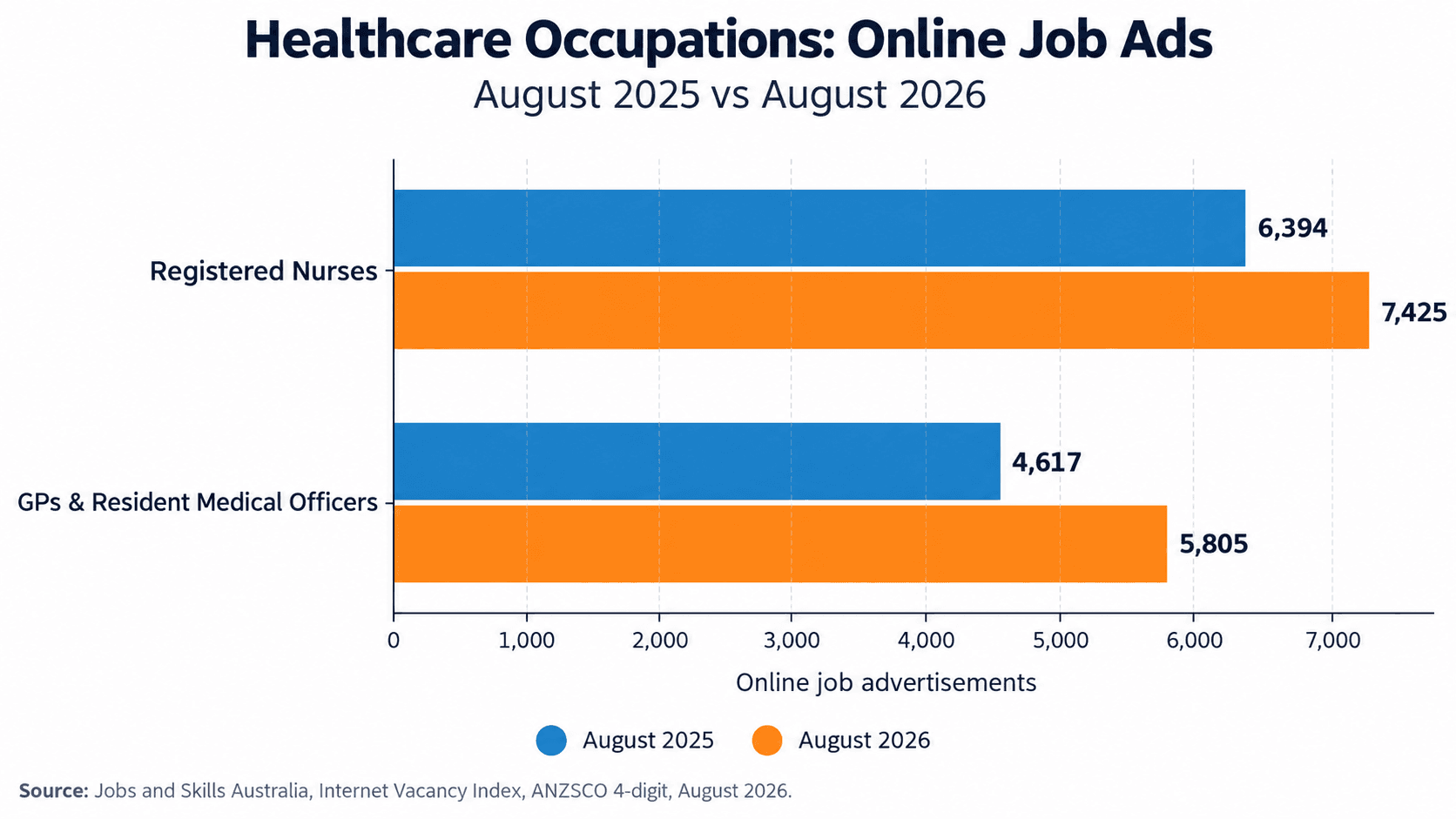
Period | Online Job Ads |
August 2025 | 6,394 |
August 2026 | 7,425 |
Year-on-year change | +16.1% |
An additional 1,000-plus advertisements in the three-month average represents a substantial increase for an occupation that was already one of the largest recruitment categories in Australia.
General Practitioners and Resident Medical Officers
Demand increased even faster for General Practitioners and Resident Medical Officers.
Period | Online Job Ads |
August 2025 | 4,617 |
August 2026 | 5,805 |
Year-on-year change | +25.7% |
This category added almost 1,200 advertisements compared with the same period one year earlier.
For employers in healthcare, the issue is therefore not simply whether healthcare workers are needed. The challenge is finding candidates who can satisfy registration, qualification, skills assessment and, where applicable, sponsorship requirements.
Employers considering overseas recruitment should also understand that healthcare sponsorship involves more than identifying a candidate. Registration and assessment requirements can become the real bottleneck.
For a detailed breakdown of nursing and carer pathways, see our guide to Healthcare Sponsorship Australia 2026: Requirements for Nurses and Carers.
Trades and Resource Occupations Are Also Moving Higher
Healthcare is not the only part of the labour market showing stronger recruitment pressure.
Several trade, resource and infrastructure-related occupations increased materially between August 2025 and August 2026.
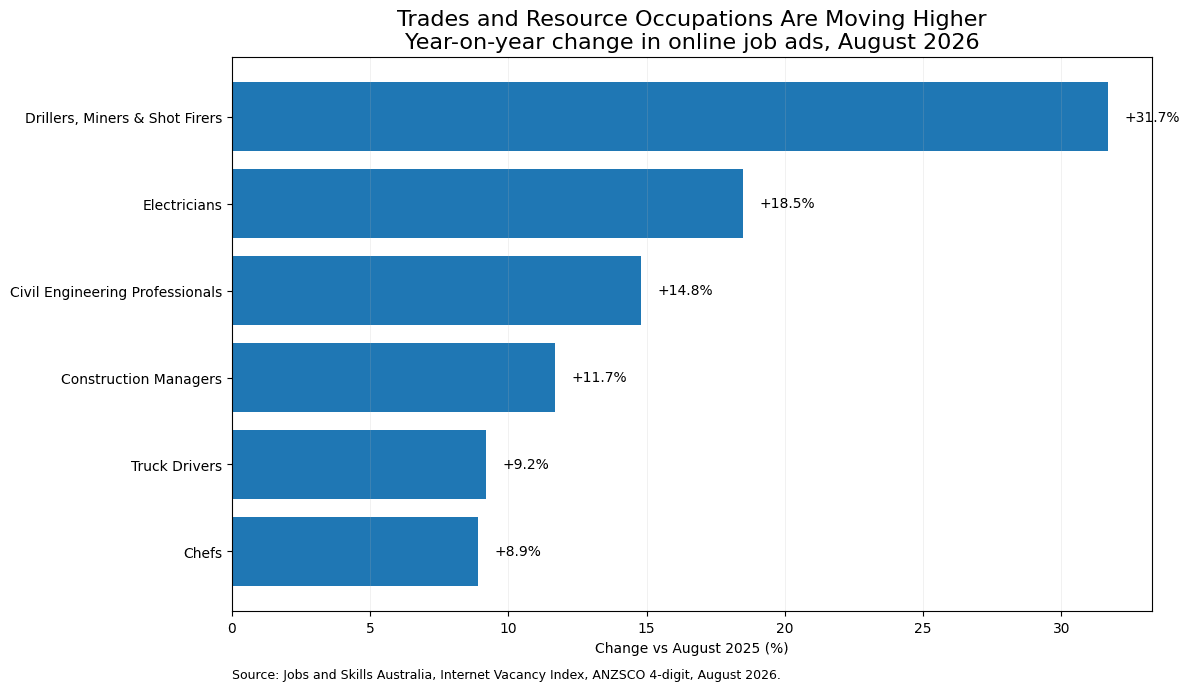
Occupation | Aug 2025 | Aug 2026 | YoY Change |
Drillers, Miners and Shot Firers | 783 | 1,032 | +31.7% |
Electricians | 2,831 | 3,355 | +18.5% |
Civil Engineering Professionals | 2,058 | 2,363 | +14.8% |
Construction Managers | 3,570 | 3,986 | +11.7% |
Truck Drivers | 2,687 | 2,934 | +9.2% |
Chefs | 2,766 | 3,011 | +8.9% |
The largest percentage increase in this group came from Drillers, Miners and Shot Firers, with advertisements rising 31.7%.
Electricians are particularly important because they combine relatively high vacancy volume with strong growth. Approximately 3,355 advertisements were recorded in August 2026, more than 500 above the August 2025 figure.
Civil Engineering Professionals and Construction Managers also recorded double-digit growth.
Together, these figures point to sustained hiring requirements around physical infrastructure, construction, resources and technical trades.
ICT Is Telling a Different Story
Software and Applications Programmers remained a sizeable occupation with approximately 2,896 advertisements in August 2026. However, this was down from approximately 3,589 one year earlier. That represents a decline of 19.3%. Several other ICT categories also declined.
ICT Occupation | Aug 2026 Ads | YoY Change |
Software and Applications Programmers | 2,896 | -19.3% |
Database and Systems Administrators, and ICT Security Specialists | 513 | -16.3% |
Multimedia Specialists and Web Developers | 67 | -20.0% |
ICT Support and Test Engineers | 331 | -9.1% |
ICT Business and Systems Analysts | 1,752 | -6.0% |
Computer Network Professionals | 362 | -5.7% |
This does not mean Australia no longer needs ICT professionals, it means online recruitment activity for several major ICT occupation groups was lower in August 2026 than it was one year earlier.
A decline in advertisements can reflect several factors, including changes in employer hiring plans, completed hiring cycles, economic conditions, productivity investment, candidate availability or shifts in the types of technology skills businesses are seeking.
The IVI data alone cannot tell us which explanation is responsible, what it does show clearly is that ICT recruitment demand is not moving in the same direction as healthcare, electrical trades, mining and several infrastructure-related occupations.
The Real Story Is Divergence
Looking only at total job advertisements would make Australia’s labour market appear relatively stable, looking occupation by occupation reveals a much larger shift.
Selected year-on-year changes
Occupation | Change |
Drillers, Miners and Shot Firers | +31.7% |
GPs and Resident Medical Officers | +25.7% |
Electricians | +18.5% |
Registered Nurses | +16.1% |
Civil Engineering Professionals | +14.8% |
Construction Managers | +11.7% |
ICT Business and Systems Analysts | -6.0% |
Database/System Administration and ICT Security | -16.3% |
Software and Applications Programmers | -19.3% |
Employers competing for nurses, doctors, electricians, mining workers or engineering professionals are operating in a very different recruitment market from an employer hiring into some ICT categories.
Does Higher Vacancy Growth Mean an Occupation Is in Shortage?
Not automatically. This is an important distinction for employers, The Internet Vacancy Index measures online job advertisements. Jobs and Skills Australia describes it as a proxy for recruitment activity and labour demand.
It does not measure every vacancy in Australia. It also does not mean that every occupation with increasing advertisements is officially classified as being in shortage.
There are several limitations:
Jobs advertised outside the contributing job boards are not fully captured.
One advertisement can sometimes represent more than one position.
Some vacancies are filled without being publicly advertised.
Recruitment practices differ significantly between occupations.
The IVI does not determine whether an occupation qualifies for employer-sponsored migration.
For this reason, IVI should be used as one labour market indicator rather than as a standalone sponsorship test.
What Does This Mean for Australian Employers?
The August data carries several practical implications.
1. Recruitment planning needs to become occupation-specific
A national hiring trend is increasingly less useful on its own.
An employer recruiting software developers may be seeing a different candidate market from an employer recruiting nurses or electricians.
Salary benchmarking, recruitment timelines and sourcing strategies should therefore be based on the specific occupation and location.
2. Employers in rapidly growing occupations may need to widen their candidate pool
When online recruitment demand rises strongly across an occupation, competition for experienced workers can increase. Employers may need to consider:
recruitment across multiple Australian regions
stronger candidate sourcing
improved job advertisements
clearer salary positioning
workforce development and training
overseas recruitment where an appropriate sponsorship pathway exists
3. A difficult recruitment market does not remove sponsorship compliance
An employer may have genuine difficulty finding a local worker, but employer sponsorship still requires a compliant process. Depending on the visa pathway, this can include Labour Market Testing, salary requirements, evidence of a genuine position and other nomination documentation.
Before considering sponsorship, employers should understand the four steps Australian employers must follow for employer sponsorship in 2026.
4. Migration processing priorities should be considered separately from labour demand
Labour demand and visa processing priority are related policy issues, but they are not the same thing.
Australia’s September 2026 Directions 121 and 122 changed the processing order for a range of skilled visa applications, including priority treatment for specified sectors and occupations.
Employers planning international recruitment should therefore consider two separate questions:
Is the business experiencing a genuine recruitment need?
How is the relevant visa pathway currently processed?
Our guide to Directions 121 and 122 and skilled visa processing explains the latest priority structure.
What About Australia’s Broader Migration Strategy?
The changing vacancy mix also sits within a wider migration policy environment.
Australia continues to adjust how temporary and permanent migration is targeted, how employer-sponsored workers move through the system and how government responds to areas of persistent workforce pressure.
Recent migration policy announcements from Immigration Minister Tony Burke add another layer to this environment.
For employers, the practical takeaway is that labour market data, occupation eligibility, visa rules and processing priorities should be considered together, rather than in isolation.
Read our analysis of Immigration Minister Tony Burke’s Labor Migration Plan for the broader policy context.
Should Employers Sponsor Workers in High-Demand Occupations?
High demand alone is not a reason to sponsor a worker.
Sponsorship becomes relevant when the business has a genuine role, cannot adequately resolve the hiring requirement through its normal recruitment process, identifies an appropriate candidate and can satisfy the relevant sponsorship and nomination requirements.
Before proceeding, employers should assess:
Occupation eligibility Confirm that the role aligns with the appropriate occupation classification and visa pathway.
Genuine business need The position should be a genuine requirement of the business.
Local recruitment evidence Complete Labour Market Testing where required and retain compliant evidence.
Salary and market rate Ensure the proposed salary satisfies both migration thresholds and the Annual Market Salary Rate requirements that apply to the position.
Candidate suitability Check qualifications, work experience, registration, licensing and skills assessment requirements.
Visa pathway Determine whether the appropriate route is a temporary, permanent or regional employer-sponsored pathway.
This is where labour market intelligence becomes useful. Data can identify where recruitment pressure is increasing, but the sponsorship strategy still needs to be built role by role.
What Employers Should Watch Next
The most useful question for the remainder of 2026 is not whether Australian job vacancies rise or fall overall.
It is which occupations continue to diverge.
If healthcare and trade vacancies continue rising while ICT recruitment remains softer, employers may need to adjust workforce planning, salary assumptions and candidate sourcing strategies accordingly.
The next IVI releases will help show whether the August pattern represents a continuing structural shift or a shorter-term hiring cycle.
For employers experiencing persistent workforce shortages, Genuine Solutions can assist with candidate sourcing and the recruitment documentation required to support an employer sponsorship process.
Our focus is practical: identify the workforce gap, document the recruitment process properly and help employers build a stronger candidate pipeline before nomination.
FAQ
Is Australia experiencing a skills shortage in 2026?
Australia continues to experience significant recruitment pressure in a number of occupations, but the August 2026 IVI shows that hiring demand is not moving evenly across the labour market. Healthcare, trades, mining and several engineering occupations recorded strong year-on-year increases, while several major ICT occupations declined.
What jobs are seeing strong hiring growth in Australia in 2026?
Among occupations with meaningful vacancy volumes, the August 2026 IVI shows strong annual growth for Drillers, Miners and Shot Firers, General Practitioners and Resident Medical Officers, Electricians, Registered Nurses, Civil Engineering Professionals and Construction Managers.
Are healthcare jobs still in demand in Australia?
Yes. In the August 2026 three-month average, Registered Nurses recorded approximately 7,425 online job advertisements, up 16.1% year on year. General Practitioners and Resident Medical Officers recorded approximately 5,805 advertisements, up 25.7%.
Are ICT jobs declining in Australia?
Online job advertisements for several ICT occupations were lower in August 2026 than one year earlier. Software and Applications Programmers declined 19.3%, while Database and Systems Administrators and ICT Security Specialists declined 16.3%. This indicates lower online recruitment activity, not the disappearance of ICT employment or skills requirements.
Does a high number of vacancies mean an occupation qualifies for sponsorship?
No. Vacancy demand and migration eligibility are separate. An employer must still confirm occupation eligibility, the appropriate visa pathway, salary requirements, genuine need, Labour Market Testing where applicable and all other sponsorship conditions.
Can overseas workers help employers fill skills gaps?
Overseas recruitment can be one option when employers have a genuine workforce requirement and an appropriate employer-sponsored visa pathway is available. Employers should first assess the occupation, candidate, salary, recruitment evidence and nomination requirements.
Sources and Methodology
Primary data source: Jobs and Skills Australia, Internet Vacancy Index, ANZSCO 4-digit occupations, States and Territories, August 2026.
Data used in this article: Australia-wide three-month average figures for August 2025 and August 2026.
Method: Year-on-year percentage change was calculated by comparing the August 2026 three-month average with the corresponding August 2025 figure for each occupation.
Important limitation: The IVI measures online job advertisements and is an indicator of recruitment activity and labour demand. It does not represent all vacancies in Australia and does not by itself determine official skills shortage status or employer sponsorship eligibility.
Conclusion
Australia’s skills shortage in 2026 is increasingly defined by where hiring pressure is growing, not simply by the total number of vacancies.
The August IVI data shows strong increases across healthcare, electrical trades, mining, construction and civil engineering. At the same time, recruitment activity across several major ICT occupations has fallen compared with August 2025.
For employers, the implication is practical. Workforce planning should start with occupation-level evidence, then move to local recruitment, candidate sourcing and, where required, a compliant sponsorship pathway.
Genuine Solutions helps Australian employers connect recruitment needs with practical workforce and sponsorship documentation support, so hiring decisions are based on evidence rather than assumptions.