


Healthcare vs Trades vs ICT: Where Is Job Demand Strongest in Australia?
Australia's job market is sending different signals depending on the occupation and location. Healthcare recruitment remains strong in several professional roles, certain skilled trades continue to attract substantial job advertising, and some major ICT occupations are recording fewer advertisements than a year ago.
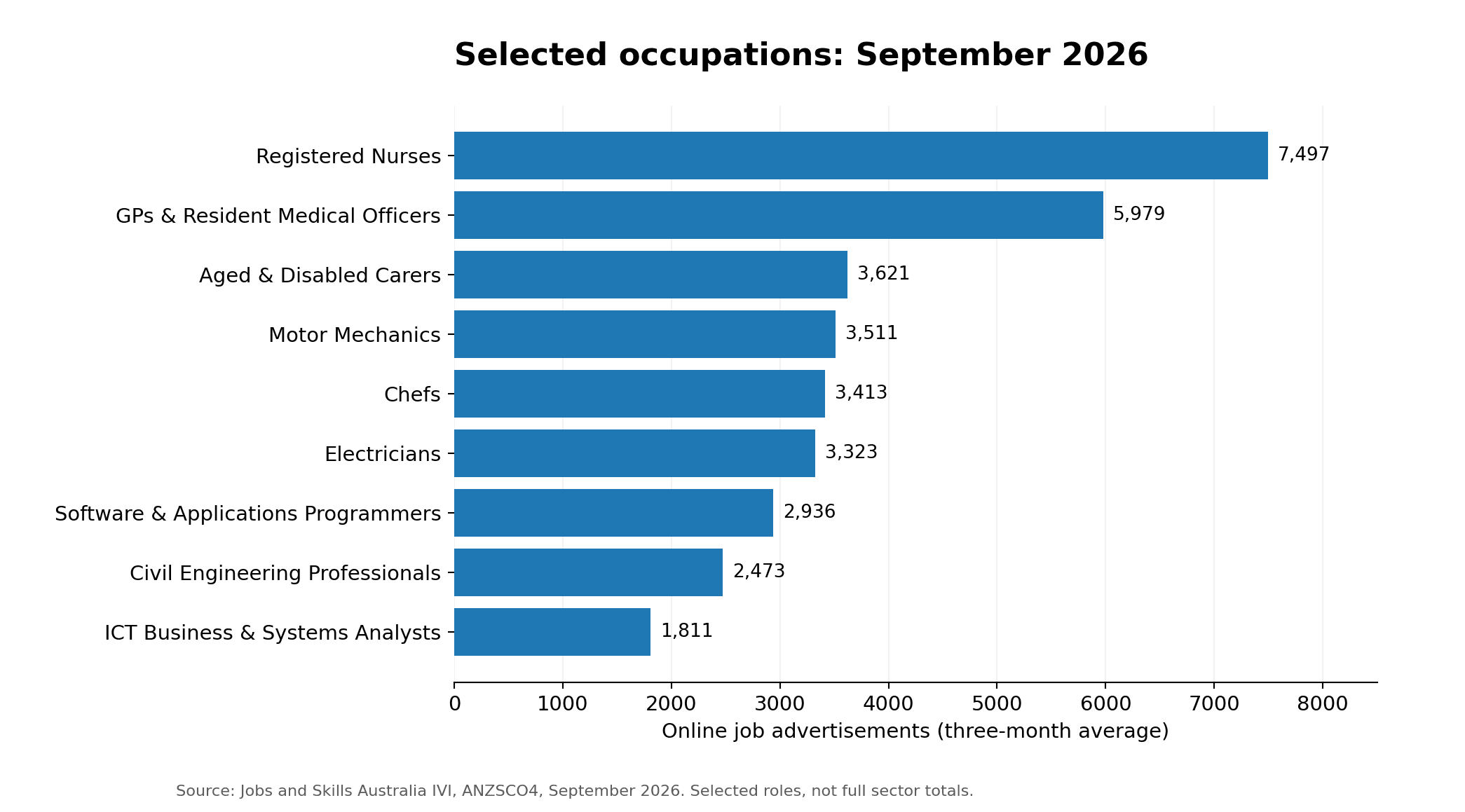
According to the September 2026 Internet Vacancy Index (IVI) data from Jobs and Skills Australia, Registered Nurses recorded approximately 7,497 online job advertisements, while Electricians recorded 3,323 and Software and Applications Programmers recorded 2,936. These figures are three-month averages for individual occupations, rather than complete industry totals.
For Australian employers and skilled workers, the important question is not simply which industry has the most jobs. It is which occupations are being advertised, where employers are looking for workers, and how demand has changed over time.
What Does Australia's Latest Job Demand Data Show?
The Internet Vacancy Index tracks newly advertised jobs across SEEK, CareerOne and Workforce Australia. Its occupation-level figures provide an indication of recruitment activity, helping employers and job seekers understand how advertised demand differs across roles and locations.
At the broader occupation-group level, September 2026 trend data recorded approximately 30,538 advertisements for Technicians and Trades Workers, compared with 14,579 for Medical Practitioners and Nurses and 5,866 for ICT Professionals.
These groups should not be treated as complete or directly equivalent healthcare, trades and ICT sectors. Healthcare also includes carers and allied health occupations, while the broader technicians and trades category includes technical roles outside traditional trades. To understand the differences properly, it is more useful to look at specific occupations.
Which Occupations Have the Most Job Advertisements?
Selected occupations in the September 2026 three-month average recorded:
Occupation | Online job advertisements |
|---|---|
Registered Nurses | 7,497 |
General Practitioners and Resident Medical Officers | 5,979 |
Aged and Disabled Carers | 3,621 |
Motor Mechanics | 3,511 |
Chefs | 3,413 |
Electricians | 3,323 |
Software and Applications Programmers | 2,936 |
Civil Engineering Professionals | 2,473 |
ICT Business and Systems Analysts | 1,811 |
Source: Jobs and Skills Australia, September 2026 IVI, ANZSCO four-digit occupation data. Figures are rounded three-month averages.
The comparison shows why a simple industry ranking can be misleading. Registered Nurses alone attracted considerably more online advertisements than Software and Applications Programmers, while several trades and service occupations also recorded substantial activity.
Healthcare, Trades and ICT: Which Jobs Are Growing?
Job advertising volume tells us how active recruitment is at a particular point in time. Year-on-year changes add another perspective by showing whether advertising activity is increasing or decreasing.
Comparing September 2026 with September 2025, General Practitioners and Resident Medical Officers recorded approximately 33.9% growth in online advertisements, while Registered Nurses increased by 10.8%. Electricians rose by approximately 13.8%, and Civil Engineering Professionals increased by 17.2%.
ICT presented a different picture. Software and Applications Programmers recorded approximately 20.9% fewer advertisements, while ICT Business and Systems Analysts declined by around 4.0%.
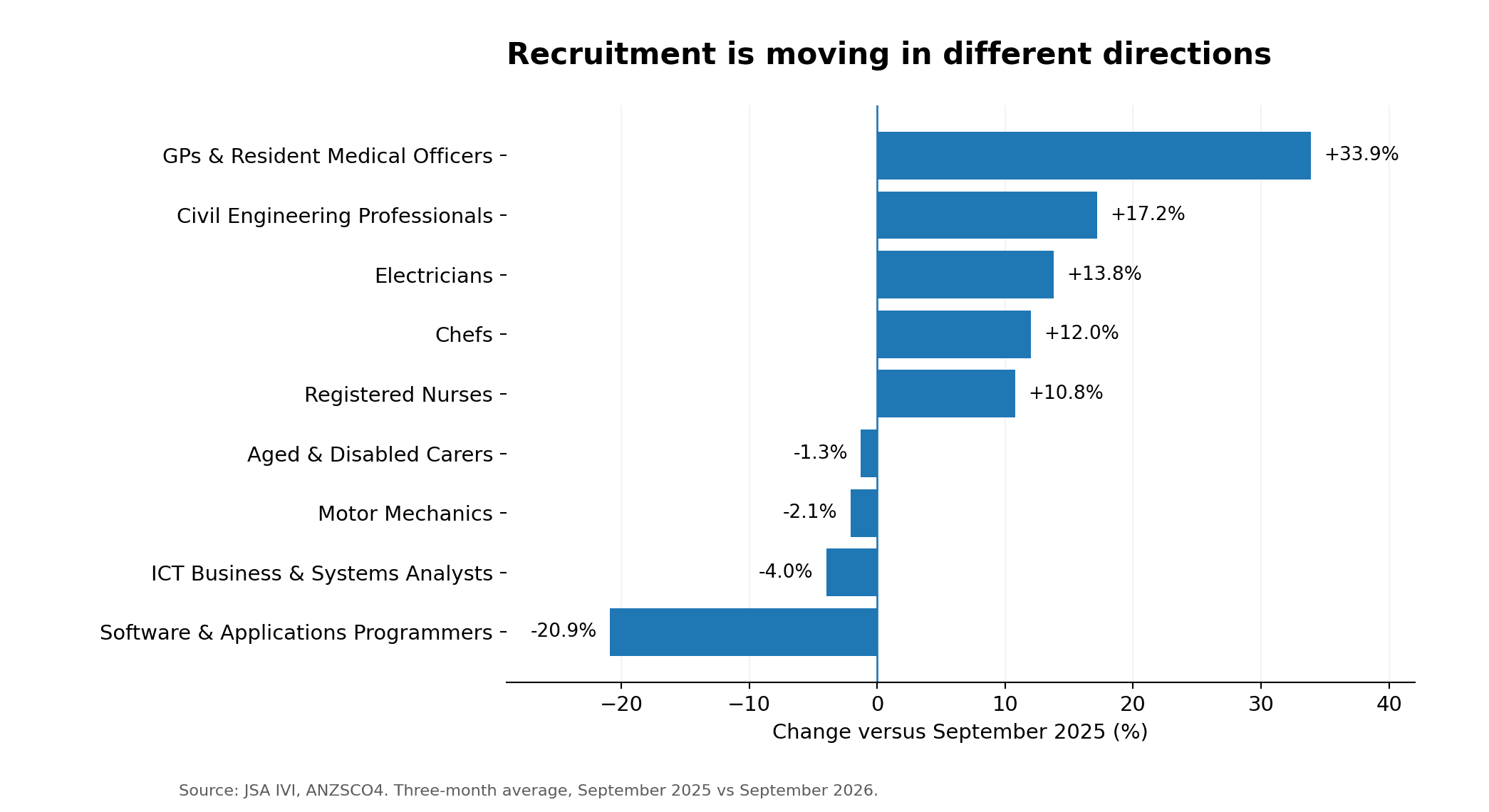
These changes do not mean every healthcare or trade role is growing, or every ICT role is declining. Aged and Disabled Carers, for example, recorded a small annual decline of approximately 1.3%, despite having more than 3,600 advertisements in the September average.
The main takeaway is that Australia's recruitment market is becoming more differentiated. Employers hiring nurses, electricians and software developers are not necessarily experiencing the same advertising conditions.
Why Is Healthcare an Important Recruitment Market?
Healthcare advertising remains substantial across several professional and care-related roles. Registered Nurses and General Practitioners are particularly prominent in the September data, although demand differs between healthcare occupations.
For employers, recruitment planning also involves professional registration, qualifications, experience and the requirements of the specific position. Advertising activity alone cannot determine whether a candidate is suitable or eligible for sponsorship.
Businesses exploring international recruitment can read our Healthcare Sponsorship Australia 2026: Requirements for Nurses and Carers guide for more information about the relevant considerations.
Are Skilled Trades Still in Demand?
Yes, several skilled trades continue to show substantial recruitment activity, but growth is not uniform. Electricians recorded approximately 3,323 advertisements in September 2026, up 13.8% from a year earlier. Motor Mechanics recorded a larger number of advertisements, at approximately 3,511, but were down around 2.1% year on year.
This distinction matters to employers. A large advertising market does not always mean recruitment demand is accelerating, and a growing occupation does not automatically mean employers will struggle to recruit suitable local workers.
The practical approach is to assess the specific trade, location, qualification requirements and available candidate pool before making recruitment decisions.
Is ICT Job Demand Declining in Australia?
Several major ICT occupations recorded fewer online advertisements in September 2026 than in September 2025. Software and Applications Programmers declined by approximately 20.9%, while ICT Business and Systems Analysts decreased by around 4.0%.
However, lower advertising activity does not mean the technology industry has stopped recruiting. Employers may still require specialised technical capabilities, and demand can vary significantly between different ICT occupations and locations.
For job seekers, it is therefore more useful to research individual ICT roles and local employment markets than to assume all technology-related jobs follow the same trend.
Where Are Healthcare, Trades and ICT Jobs Most Advertised?
Location adds another important dimension to Australia's recruitment market. The September 2026 IVI data shows that even occupations with substantial national demand can have very different geographic distributions.
For example, Registered Nurse advertisements were highest in New South Wales, followed by Victoria and Queensland. Electrician advertisements were comparatively strong across Queensland, New South Wales and Western Australia. Software and Applications Programmer advertisements were concentrated more heavily in New South Wales and Victoria.
How Does Job Demand Compare Across Australian States?
State | Registered Nurses | Electricians | Software Programmers |
|---|---|---|---|
New South Wales | 2,538 | 826 | 1,060 |
Victoria | 1,753 | 519 | 797 |
Queensland | 1,463 | 841 | 457 |
Western Australia | 584 | 791 | 194 |
South Australia | 738 | 223 | 143 |
Tasmania | 153 | 41 | 16 |
Northern Territory | 127 | 49 | 10 |
Australian Capital Territory | 142 | 33 | 258 |
Source: Jobs and Skills Australia, September 2026 IVI, selected ANZSCO four-digit occupations, three-month average. Figures are rounded.
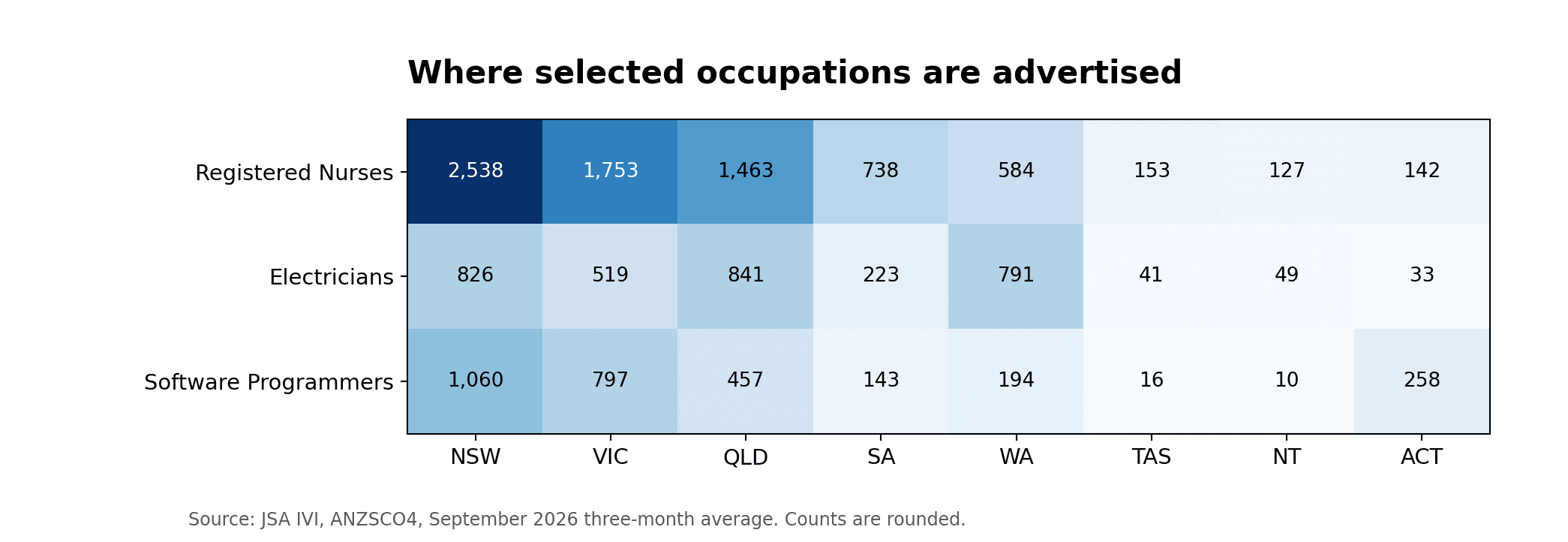
This comparison reveals differences that national rankings can hide. Queensland recorded slightly more Electrician advertisements than New South Wales, while Western Australia also represented a substantial share of that occupation's advertising. Software and Applications Programmer advertisements were more concentrated in the larger eastern labour markets, with the ACT also recording a notable number relative to its size.
These are advertisement counts, not job opportunities per resident or recruitment difficulty rates. Larger states naturally have larger labour markets, so the figures should not be interpreted as a ranking of how easy it is to find employment.
What About Regional Australia?
Regional demand matters because employers outside major capital cities may face different recruitment conditions. However, regional advertising cannot be accurately assessed using state totals alone.
Jobs and Skills Australia's IVI also provides regional, SA4 and remoteness datasets. These can help employers assess recruitment activity in specific labour markets rather than relying on national or state-wide averages.
For employers considering recruitment in regional Australia, the location of the position, the occupation and the relevant visa requirements should all be assessed separately. A vacancy being located in a regional area does not automatically make it eligible for a regional migration pathway.
What Does This Mean for Australian Employers and Skilled Workers?
For Australian employers, the September data provides a practical starting point for workforce planning. A business recruiting electricians in Western Australia, for example, is operating in a different geographic labour market from an organisation hiring software developers in Sydney.
A useful recruitment assessment should consider the specific occupation, local applicant availability, required qualifications, advertising trends and the business's actual workforce needs. Employers should also recognise that strong advertising activity is not the same as a formally assessed skills shortage.
Where suitable Australian workers cannot be sourced, overseas recruitment may be one option. However, employer-sponsored migration involves separate eligibility, nomination and visa requirements. Our guide to the four steps Australian employers must follow for employer sponsorship provides an introduction to that process.
For skilled workers, the data can help identify occupations and locations worth researching further. It does not guarantee employment, employer sponsorship or visa eligibility. Qualifications, registration, experience and employer-specific recruitment requirements remain essential.
Frequently Asked Questions
1. Which has stronger job demand in Australia: healthcare, trades or ICT?
Selected healthcare and trade occupations recorded higher advertising volumes than several major ICT occupations in September 2026. Registered Nurses had approximately 7,497 advertisements, compared with 3,323 for Electricians and 2,936 for Software and Applications Programmers. These are occupation-level comparisons, not complete industry totals.
2. Are healthcare jobs still growing in Australia in 2026?
Some healthcare occupations are showing strong annual advertising growth. General Practitioners and Resident Medical Officers increased by approximately 33.9% year on year, while Registered Nurses increased by around 10.8%. Other care-related occupations recorded different trends, so demand should be assessed at the individual occupation level.
3. Which Australian states have the highest demand for electricians?
Queensland recorded approximately 841 Electrician advertisements in the September 2026 three-month average, followed closely by New South Wales with 826 and Western Australia with 791. These are advertising volumes rather than measures of how difficult it is for employers to fill positions.
4. Are ICT jobs declining across Australia?
Online advertisements declined for several major ICT occupations between September 2025 and September 2026. Software and Applications Programmers fell by approximately 20.9%, while ICT Business and Systems Analysts decreased by around 4.0%. This does not mean all ICT specialisations or locations experienced a decline.
5. Can Australian employers sponsor overseas workers for high-demand occupations?
Potentially, but advertising demand alone does not establish eligibility. Employers must assess the relevant visa pathway, nominated occupation, business and salary requirements, candidate qualifications, and any applicable recruitment or licensing obligations. The Department of Home Affairs outlines available employer-sponsored visa options.
Understanding the Data
This analysis uses Jobs and Skills Australia's September 2026 Internet Vacancy Index workbooks, primarily the ANZSCO two-digit occupation trend series and ANZSCO four-digit occupation three-month averages. Annual changes compare September 2026 with September 2025 within the same series.
The IVI measures newly lodged online advertisements from SEEK, CareerOne and Workforce Australia. It does not cover every job vacancy, and one advertisement may relate to more than one position. The independently adjusted trend and seasonally adjusted series are not additive.
As a result, the findings should be treated as indicators of recruitment activity rather than complete employment counts, definitive occupation shortage assessments or indicators of visa eligibility.
Sources:
Final Thoughts
Australia's job market is not moving in one direction. September 2026 IVI data shows continued strength in occupations such as nursing and electrical trades, alongside lower advertising activity for some major ICT occupations. The geographic differences are equally important, with job advertisements concentrated in different states depending on the occupation.
For employers, the most useful approach is to understand the role and local labour market before deciding how to recruit. For skilled workers, occupation-level data offers a clearer starting point than broad claims about which industries are in demand.
If your business is finding it difficult to recruit suitable skilled workers and is considering overseas recruitment, Genuine Solutions can help you understand the employer sponsorship process and the requirements involved, so your next steps are based on your business's actual hiring needs.