

The Short Answer
July 2026 IVI data shows 14,195 online job advertisements for Medical Practitioners and Nurses across Australia, up 0.5% from June. That's modest monthly growth. But year-over-year? Health occupations are up roughly 11.5% vs 2019 well above the all-occupation +25% growth rate.
The headline number understates what's actually happening: regional Australia is driving the real nursing demand surge, while capital cities show flat-to-slightly-negative trends.
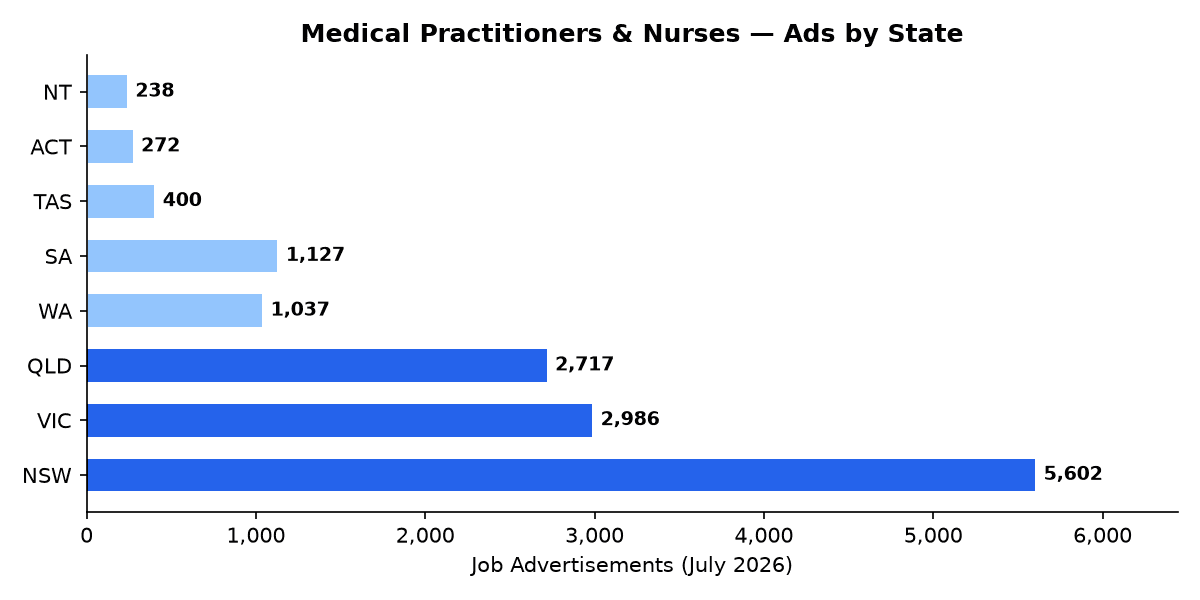
Medical Practitioners and Nurses July 2026 by State
State/Territory | Ads | Monthly Δ | Annual Context |
NSW | 5,602 | +0.1% | -2.6% vs Jul 2025 |
VIC | 2,986 | +0.3% | +0.3% vs Jul 2025 |
QLD | 2,717 | +0.9% | -0.3% vs Jul 2025 |
WA | 1,037 | -0.4% | +5.4% vs Jul 2025 |
SA | 1,127 | -0.1% | +2.8% vs Jul 2025 |
TAS | 400 | +0.2% | -1.8% vs Jul 2025 |
ACT | 272 | +0.7% | -6.9% vs Jul 2025 |
NT | 238 | -0.4% | -13.2% vs Jul 2025 |
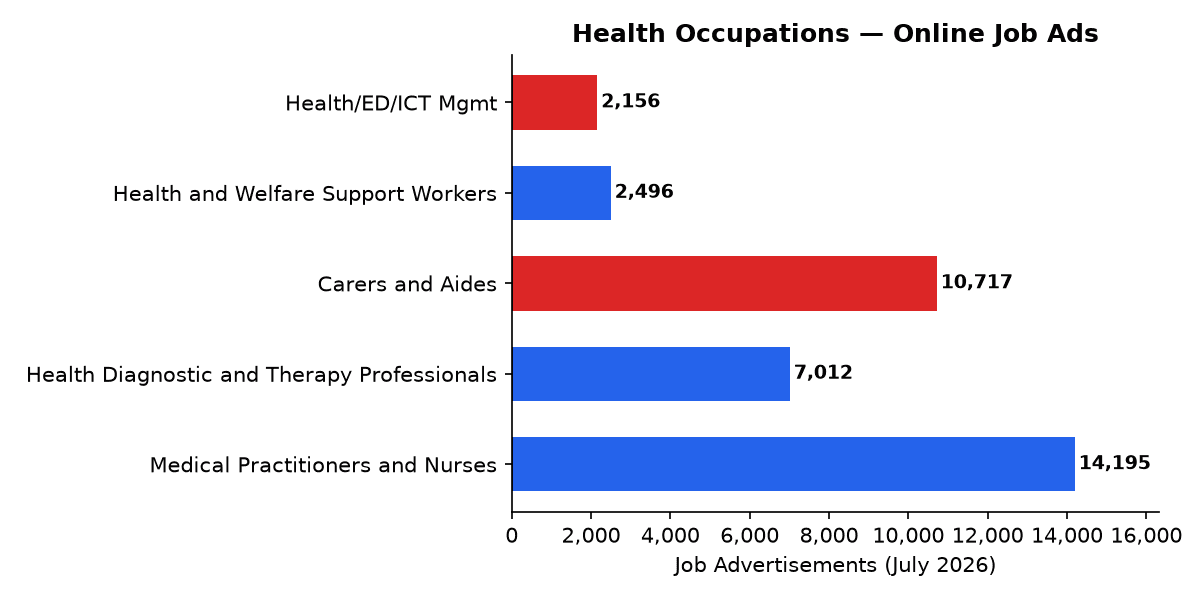
Broader Health Occupations Australia
Occupation Group | Ads | Monthly Δ |
Medical Practitioners and Nurses | 14,195 | +0.5% |
Health Diagnostic and Therapy Professionals | 7,012 | +0.7% |
Carers and Aides | 10,717 | -1.0% |
Health and Welfare Support Workers | 2,496 | +0.8% |
Health, Education, ICT and Other Managers | 2,156 | -0.7% |
The Real Story: Regional Australia
Here's what the state-level data misses: regional health demand is structurally stronger than capital city figures show.
The JSA Vacancy Report notes that 70.1% of all job ads are in capital cities, but over the last 12 months regional ads grew +0.2% while capital city ads fell -3.1%. For health occupations specifically, the regional premium is even more pronounced regional hospitals, aged care facilities, and primary care clinics are advertising at rates that city metro areas can't match.
Why it matters for nurses:
Regional nurses earn more, market pricing reflects scarcity
Career progression is faster, smaller teams mean broader responsibilities
Retention incentives are growing, governments and employers offer relocation packages, housing subsidies, and signing bonuses
The pipeline is shifting, more nursing graduates targeting regional placements
What This Means
National headline is flat (+0.5%), but the underlying trend is growth — health occupations are one of the few segments where YoY figures are positive
Location matters more than specialization, regional nurses have better prospects than city nurses in most specialties
Support roles are surging, Carers and Aides at 10,717 ads shows demand for healthcare support workers, not just registered nurses
The 'nursing shortage' narrative is outdated, it's not a shortage of nurses, it's a shortage of nurses willing to work in specific locations and sectors
FAQ
Q: Are nurses actually in demand in Australia? A: Yes — 14,195 online ads in July 2026, up 0.5% monthly and +11.5% vs 2019. But the demand is concentrated regionally, not in capital cities.
Q: Which state hires the most nurses? A: NSW leads with 5,602 ads (39% of national total). Queensland shows the strongest monthly growth at +0.9%.
Q: Is the nursing shortage real? A: It's more accurate to say there's a 'distribution mismatch' — surplus in major cities, shortage in regional and remote areas. The data shows regional IVI growth outpacing cities.
Q: What about support roles — are those hiring too? A: Yes — Carers and Aides (10,717 ads) and Health and Welfare Support Workers (2,496 ads) both show strong demand, suggesting healthcare employers need frontline staff, not just registered nurses.
Q: When's the next data release? A: 23 September 2026. IVI published at jobsandskills.gov.au/data/internet-vacancy-index.
Sources & Methodology
Primary: Jobs and Skills Australia, Internet Vacancy Index, July 2026 (seasonally adjusted)
Secondary: JSA Vacancy Report, released 19 August 2026
Data source: ANZSCO2 classification, 'Medical Practitioners and Nurses' occupation group
Coverage: IVI covers ~52% of vacancies (2025), up from 38% (2016)
Regional IVI: 37 best-fit regions, 3-month moving average, indexed
Limitation: ANZSCO4 data is 3-month moving average, not seasonally adjusted; use with caution