


A small business pays $5,550 in government charges to sponsor one Skills in Demand (subclass 482) worker on a four-year nomination. That is the $420 sponsor fee, the $330 nomination fee and $4,800 in Skilling Australians Fund levy, all set in Commonwealth legislation in force on 23 November 2026. The salary floor over the same four years is $317,692.
$5,550
Government charges a small business pays to sponsor one Core Skills worker for four years
Source: Federal Register of Legislation, as of 23 Nov 2026
At a glance
$1,200 or $1,800 a year: Skilling Australians Fund (SAF) levy per 482 nomination year, depending on turnover (SAF Charges Regulations, in force Nov 2026).
$420 and $330: standard business sponsor fee and 482 nomination fee (LIN 19/215, in force Nov 2026).
$4,015: visa application charge for a 482 main applicant (Migration Regulations, Compilation 291, in force 3 Nov 2026).
$79,423: Core Skills Income Threshold for nominations lodged from 1 July 2026.
5 years: how long a standard business sponsorship approval lasts, so one approval can cover several hires (reg 2.63A).
Is the sponsorship bill the cost that matters?
No. The government charges are the toll at the gate, and the salary is the fuel for the whole trip. When a role has sat empty for months, many employers stop at the fee schedule and see an outlay of five figures before anyone has started work. Some decide to keep advertising. Others ask the worker to cover part of the bill, which the law prohibits.
Look at the same numbers over the full nomination and they read differently. A small business's $5,550 works out to about $1,388 a year, or roughly $27 a week. That is about 1.7% of the $317,692 it must pay in base salary at the Core Skills Income Threshold over four years. The fee is rarely what breaks a sponsorship. Paying below the market rate, missing a notification deadline or passing costs to the worker can.
What most people see | What a calm employer sees |
|---|---|
A $5,550–$7,950 bill before day one | About 1.7–2.5% of four years' minimum salary |
A four-year levy paid up front | Most of it can be refunded if the hire leaves in year one |
A $420 fee for every hire | One sponsor approval lasting five years |
Fees as the main risk | Salary and obligations as the main risk |
When the flip is wrong. If the role pays close to the threshold, the hire may not last, and the business is small, the up-front cash still matters. A $5,550 outlay can be real pressure on a ten-person firm with tight cash flow, and refunds are discretionary rather than automatic. Sponsorship is also a poor fit if the job is not genuinely full-time or the business cannot show it can pay the market rate for the whole nomination period.
What does the government actually charge for one 482 hire?
There are four charges, and only three of them have to come from the employer. The sponsor fee is paid once for the approval, which lasts five years. The nomination fee and SAF levy are paid for each worker. The visa application charge belongs to the visa application itself.
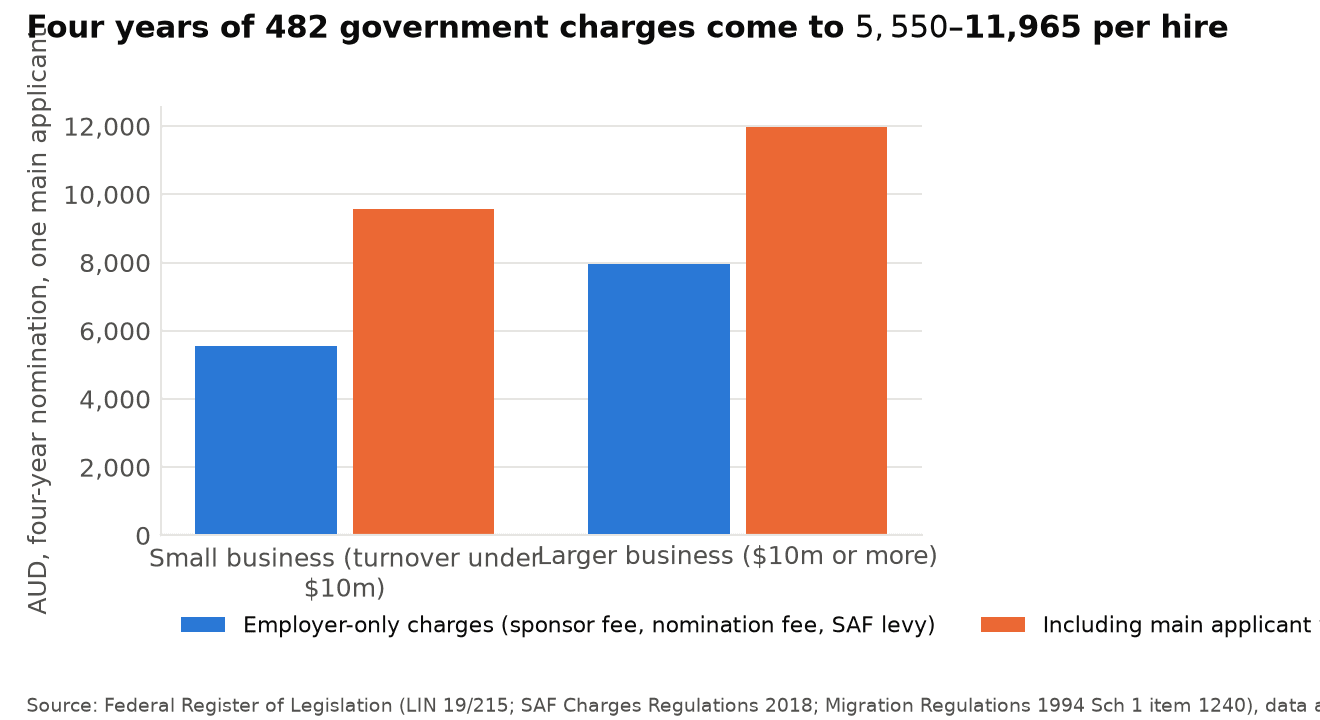
Charge | Small business (turnover under $10m) | Larger business | Legal source |
|---|---|---|---|
Standard business sponsor fee | $420 | $420 | LIN 19/215, item 2 |
482 nomination fee | $330 | $330 | LIN 19/215, item 5 |
SAF levy, four-year nomination | $4,800 ($1,200 × 4) | $7,200 ($1,800 × 4) | SAF Charges Regulations, s 5 |
Employer-only total | $5,550 | $7,950 | |
Visa application charge, main applicant | $4,015 | $4,015 | Migration Regulations, Sch 1 item 1240 |
Total including visa charge | $9,565 | $11,965 |
Each adult family member adds $4,015 and each child under 18 adds $1,005. Eligible Pacific passport holders pay $3,290 as the main applicant. Skills assessments, English tests, health checks and professional advice are extra.
So what: for a second hire under the same approval, a small business pays $5,130 rather than $5,550, because the sponsor fee does not apply again.
How does the levy compare across the 482, 186 and 494 visas?
The SAF levy is the largest employer charge, and its structure changes by visa. On the 482 it is charged for each year or part year of the nomination. On the permanent 186 and the regional 494 it is a one-off amount.
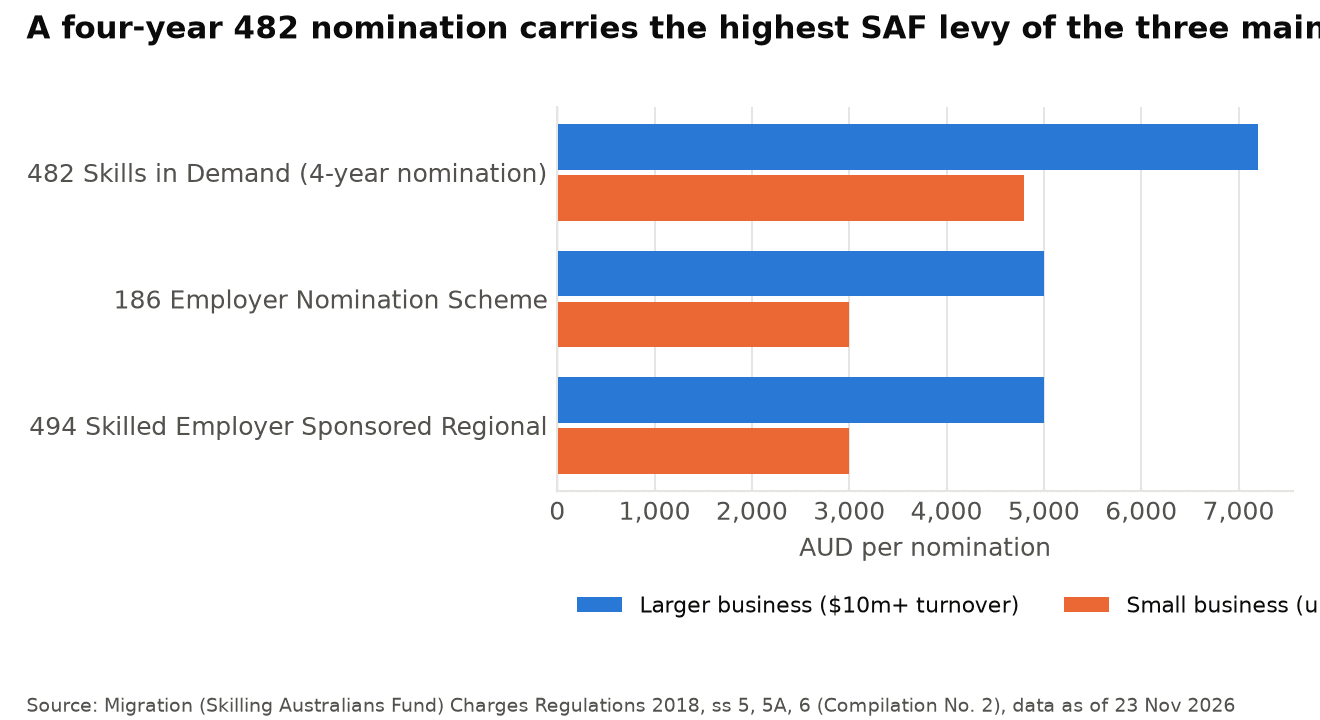
These amounts have been the same since the regulations commenced in August 2018. The levy for a 494 visa holder is reduced in proportion to the years of the visa already used.
So what: if a 482 worker is likely to move to a 186 later, budget for both levies. That comes to $7,800 for a small business and $12,200 for a larger one.
Who is allowed to pay which cost?
The sponsor fee, nomination fee, SAF levy and recruitment costs must stay with the employer. Regulation 2.87 of the Migration Regulations says an approved sponsor must not recover, transfer or seek to recover these costs from another person. That includes migration agent costs connected with sponsorship and nomination.
The visa application charge is not on that list, so the worker may pay their own visa charge. Many employers choose to cover it as part of the offer, and that is a commercial decision. Under the Migration Act, an employer found to have breached certain Fair Work obligations involving visa-holder workers can be declared a "prohibited employer". A prohibited employer cannot take on new visa-holder workers while the declaration lasts.
So what: put in writing who pays each cost before the nomination is lodged, and never take a deduction, "bond" or repayment linked to sponsorship.
What happens to the money if the hire leaves early?
Some of it can come back. Under regulation 2.73AA(3F), if a worker on a nomination of more than one year leaves within their first year of employment, the Minister may refund the SAF levy above the one-year amount. The employer must request this in writing. On a four-year nomination, that is up to $3,600 for a small business or $5,400 for a larger one.
If the visa is granted but the worker never starts, the nomination fee and levy may also be refunded. The sponsor fee and nomination fee are otherwise generally kept.
So what: the levy works more like a deposit you may partly recover than a sunk four-year cost. Diarise the first-year anniversary for every sponsored hire.
What could change the cost picture in 2027?
The charges are fixed in legislation and do not index automatically. The salary floor does. Under regulation 5.42A, the Core Skills Income Threshold is indexed every 1 July using full-time adult average weekly ordinary time earnings from the ABS. This is a scenario, not a prediction.
Scenario (1 July 2027) | Assumption: earnings growth to Dec 2026 quarter | Indicative Core Skills Income Threshold | Four-year salary floor |
|---|---|---|---|
Low | 2.5% | about $81,409 | about $325,636 |
Base | 3.5% | about $82,203 | about $328,812 |
High | 4.5% | about $82,997 | about $331,988 |
The levy has stayed at $1,200 and $1,800 since 2018. So in every scenario the fees become a slightly smaller share of the total cost, while the salary commitment grows by roughly $8,000–$14,000 over four years compared with today.
What would change this view: a new fee instrument replacing LIN 19/215, an amendment to the SAF Charges Regulations, a change to visa application charges, or a market salary rate for your occupation that sits well above the threshold. In that last case, the market rate sets the real floor, not the threshold. Nominations lodged before 1 July 2027 are assessed against $79,423, which is a reason to lodge earlier if the role is ready.
Your move: a sponsorship cost checklist
Confirm the occupation and stream. Check it against the Core Skills Occupation List or the Specialist Skills settings with a skills shortage assessment.
Set the salary first. It must meet both the threshold and the annual market salary rate. See our guide to 482 visa salary requirements and market salary.
Check your turnover band. It decides $1,200 or $1,800 a year, and you must report it correctly or you risk a withdrawal and a re-lodgement.
Run labour market testing properly before you nominate, using our labour market testing support.
Agree in writing who pays the visa charge, and keep every sponsorship cost on the business's books.
Diarise your obligations: notify Home Affairs within 28 days if the worker leaves, changes duties or fails to start. Keep records, and pay reasonable return travel costs if asked.
Mark the first-year anniversary so you can request any SAF refund you are entitled to.
Watch out: The expensive mistakes are not the fees. Recovering sponsorship costs from a worker, paying below the market salary rate or breaching Fair Work obligations can lead to sanctions, a bar on sponsoring and a ban on employing new visa holders. Get the salary and the paperwork right before you lodge.
If you are working out whether sponsorship makes sense for a hard-to-fill role, our employer sponsorship steps guide sets out the process. Genuine Solutions' workforce solutions team can help you cost the hire, test the labour market and plan your compliance obligations from day one.
FAQ
How much does it cost an employer to sponsor a 482 worker?
For a four-year nomination, a business with turnover under $10 million pays $5,550 in employer-only charges. That is the $420 sponsor fee, the $330 nomination fee and a $4,800 SAF levy. A larger business pays $7,950. The $4,015 visa charge for the main applicant is extra and may be paid by either party.
Can an employee pay the SAF levy or nomination fee?
No. Regulation 2.87 of the Migration Regulations prohibits a sponsor from transferring or recovering sponsorship, nomination, levy or related recruitment costs, including migration agent costs, from another person. The worker may pay their own visa application charge, because that charge belongs to the visa application rather than the sponsorship.
Is the Skilling Australians Fund levy refundable?
Partly, in limited cases. If a worker on a nomination of more than one year leaves within their first year, the Minister may refund the levy above the one-year amount on written request. Refunds can also apply if the visa is granted but the worker never starts. Refunds are discretionary, not automatic.
Do I pay the $420 sponsor fee for every worker?
No. The $420 is for standard business sponsorship approval, which lasts five years. During that time each new 482 hire costs the nomination fee and the SAF levy for that nomination, which comes to $5,130 for a four-year nomination by a small business.
What salary must I pay a Core Skills 482 worker?
At least the Core Skills Income Threshold, which is $79,423 for nominations lodged from 1 July 2026, and at least the annual market salary rate for the occupation, whichever is higher. The threshold is indexed each 1 July, so check it before you lodge.
Are 482 sponsorship costs tax deductible?
Home Affairs states that SAF levy payments are tax deductible. For how this applies to your business, and to the other fees, speak with your accountant or registered tax agent.
The takeaway: Employers who budget for the toll and forget the fuel get stuck. The fee is the price of entry, and the salary and the obligations decide whether the sponsorship lasts. A sponsorship is easy to pay for and expensive to get wrong.
Sources and method
Source | What it gave | Data date |
|---|---|---|
Migration (LIN 19/215: Sponsorship Applications and Nominations) Instrument 2019 | $420 sponsor fee; $330 nomination fee; instrument in force | Checked 23 Nov 2026 |
Migration (Skilling Australians Fund) Charges Regulations 2018 | SAF levy for 482, 186/187 and 494 | Compilation No. 2, 7 Dec 2024; checked 23 Nov 2026 |
Visa charges (Sch 1 item 1240); refunds (r 2.73AA); obligations (rr 2.79, 2.80, 2.84, 2.87); sponsorship term (r 2.63A); indexation (r 5.42A) | Compilation 291, in force 3 Nov 2026 | |
Home Affairs Legislation Amendment (2026 Measures No. 1) Regulations 2026 | Income threshold of $79,423 from 1 July 2026 | Commenced 1 Jul 2026 |
SAF levy structure, payment timing, tax deductibility | Checked 23 Nov 2026 | |
Core Skills Income Threshold of $79,423 from 1 July 2026 | Checked 23 Nov 2026 | |
Confirms the CSIT and TSMIT of $79,423 from 1 July 2026 | 2 Jul 2026 | |
Prohibited employer and migrant worker sanctions (ss 245AYD–245AYJ) | Compilation 172, in force 8 Oct 2026 |
Method: the totals add the legislated charges for one main applicant on a four-year Core Skills nomination. They exclude skills assessments, health checks, English tests, family members and professional fees. The 2027 thresholds are illustrative calculations at stated earnings-growth rates, not official figures. The official amount depends on ABS earnings data and is published by Home Affairs after 1 July 2027.
Disclaimer
This article provides general information only and does not constitute migration, legal, tax or financial advice. Visa requirements, fees and thresholds change, and individual circumstances differ. Before you make sponsorship decisions, check current requirements with the Department of Home Affairs or get advice from a registered migration agent.
If your business is weighing up sponsorship for a hard-to-fill role, Genuine Solutions can help you cost the hire accurately, meet labour market testing and salary requirements, and set up the compliance steps that keep a sponsorship on track. Talk to our team.