

Jobs and Skills Australia said on 27 October 2026 that its Jobs and Skills Report 2026 "did not project 139,000 jobs would be lost to AI". The figure came from a scenario in which employment growth shifts towards trade and technical work, and professionals still account for 47% of projected growth. For SMEs, the more useful number is AI adoption: 31% in smaller businesses compared with 70% in larger ones.
47%
Share of total employment growth still going to Skill Level 1 (professional) occupations in the JSA scenario behind the "139,000" headline
Source: Jobs and Skills Australia, 27 Oct 2026
At a glance
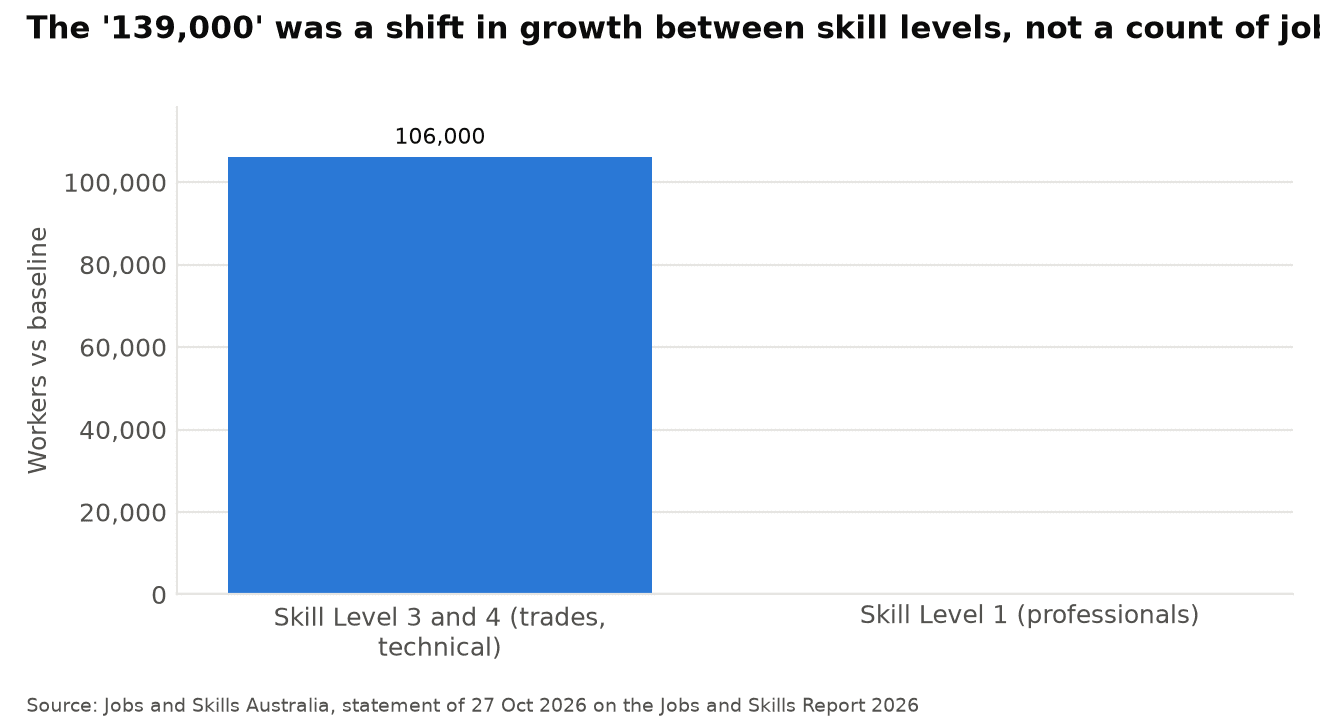
139,000 is the number of fewer Skill Level 1 workers in one modelled scenario, compared with baseline growth over the next decade. JSA says it is not a job-loss forecast (JSA, 27 Oct 2026).
106,000 more Skill Level 3 and 4 workers (trades and technical roles) appear in the same scenario (JSA, 27 Oct 2026).
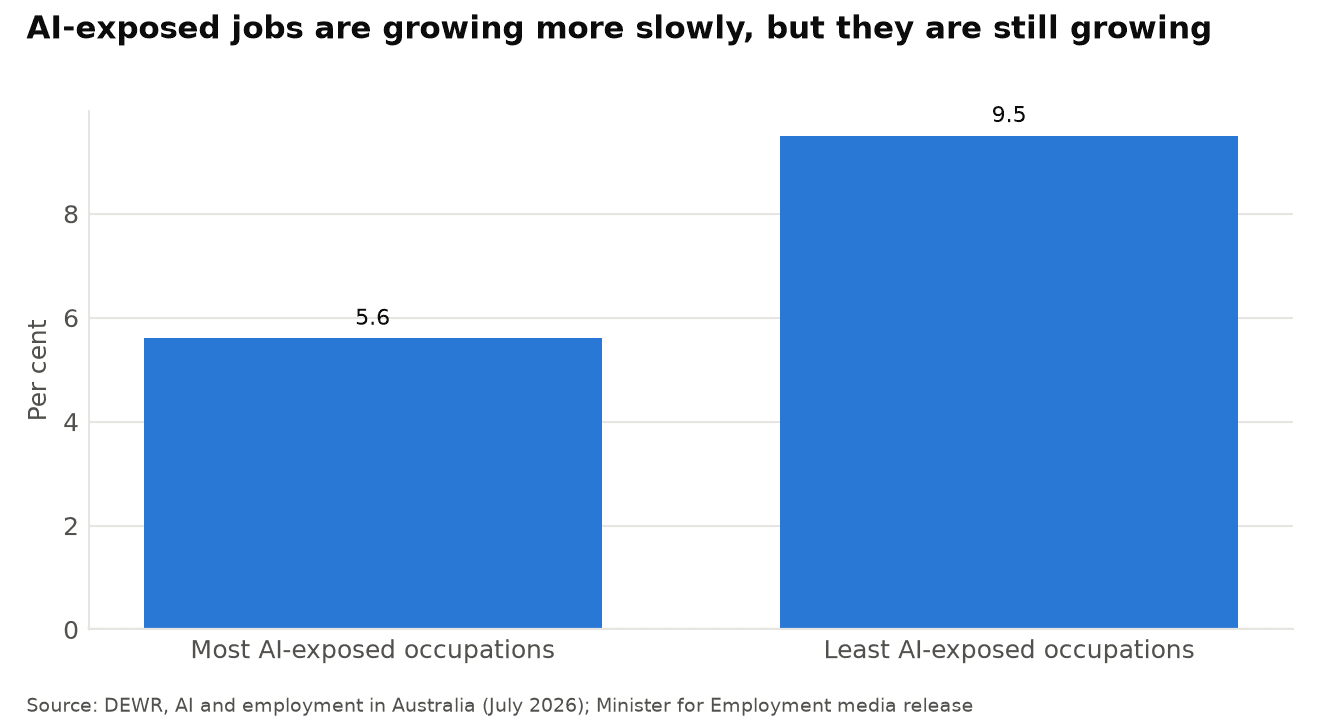
5.6% vs 9.5%: employment growth since November 2022 in the occupations most and least exposed to AI (DEWR, AI and employment in Australia, July 2026).
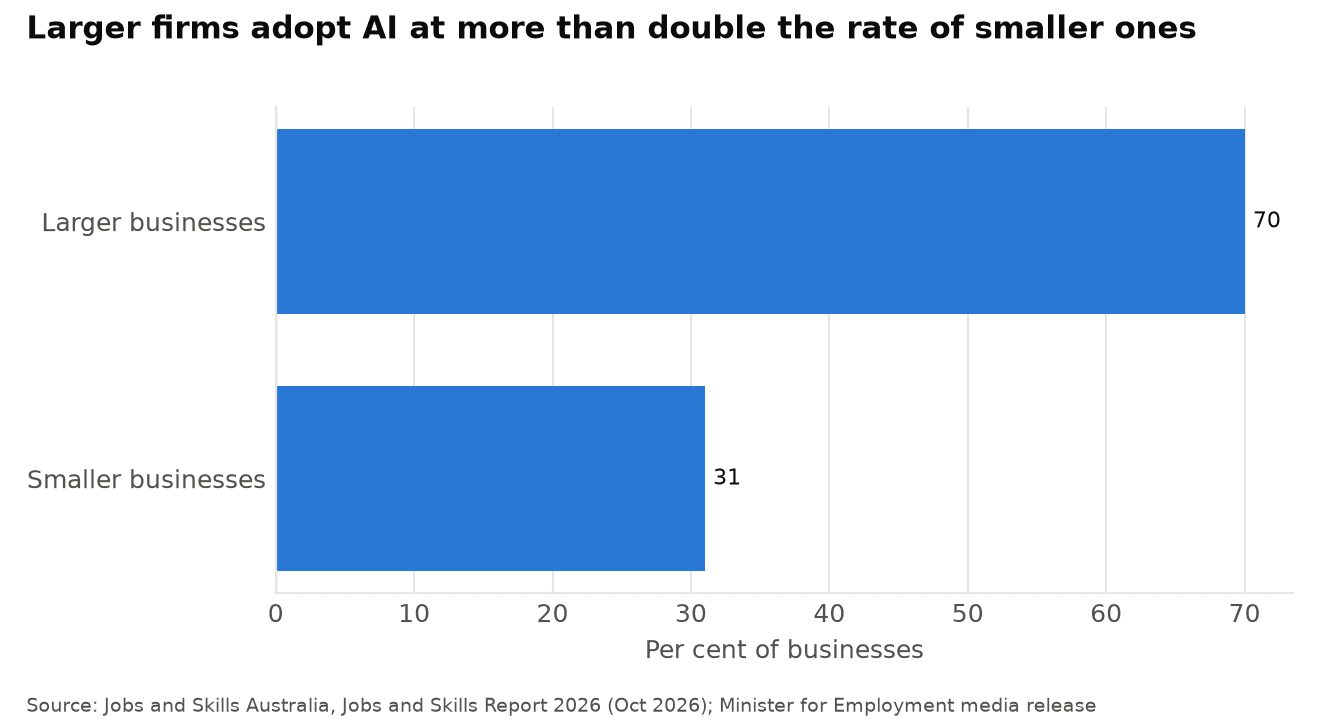
70% vs 31%: AI adoption in larger businesses compared with smaller ones (Jobs and Skills Report 2026, October 2026).
93% of projected employment growth is expected in occupations that need post-school qualifications (Jobs and Skills Report 2026).
What is the flip on AI and jobs in Australia?
The flip is that the labour market is changing gradually, like a tide, and nothing in the data shows a wave about to wipe out jobs. The "139,000 jobs lost to AI" headline spread quickly and led some business owners to talk about pausing graduate hiring or replacing roles with tools before they had tested either. Jobs and Skills Australia issued a statement to correct it.
The modelled scenario asked what would happen if people made education and career choices according to labour market demand. In that case growth shifts towards trades and technical roles, and professional jobs keep growing, accounting for 47% of total employment growth. Put plainly, the 139,000 is the gap between two growth paths. No 139,000 people lose their jobs.
So the calm question for an SME is less "which roles will AI remove?" and more "why are we adopting AI at less than half the rate of larger firms?" That gap is one you can do something about.
What most people see | What a calm business owner sees |
|---|---|
"AI will cut 139,000 professional jobs" | A scenario in which professional jobs still deliver 47% of growth |
AI is emptying office roles right now | Exposed roles are growing more slowly (5.6% vs 9.5%) but still growing |
Big firms are using AI to shrink their teams | Big firms are adopting faster (70% vs 31%), and that gap is where SMEs lose ground |
Hold off on hiring until things settle | Hire for skills and train the people you already have |
When the flip is wrong. The flip is weaker if your business relies heavily on clerical and administrative work. DEWR found those highly exposed roles are growing more slowly than others, and the department treats the question of whether AI has reduced employment in exposed occupations as unsettled. If most of your payroll sits in routine data entry or document processing, plan for change in those roles over the next few years, and do it with training and redesign before you consider cuts.
Is AI already reducing jobs in Australia?
On the evidence so far, AI is slowing growth in some roles but is not cutting overall employment. DEWR's AI and employment in Australia report (Office of the Chief Economist, July 2026) found that since November 2022, employment grew 5.6% in the occupations most exposed to AI and 9.5% in the least exposed. The department calls this "an early indication of some modest slowing" and says the results are suggestive rather than definitive.
The same report found that job growth for young people and graduates, often described as most at risk, held up after generative AI arrived. The slower growth was concentrated in exposed work such as clerical and administrative roles.
So what: a gap of 3.9 percentage points over about three and a half years is something to plan around, and it gives no reason to restructure in a panic.
Where is the real gap for small businesses?
The real gap is in adoption. The Jobs and Skills Report 2026 found that 70% of larger businesses have adopted AI, compared with 31% of smaller businesses, and that adoption is also higher in metropolitan areas than in regional Australia. The government's release on the report puts the use of AI tools at "almost one in two Australians" in daily life.
The release names access to capital, digital infrastructure and workforce capability as what decides whether a business can use AI well, together with investment in training. Most SMEs can't do much about the first two this quarter. They can act on workforce capability straight away, through their own staff.
So what: if half your team already uses AI tools at home, the gap at work comes from missing structure, such as approved tools, clear rules and some training. Your staff are not the obstacle.
Which skills does the data reward?
The data rewards qualifications and practical, applied skills. JSA projects that around 93% of employment growth will be in occupations that need post-school qualifications. The 2026 Occupation Shortage List found 48% of Technicians and Trades Workers occupations in national shortage, the highest share of any major group, with Professionals next at 37%.
Indicator | Figure | Source, date |
|---|---|---|
Growth in roles needing post-school qualifications | ~93% of projected growth | JSA, Jobs and Skills Report 2026 (Oct 2026) |
Technicians and Trades occupations in shortage | 48% | JSA, 2026 OSL Key Findings (Oct 2026) |
Professional occupations in shortage | 37% | JSA, 2026 OSL Key Findings (Oct 2026) |
All assessed occupations in shortage | 27% (279 of 1,021) | JSA, 2026 OSL Key Findings (Oct 2026) |
These figures don't describe a labour market with a surplus of professionals. They describe tight markets across both trades and professions. For technology roles in particular, people who can configure, check and govern AI tools add to what a team can do. They don't take jobs from it.
So what: a staff member who knows the business and also knows the tools is worth more to you than either a tool or a new hire on their own.
What could happen next? (Scenario, not prediction)
DEWR designed its monitoring framework to track whether the early signs of slower growth in AI-exposed occupations "grow, fade or persist". Those three outcomes are a sensible frame for SME planning over the next 12 to 24 months. The table below sets them out with the assumption behind each. Scenario, not prediction.
Scenario | Assumption | What it means for an SME |
|---|---|---|
Low: the gap fades | Exposed roles change their task mix without slowing, and the 5.6% vs 9.5% gap narrows | AI acts mainly as a productivity tool, and adopting it slowly costs only efficiency |
Base: the gap persists | Exposed roles keep growing a few points slower while overall employment keeps growing | Admin and clerical roles change shape gradually, so you retrain and redesign rather than replace |
High: the gap grows | Agentic tools take over more routine processing and the gap widens in later DEWR updates | Routine back-office roles shrink in hiring plans, and businesses with trained staff move people into higher-value work |
A few things would change this view. A widening gap in the next DEWR update would point to the high scenario. So would a rise in SME adoption from 31% that comes with flat hiring in exposed roles. A fall in unemployment in clerical occupations would support the low scenario. In all three cases the tide moves gradually, and businesses that train early get to choose how they respond.
What should your business do now?
Check where the headline came from before you act on it. Before you change hiring plans because of an AI story, find the original source. In this case it was a JSA statement that corrected the headline.
Map exposure by task rather than by job title. List the routine tasks in each role, such as data entry, summarising and drafting. Those tasks are where AI fits, and none of them make up a whole role on their own.
Close the adoption gap on purpose. Choose one or two approved tools and one process to pilot. Our AI and automation services start from that scoping step.
Train before you buy. JSA and the government both name workforce capability as the deciding factor, so put training budget alongside licence spend.
Get your data in order. AI gives poor answers when it reads messy records. A data and analytics review usually comes before useful automation.
Hire for skills that will hold their value. The shortage list favours qualified trade, technical and professional skills. A skills shortage assessment can show where your roles fit.
Watch out: Two risks pull in opposite directions. If you cut or freeze roles because of a misread headline, you lose people who are hard to replace in a market where 27% of occupations are still in shortage. If you adopt AI with no rules, you risk privacy and security problems. Start with a written AI-use policy and human review of AI outputs, and don't treat any tool as a guaranteed saving.
For more on how demand is moving between trades, healthcare and ICT, see our analysis of Australia's shifting skills shortage in 2026.
FAQ
Did Jobs and Skills Australia predict 139,000 jobs lost to AI?
No. On 27 October 2026, JSA said the Jobs and Skills Report 2026 did not project 139,000 jobs lost to AI. The figure came from a scenario in which education and career choices follow labour market demand. In it, Skill Level 1 growth is 139,000 workers lower than baseline over the next decade, and those occupations still account for 47% of total employment growth.
Is AI reducing employment in Australia right now?
Not across the economy as a whole. DEWR's July 2026 report found that the most AI-exposed occupations grew 5.6% from November 2022, against 9.5% for the least exposed. The department describes this as an early, modest slowing in some highly exposed roles and says the evidence is suggestive rather than definitive.
Which roles are most exposed to AI?
DEWR points to clerical and administrative roles as among the more exposed occupations that are growing more slowly. Exposure means AI can perform some of a role's tasks. It doesn't mean the role disappears. For an SME, the practical step is to list routine tasks within each role and decide which ones a tool could support with human review.
Why are small businesses behind on AI adoption?
The Jobs and Skills Report 2026 found adoption of 31% in smaller businesses against 70% in larger ones. The government names access to capital, digital infrastructure and workforce capability as the main factors. Of the three, staff capability is the one most SMEs can improve quickly and cheaply.
Should I stop hiring graduates because of AI?
The data doesn't support that. DEWR found job growth for young people and graduates stayed resilient after generative AI arrived, and JSA expects about 93% of employment growth in roles that need post-school qualifications. Graduates who learn AI tools at work can add more to a team, so they are still a reasonable hire.
The takeaway: The 139,000 story is a warning about headlines more than about AI. Small businesses risk losing ground through slow adoption, and AI is not taking their staff. A tide only threatens businesses that never learn to read it, so train your people first and add the tools after that.
Sources and method
Source | What it gave | Data date |
|---|---|---|
Jobs and Skills Australia: Statement clarifying media references to '139,000 jobs lost to AI' | 139,000 and 106,000 scenario figures, 47% share, clarification | 27 Oct 2026 |
Jobs and Skills Australia: Understanding skills is critical to Australia thriving in the rise of AI | Release of the Jobs and Skills Report 2026 | 20 Oct 2026 |
Minister for Employment: Skills key to unlocking productivity benefits in Australia | AI adoption 70% vs 31%, "almost one in two" using AI, 93% post-school qualification growth | Oct 2026 |
Exposed vs less-exposed employment growth, caveats | Jul 2026 | |
Minister for Employment: Australia's labour market remains resilient amid the rise of AI | 5.6% vs 9.5% growth since Nov 2022; youth and graduate resilience | Jul 2026 |
Jobs and Skills Australia: 2026 Occupation Shortage List Key Findings Report | 48%, 37% and 27% shortage shares | Oct 2026 |
Method: every figure comes from Jobs and Skills Australia, the Department of Employment and Workplace Relations or the Minister for Employment, and was checked on 20 November 2026. The 139,000 and 106,000 figures are differences from a baseline projection in one modelled scenario, not forecasts of job losses or gains. The Forecast section uses DEWR's own "grow, fade or persist" framing and does not produce a numeric projection.
Talk to Genuine Solutions
If your business wants to use AI without cutting corners on staff, data or security, Genuine Solutions can help you scope a sensible first project, train your team and set clear rules for use. Contact us to talk through where AI fits in your business.
Disclaimer: This article provides general information only and does not constitute professional, legal or financial advice. Figures are drawn from Australian Government sources as of 20 November 2026 and may change. Consider your business's circumstances and seek tailored advice before making decisions.