


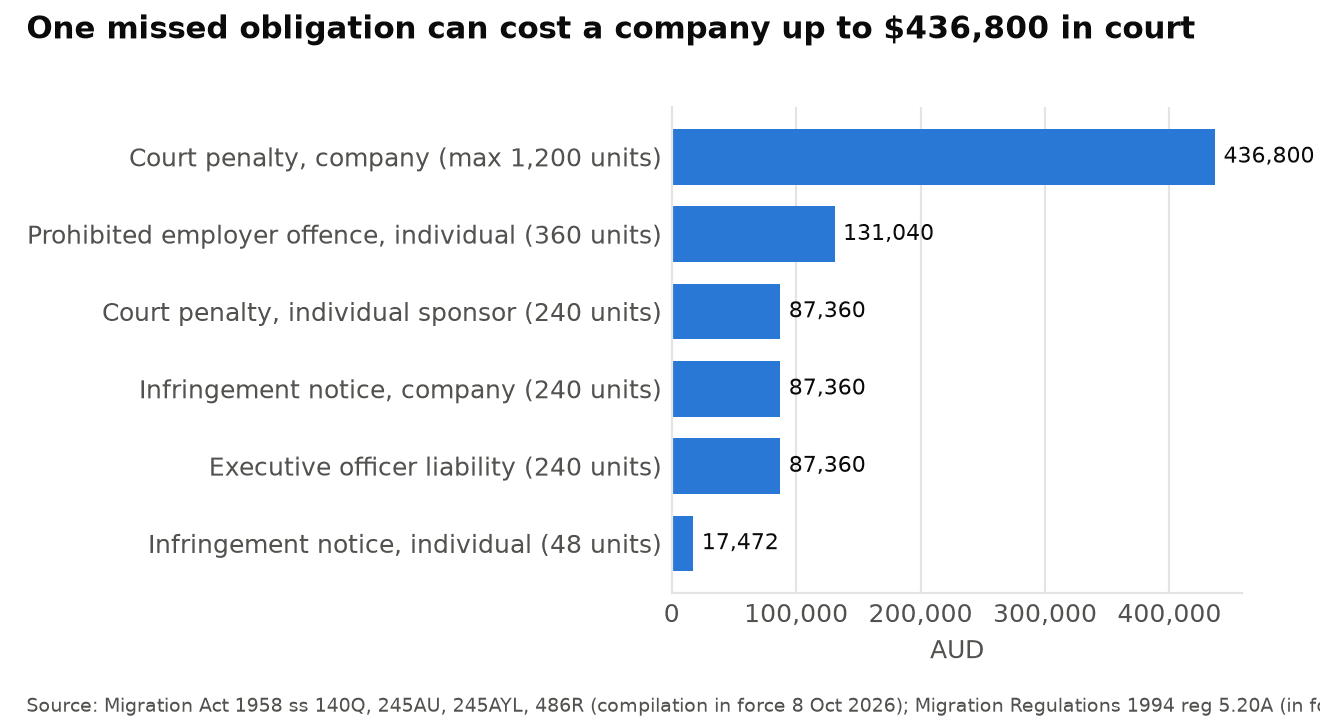
From 1 July 2026, one failure by a company to meet a sponsorship obligation can lead to a court penalty of up to $436,800. That is 1,200 penalty units at $364 each, under section 140Q of the Migration Act and the Crimes (Amount of a Penalty Unit) Instrument 2026. Most of the duties behind that figure come down to one deadline: telling the Department within 28 days.
28 days
Time a 482 or 494 sponsor has to tell the Department about a reportable change, such as a sponsored worker leaving
Source: Migration Regulations 1994, reg 2.84(6), compilation in force 3 Nov 2026
At a glance
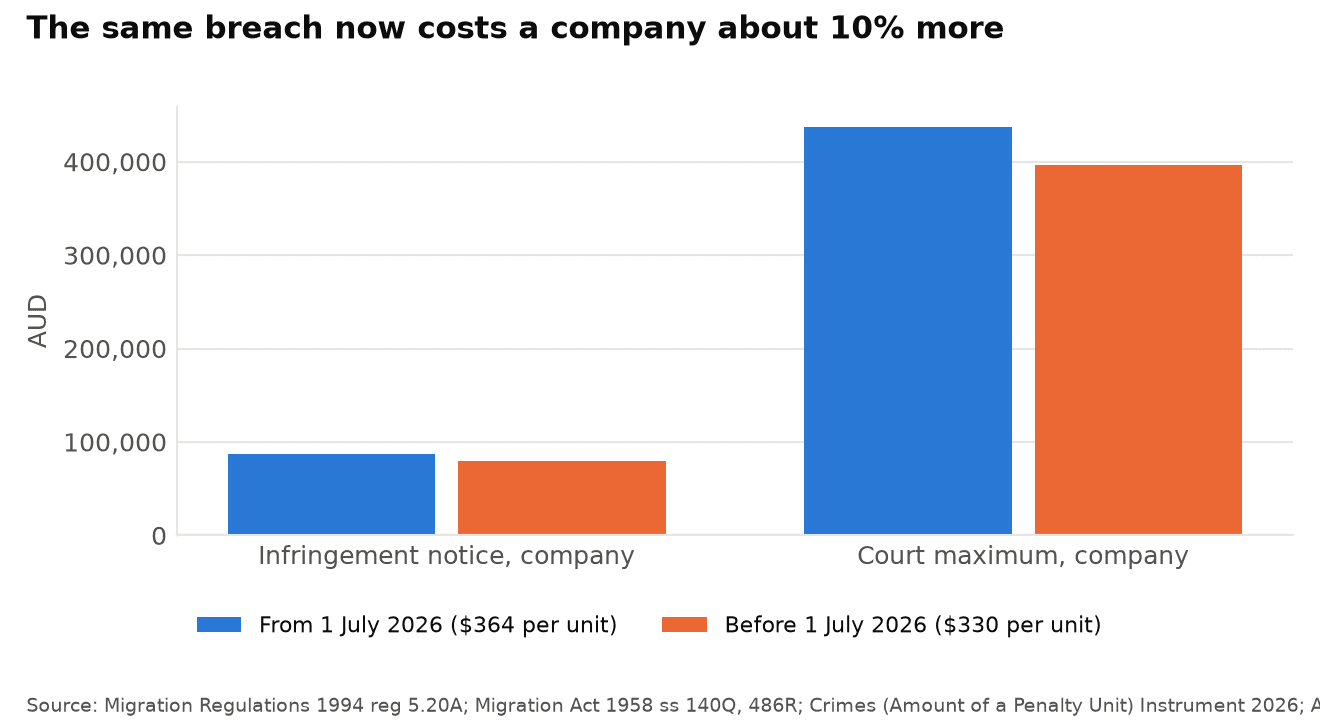
$364: value of a Commonwealth penalty unit for contraventions from 1 July 2026, up from $330 (Crimes (Amount of a Penalty Unit) Instrument 2026; ACCC).
240 penalty units ($87,360): the civil penalty for an approved work sponsor that fails an obligation. A court can order a company to pay up to five times that (Migration Act ss 140Q and 486R, as at Oct 2026).
28 days: the deadline for reporting a sponsored worker leaving, a change in their duties, or a new company director (reg 2.84, as at Nov 2026).
30 days: the deadline for paying a sponsored worker's return airfare once they ask in writing (reg 2.80, as at Nov 2026).
2 years: how long sponsor records must be kept after the sponsorship ends and no sponsored worker remains (reg 2.82, as at Nov 2026).
What is the flip on sponsorship obligations?
Most employers treat sponsorship obligations like a cliff edge. They read "$436,800", picture a raid, and either avoid sponsoring altogether or file the obligations away in a folder after the visa is granted. Both reactions miss what the rules actually look like.
Read the regulations line by line and the obligations look more like a calendar than a cliff. Most of them are dated tasks: report within 28 days, pay a requested airfare within 30 days, produce records within the period a notice sets (at least 7 days), and keep those records for two years afterwards. The rest is about keeping things steady: pay the nominated salary, keep the worker in the nominated occupation, and never pass sponsorship costs on to them. The law also sets out a scale of responses. A compliance notice or an infringement notice can come well before a court case.
What most people see | What a calm employer sees |
|---|---|
A $436,800 fine hanging over every hire | A court maximum for a company, used for serious cases. The scale starts lower |
A long list of rules nobody can follow | About a dozen duties, and most of them are dates you can put in a calendar |
Risk that ends when the visa is granted | Duties that run until two years after the last sponsored worker leaves |
Compliance as a legal problem | Compliance as a payroll and HR routine |
When the flip is wrong. The calendar view doesn't work if the breach is about the deal itself. Underpaying the nominated salary, using a worker outside the nominated occupation, or taking money from a worker for sponsorship costs are not missed dates. These are the breaches the higher end of the scale is built for. For directors, section 245AU adds personal exposure of 240 penalty units.
Which obligations apply to a 482 or 494 sponsor?
Division 2.19 of the Migration Regulations lists the obligations for approved work sponsors. As at the compilation in force on 3 November 2026, the main duties for 482 and 494 sponsors are:
Obligation | Regulation | The practical test |
|---|---|---|
Cooperate with inspectors | 2.78 | Give inspectors access and answer their questions |
Equivalent terms and earnings | 2.79 / 2.79A | Pay no less than the nominated amount and no less than an Australian doing the same work at the same location |
Pay return travel costs | 2.80 | Economy airfare, paid within 30 days of a written request |
Commonwealth location and removal costs | 2.81 | Liable up to $10,000, less any return travel already paid |
Keep records | 2.82 | Records must be reproducible and kept until 2 years after the sponsorship ends |
Provide records on request | 2.83 | Within the period set by the notice, which must give at least 7 days |
Notify events | 2.84 | Within 28 days |
Work in the nominated occupation | 2.86 | No moving the worker to other roles without a new nomination |
No cost recovery | 2.87 | The worker cannot be asked to pay sponsorship, nomination or migration agent costs |
No discriminatory recruitment | 2.87C | Recruitment must not discriminate |
So what: if you sort these into "dated tasks" and "ongoing conditions", the list is short enough to manage in-house.
What triggers the 28-day clock?
Under regulation 2.84(3), a standard business sponsor must report events including:
a sponsored worker's employment ending, or being expected to end
a change to the sponsored worker's duties
a sponsored worker not starting work by the agreed date
a change to the business address or contact details
a new director, or the business entity ceasing to exist
formal insolvency events, such as appointing an administrator or liquidator.
Each event must be reported within 28 days of the change or event. For a worker leaving, the 28 days run from the day they leave (reg 2.84(6)). A sponsor can report a planned last day in advance. If the date then moves, the sponsor must report the new date or confirm the worker is staying (reg 2.84(5)). The obligation starts on the day the sponsor is approved. It ends only when sponsorship has ended and no sponsored worker or family member remains linked to the business (reg 2.84(7)).
So what: the events that start the clock are ones HR and the company secretary already deal with: resignations, restructures, board changes. Link those processes to a sponsor alert and most of the risk is gone.
How much has a breach cost since 1 July 2026?
The penalty unit went up 10.3%, from $330 to $364, for contraventions on or after 1 July 2026. That lifts every sponsor penalty by the same proportion.
Response | Penalty units | Amount at $364 |
|---|---|---|
Infringement notice, individual sponsor | 48 | $17,472 |
Infringement notice, company | 240 | $87,360 |
Civil penalty, individual sponsor (court) | 240 | $87,360 |
Civil penalty, company (court maximum, 5×) | 1,200 | $436,800 |
Section 140K also lists the responses that cost no money but can hurt more: a bar on new sponsorship, cancellation of sponsor approval, an enforceable undertaking, a compliance notice and a security. The Minister must publish the sponsor's name, the obligation breached and the action taken (s 140K(4); reg 2.87D).
So what: for many employers the published name and a bar on new nominations cost more than the fine, because they shut off the hiring pipeline.
What happens next? Three scenarios for 2029
Scenario, not prediction. The penalty unit is indexed to CPI every three years. The next adjustment after 1 July 2026 is due on 1 July 2029. The table assumes average annual inflation of 2%, 2.5% or 3.5% over the three years, and no change to the Migration Act penalty provisions.
Scenario | Assumed annual CPI | Penalty unit (approx.) | Company infringement notice (240 units) | Company court maximum (1,200 units) |
|---|---|---|---|---|
Low | 2.0% | $386 | $92,640 | $463,200 |
Base | 2.5% | $392 | $94,080 | $470,400 |
High | 3.5% | $404 | $96,960 | $484,800 |
On every path the cost of a breach goes up by a few thousand dollars at the low end and tens of thousands at the top. The steadier part of the forecast is what does not change. The 28-day, 30-day and 2-year periods are written into the Regulations. They only move if the Regulations are amended, and price indexation does not touch them.
What would change this view:
an amendment to the penalty amounts in section 140Q or regulation 5.20A
a change to the 28-day reporting period in regulation 2.84
a published shift in enforcement priorities that makes compliance notices more or less common
inflation outside the 2–3.5% range.
Your move: a sponsor compliance checklist
Map every live sponsorship. List each 482 and 494 worker with their nominated occupation, nominated salary and nomination approval date.
Link HR events to a sponsor alert. Resignations, role changes, start-date delays, director appointments and address changes should each prompt a report to the Department within 28 days.
Test pay every pay run. Check each worker against the nominated amount and against Australians doing the same work at the same location (regs 2.79 and 2.79A). Our 482 salary requirements guide covers the thresholds.
Check the role, not only the pay. Make sure the worker's actual duties still match the nominated occupation (reg 2.86).
Audit costs. Confirm that no sponsorship, nomination, recruitment or migration agent cost has been passed to the worker, directly or through deductions (reg 2.87).
Keep a return-travel procedure ready. Written request in, economy fare paid within 30 days, record kept (regs 2.80 and 2.82).
Set a records retention rule. Keep sponsorship records for two years after the last sponsored worker leaves, in a format you can reproduce on request.
Brief your directors. Section 245AU can make executive officers personally liable when they fail to take reasonable steps.
Watch out: The two-year tail is the obligation businesses most often miss. Record-keeping and record-production duties continue after sponsorship ends, so a restructure, a system migration or a sale of the business must keep those records intact.
If you are building a sponsorship program from scratch, start with our four-step employer sponsorship guide and our explainer on labour market testing for Australian employers.
FAQ
Do sponsorship obligations end when the 482 visa is granted?
No. Most obligations start when the nomination is approved or the visa is granted, and they continue through employment. Record-keeping and record-production duties run until two years after the business stops being a sponsor and has no sponsored workers left (regs 2.82 and 2.83).
Can a sponsored worker pay part of the visa or nomination costs?
No. Regulation 2.87 bars a sponsor from recovering, transferring or seeking to recover costs linked to becoming or being a sponsor, to the nomination (including the nomination training contribution charge) or to recruiting the worker. That includes migration agent costs.
What if a sponsored worker resigns without notice?
Report it within 28 days of their last day of work (reg 2.84(6)). If you reported an expected last day that then changes, report the new date or confirm they are staying. Keep a record of the report and its details (reg 2.82(3)(b)).
Do the same obligations apply to 494 regional sponsors?
Largely, yes. Regulation 2.79A applies the equivalent terms and earnings rules to 494 workers. The return travel, record-keeping, notification, occupation and cost-recovery obligations also cover 494 sponsors. Regulation 2.86 adds written-contract and no-on-hire conditions for many 494 roles.
Are directors personally exposed?
They can be. Under section 245AU of the Migration Act, an executive officer who knew of, or was reckless or negligent about, a sponsorship-related contravention and failed to take reasonable steps to prevent it faces a civil penalty of 240 penalty units ($87,360 from 1 July 2026).
The takeaway: The fine gets the headlines, but the calendar decides most cases. Treat each obligation as a recurring date owned by payroll and HR, rather than a legal emergency for later, and the $436,800 figure stays theoretical. Sponsorship goes wrong when nobody is watching the calendar, more often than when someone sets out to break the rules.
Sources and method
Source | What it gave | Data date |
|---|---|---|
Migration Regulations 1994, Division 2.19 and reg 5.20A (Federal Register of Legislation) | Each sponsorship obligation, the 28-day, 30-day, 7-day and 2-year periods, the $10,000 cost cap, infringement notice units | Compilation 291, in force 3 Nov 2026 |
Migration Act 1958, ss 140K, 140Q, 245AU, 245AYL, 486R (Federal Register of Legislation) | Sanction types, civil penalty units, 5× multiplier for companies, executive officer liability, publication of sanctions | Compilation 172, in force 8 Oct 2026 |
Penalty unit of $364 from 1 July 2026 | Registered 16 Jun 2026 | |
Confirms the increase from $330 to $364 on 1 July 2026 | Checked 23 Nov 2026 |
Dollar amounts are penalty units multiplied by $364 and apply to contraventions on or after 1 July 2026. Earlier conduct uses the unit value that applied at the time. The figures are maximums or fixed infringement amounts, not typical outcomes. The 2029 scenarios apply assumed inflation rates to the current unit value and are not official projections. Obligations for labour agreement sponsors can be varied by the agreement itself, and this article does not cover those variations.
Disclaimer
This article is general information only and is not legal or migration advice. Sponsorship obligations and penalties can change, and how they apply depends on your circumstances. Before acting, check the current legislation and Department of Home Affairs guidance, and get advice from a registered migration agent or legal practitioner.
If your business sponsors skilled workers, or plans to, Genuine Solutions can help you map your sponsorship obligations, set up a practical compliance calendar and plan your next nominations with confidence. Explore our workforce solutions or contact our team to start the conversation.