


The Australian Signals Directorate (ASD) responded to 139 ransomware incidents in FY2025–26, close to the 138 it recorded the year before, according to its Annual Cyber Threat Report 2025–26 released in October 2026. The count held steady but the damage did not: extensive ransomware incidents rose from 16 to 24.
139
Ransomware incidents ASD responded to in FY2025–26 (138 the year before)
Source: ASD Annual Cyber Threat Report 2025–26, October 2026
At a glance
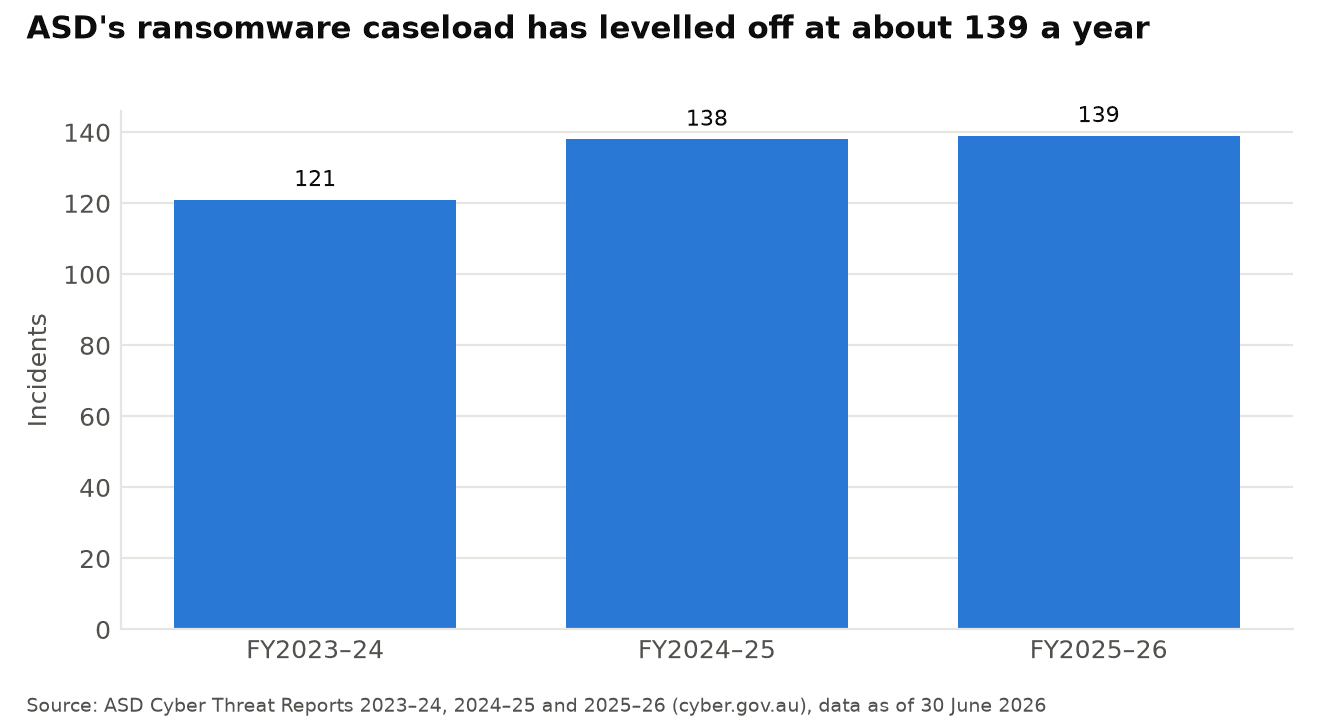
ASD responded to 139 ransomware incidents in FY2025–26, up from 138 in FY2024–25 and 121 in FY2023–24 (ASD, October 2026).
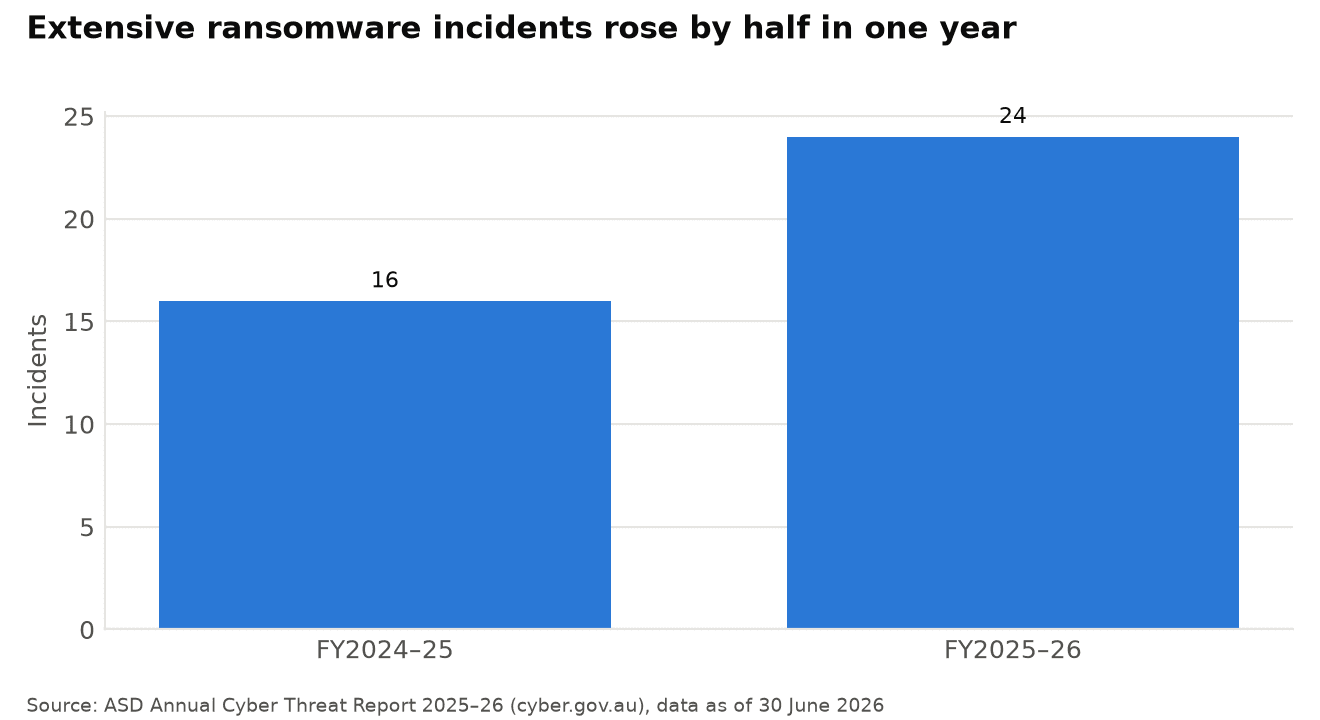
Extensive ransomware incidents rose from 16 to 24 in FY2025–26 (ASD, October 2026).
Ransomware has made up about 11% of all incidents ASD responded to on average since FY2021–22 (ASD, October 2026).
ASD responded to more than 1,500 cyber security incidents in FY2025–26, up from more than 1,200 in FY2024–25 (ASD, October 2026 and October 2025).
Since 30 May 2025, businesses with annual turnover above $3 million must report any ransomware payment within 72 hours (Cyber Security Act 2024; Home Affairs).
Is ransomware really getting worse for Australian businesses?
Most of the coverage this month has the same message: AI is supercharging attacks, ransoms are getting bigger and more businesses are paying. You can hear the alarm in every vendor webinar. Fair enough, because the threat is real. ASD's own figures, though, tell a different story. The number of ransomware cases it handled barely moved, from 138 to 139.
What changed is how bad each case was. Extensive incidents, the ones that seriously disrupt an organisation, went from 16 to 24. So the useful question for a business owner is not "will ransomware find us?" The useful question is "when it does, can we get back in using our own spare key?" A spare key only counts if you have actually tried it in the lock. That means a backup you have restored, a plan you have rehearsed and a decision about paying that you made before anyone was under pressure.
What most people see | What a calm business owner sees |
|---|---|
"Ransomware is exploding" | The ASD caseload is flat (138 to 139), but severity is rising (16 to 24 extensive incidents) |
"If we're hit, we'll have to pay" | Paying is a choice. Above $3 million turnover it also starts a 72-hour legal reporting clock |
"We have backups, so we're fine" | A backup you have never restored is an assumption you haven't tested yet |
"This is an IT problem" | Recovery time is a business-continuity problem, so it belongs on the owner's desk |
When the flip is wrong. A flat count at ASD does not mean flat risk for every business. ASD only counts incidents that are reported to it or that it detects, and many small businesses never report. If your business runs old, unpatched systems or depends on one supplier's remote access, your risk can rise even while the national number holds still. In that case, treat the severity trend as the headline.
How serious are the incidents now?
They are more serious. Extensive ransomware incidents rose by half, from 16 to 24, in FY2025–26, while the total ransomware count stayed almost flat.
ASD also responded to more than 1,500 cyber security incidents of all types in FY2025–26. Ransomware has made up about 11% of incidents on average since FY2021–22. It is not the most common problem ASD sees, but it is one of the most disruptive, because it stops the business from running.
Overseas research points the same way. In November 2026, the Google Threat Intelligence Group reported an AI agent that turned published security patches into working exploits with no human involved, as reported by The Register. That kind of tooling shortens the time between a vendor releasing a patch and an attacker using the flaw.
So what: you can't control how many attackers there are. You can control how quickly you patch and how quickly you recover.
What does the law require if a business pays?
If your business has annual turnover above $3 million and it makes a ransomware or cyber extortion payment, or learns that someone paid on its behalf, it must report the payment to ASD within 72 hours. This has applied since 30 May 2025 under Part 3 of the Cyber Security Act 2024.
Rule | What it means for your business |
|---|---|
Who must report | Businesses with annual turnover above $3 million in the previous financial year, plus certain critical infrastructure entities regardless of turnover |
What triggers it | Making a payment, or becoming aware that one was made on your behalf. A demand on its own does not trigger it |
Deadline | 72 hours from the payment or from becoming aware of it |
Contents | Business details, the incident and its impact, the demand, the payment and communications with the attacker |
Penalty | Civil penalty of up to 60 penalty units for failing to report |
Enforcement | Education-first from 30 May to 31 December 2025, with a more active compliance focus from 1 January 2026 |
The Act also limits how the government can use and disclose these reports. Paying is not illegal, but the government does not recommend it. Payment does not guarantee you will get your data back, and it can fund the next attack.
So what: if your business is over the threshold, a decision to pay now comes with legal paperwork attached, and the 72-hour clock runs alongside your recovery work.
Why does recovery speed matter more than prevention alone?
Every serious incident turns into a race against the clock. Some attacks will get through no matter how good your defences are. When that happens, your options depend on one thing: whether you can restore clean systems without the attacker's help.
If you can restore within a few days | If you can't restore |
|---|---|
Paying is rarely worth considering | Paying feels like the only option |
The 72-hour reporting clock never starts | A payment starts the 72-hour reporting clock (above $3m turnover) |
Staff and customers face a short disruption | Weeks of downtime and difficult customer conversations |
You can show insurers and clients the evidence | You are relying on an attacker's promise |
Insurers have noticed too. Industry coverage in November 2026, including The Register, reported cyber insurers asking for evidence of a recent successful restore instead of just a green backup status. Whatever your insurer asks for, a successful test restore is the evidence that counts.
So what: of all your cyber spending, the restore test is the one that most directly decides whether paying a ransom ever becomes an option you have to weigh.
What could the next year look like?
Scenario, not prediction. With only three years of comparable figures, this is a scenario table, not a trend line.
Scenario | FY2026–27 ransomware incidents ASD responds to | Assumptions |
|---|---|---|
Low | About 120 | More businesses patch faster, law-enforcement disruption of major groups continues, and the count drops back to the FY2023–24 level (121) |
Base | About 135–145 | The caseload stays flat, as it did between FY2024–25 (138) and FY2025–26 (139), and severity stays high |
High | 160 or more | AI-assisted exploitation of newly patched flaws becomes common among criminal groups, and more payment reports reveal incidents that went unreported before |
In all three scenarios, the share of serious incidents matters more than the total. The rise from 16 to 24 extensive incidents is the number to watch in next year's report.
What would change this view:
ASD publishing the number of mandatory ransomware payment reports it received, which would show how often Australian businesses actually pay
A major ransomware group being taken down, or a new one emerging
Changes to the $3 million threshold or to Home Affairs' compliance approach
A widely exploited flaw in a common small-business platform, such as remote access, firewalls or accounting software
Whichever way the count moves, the response is the same: shorten the time between being locked out and getting back in.
What should your business do this quarter?
Use this as a six-point recovery-readiness scorecard. Score one point for each item you can show evidence for today.
Restore test completed in the last six months. Restore at least one critical system, such as accounting, CRM or the file server, from backup, and record how long it took.
At least one backup the attacker can't reach. Keep an offline or immutable copy that your everyday admin accounts cannot delete.
Multi-factor authentication on email, remote access and admin accounts. These are the most common ways in.
Patching window measured in days, not months. This matters most for internet-facing devices such as firewalls and VPNs.
A one-page incident plan. Who calls ASD's Australian Cyber Security Hotline (1300 CYBER1), who isolates systems, who talks to customers and who decides about payment.
Turnover check. Know whether you are above the $3 million threshold and who would file a payment report within 72 hours.
A score of 5–6 means you are in a strong position. A score of 3–4 means you should fix the gaps before the end-of-year shutdown. A score of 0–2 means recovery, not prevention, is your first project.
Watch out: Don't restore straight back into a live network before the attacker has been removed. A rushed restore can reinfect your systems and destroy evidence. Isolate the affected systems, get expert help and keep records from the first hour, because they will be needed if a 72-hour report is triggered.
If you'd like a second opinion on your backups, patching or incident plan, Genuine Solutions' cybersecurity services and managed IT solutions can help you test a restore, tighten access and put a practical plan on paper. Businesses that want clearer reporting on downtime and recovery data can also look at our data and analytics services.
Frequently asked questions
Is paying a ransom illegal in Australia?
No. Paying a ransom is not illegal in general, but the Australian Government advises against it. Payment does not guarantee you will get your data back or that it will be deleted. If your business has annual turnover above $3 million, any payment must be reported to ASD within 72 hours under the Cyber Security Act 2024.
Does a small business under $3 million turnover need to report a ransomware payment?
The mandatory payment-reporting rule applies to businesses above the $3 million turnover threshold and to certain critical infrastructure entities. Smaller businesses are not required to file the 72-hour payment report, but ASD still encourages every business to report cyber incidents so it can help and warn others.
Do we have to report a ransom demand if we don't pay?
No. The mandatory obligation is triggered by a payment, not by a demand. If you receive a demand and decide not to pay, there is no 72-hour payment report to file. Reporting the incident to ASD is still worth doing, because it may be able to help with containment and recovery.
How often should a small business test its backups?
Test often enough that you can prove a recent restore. A practical rhythm is a full test restore of at least one critical system every six months, plus a check after any major system change. Record how long the restore took, because that figure is your real recovery time.
Is ransomware increasing in Australia?
The number of incidents ASD handles has levelled off: 138 in FY2024–25 and 139 in FY2025–26. The severity has risen, though, with extensive ransomware incidents climbing from 16 to 24. For most businesses, the trend to plan for is more disruption per incident, not more incidents.
The takeaway: Ransomware is a test of how quickly you can recover, more than a test of how strong your defences are. A business that has practised a restore can choose not to pay. A spare key only counts once you've tried it in the lock.
Sources and method
Source | What it gave | Data date |
|---|---|---|
139 ransomware incidents; extensive incidents 16 to 24; 1,500+ incidents | FY2025–26, published October 2026 | |
Ransomware averaging 11% of incidents since FY2021–22; ransomware count | FY2025–26 | |
More than 1,500 incidents responded to | FY2025–26 | |
138 ransomware incidents; 1,200+ incidents; 11% share | FY2024–25, published October 2025 | |
Home Affairs, 2025 Review: Transition from Horizon 1 to Horizon 2 | Confirms 138 ransomware incidents in FY2024–25 | 2025 |
121 ransomware incidents, about 11% of incidents | FY2023–24 | |
72-hour reporting duty, report contents, 60 penalty units, limits on use of reports | As made 29 Nov 2024 | |
Home Affairs ransomware payment reporting factsheet and ASD reporting page | $3 million threshold, start on 30 May 2025, phased compliance from 1 January 2026, no report needed if no payment | Checked 22 Nov 2026 |
Method and limits: ASD's figures count only incidents reported to or detected by ASD, so they understate total ransomware activity among Australian businesses. ASD describes its statistics as point-in-time analysis. The forecast is a scenario table based on three years of comparable counts, not a statistical model. Commercial survey figures on ransom payment rates and amounts were left out because they could not be confirmed against an official source.
Disclaimer
This article is general information for Australian businesses, current as of 22 November 2026. It is not legal, insurance or technical advice for your specific situation. Check your obligations under the Cyber Security Act 2024 with the Department of Home Affairs or a qualified adviser, and contact ASD's Australian Cyber Security Hotline on 1300 CYBER1 if you are dealing with an active incident.