


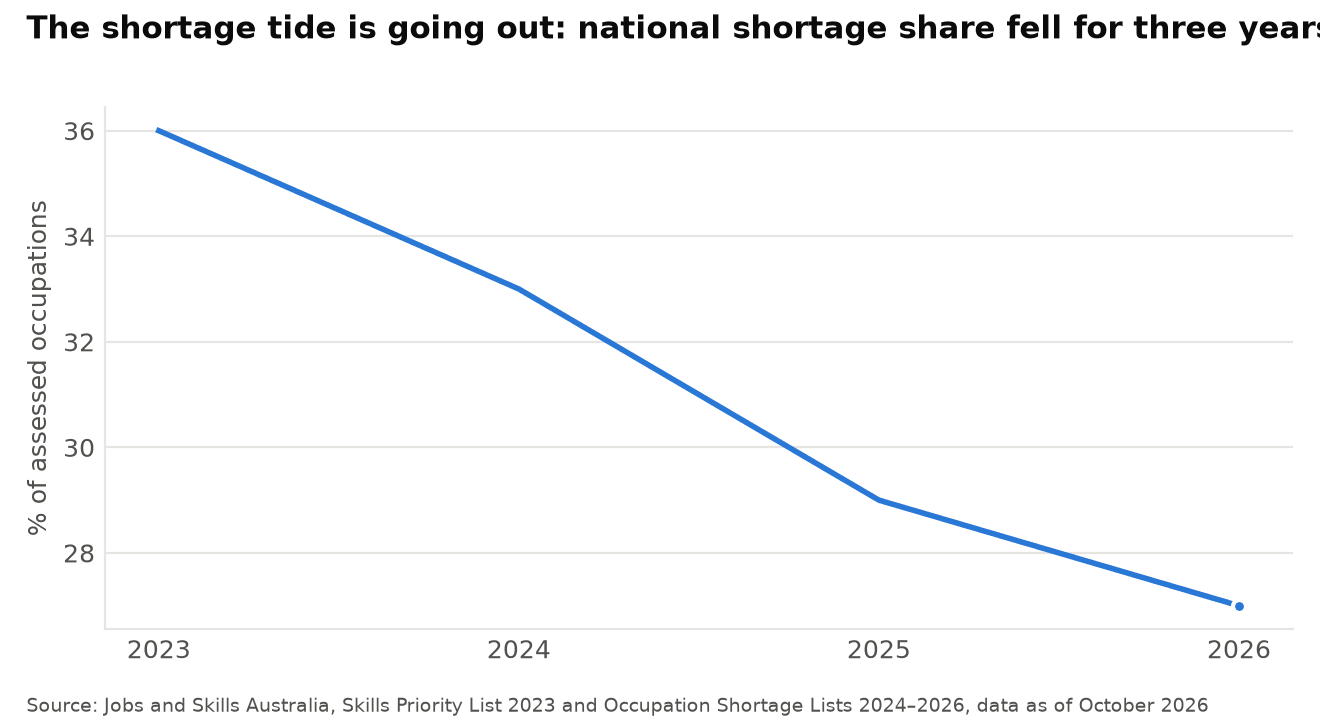
Only 27% of assessed occupations (279 of 1,021) were in national shortage in Jobs and Skills Australia's 2026 Occupation Shortage List, released in October 2026. That is down from 36% in 2023. For regional employers weighing the 494 visa, the more useful figure in the same report is a different one. It counts the roles that never left the list.
127
Occupations in national shortage in every list from 2021 to 2026
Source: Jobs and Skills Australia, 2026 Occupation Shortage List, October 2026
At a glance
27% of assessed occupations were in national shortage in 2026, down from 29% in 2025 (JSA, October 2026).
127 occupations have been in shortage in every list since 2021, and about 90% of them are trades or professional roles (JSA, October 2026).
Employers filled 57% of vacancies in shortage occupations, compared with 78% in other occupations (JSA, 2026 OSL).
In August 2026, 47% of recruiting employers outside the capital cities reported difficulty hiring, compared with 44% in the capitals (JSA, Recruitment Insights Report).
Regional-only shortages fell to 15 occupations in 2026, down from 21 in 2025 (JSA, October 2026).
What does the falling shortage rate really tell regional employers?
It tells you the tide is going out, and that changes less than it seems. Most headlines read the 27% figure as relief. Some employers take it as a reason to stop sponsorship planning and wait for local applicants.
Fair point, up to a limit. Shortages across the whole market are easing, and Jobs and Skills Australia reported that job ads held steady nationally in September 2026. When the tide drops, though, it shows the rocks underneath. Those rocks are the 127 occupations that have stayed in shortage through six lists in a row, across a COVID tightening and a cooling period.
A calm regional employer stops asking whether there is a shortage in general. The better question is whether their role is one of the rocks. If it is, the 494 visa still does what it was built to do. It is a five-year workforce commitment for a role the local market has not filled since 2021.
What most people see | What a calm regional employer sees |
|---|---|
Shortages fell to 27%, so hiring will get easier | The fall is across all occupations, and the persistent 127 did not move |
Regional areas are where shortages are worst | The capital–regional gap is about 3 points, and regional-only shortages fell to 15 |
Sponsorship is a last resort for an empty role | A 494 is a five-year retention plan for a role that stays hard to fill |
Waiting a year costs nothing | Shortage roles fill at 57%, so an open role usually stays open |
When the flip is wrong. If your occupation moved out of shortage this year, the calm move is to test the local market properly before you sponsor. In 2026, 42 occupations moved from shortage to no shortage. The same applies if your difficulty comes from pay, rosters or location rather than a shortage of skilled people. A visa will not fix a role that local workers turn down for reasons you can change.
Is hiring really harder outside the capital cities?
Yes, but only slightly, and the gap moves from month to month. In Jobs and Skills Australia's August 2026 Recruitment Insights Report, 47% of recruiting employers in rest-of-state areas reported difficulty. In the capital cities the figure was 44%. JSA's October 2026 update said employers outside major cities were still reporting more recruitment activity and more difficulty.
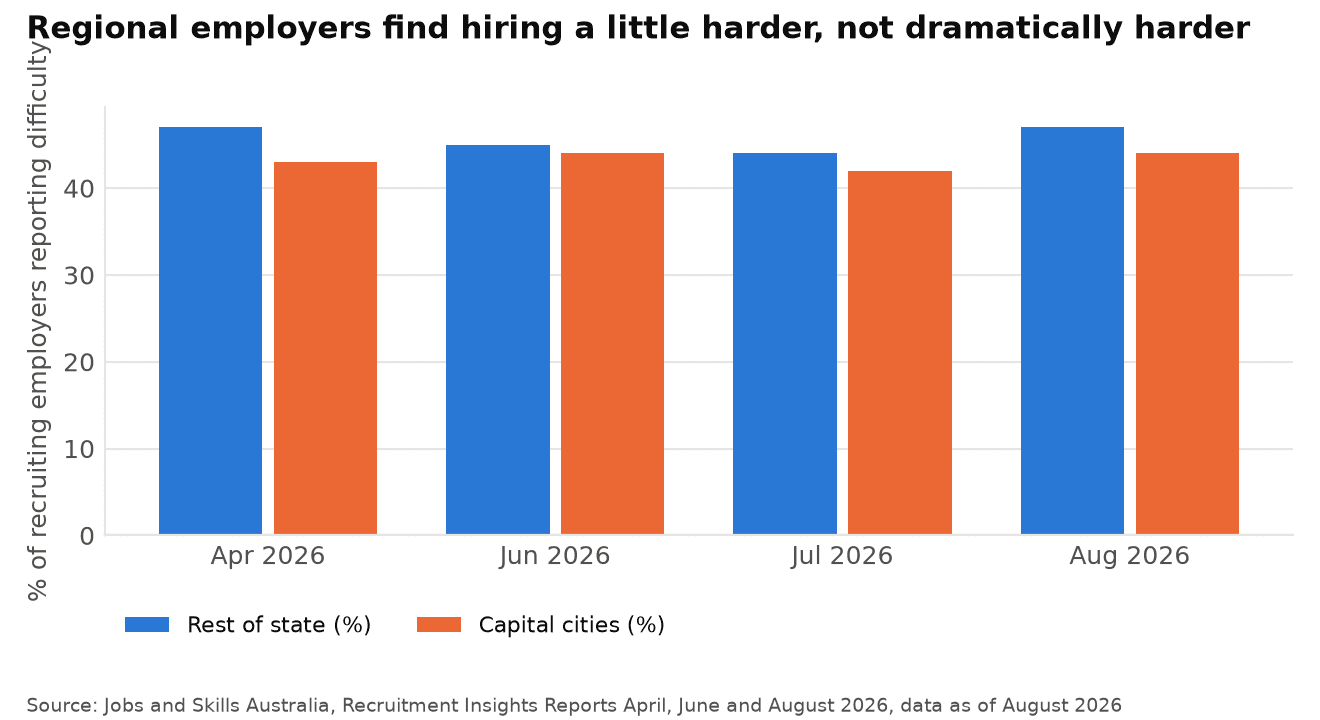
The gap was 4 points in April 2026 and 1 point in June. The 2026 Occupation Shortage List also found fewer regional-only shortages, with 15 occupations in shortage regionally but not in the capitals, down from 21.
So what: "Regional" on its own is not a reason to sponsor. The occupation is.
Which roles are the rocks under the tide?
The rocks are the 127 occupations that have been in national shortage in every list from 2021 to 2026. Jobs and Skills Australia reports that trades workers and professionals make up 115 of them, about 90%. Many are in construction, engineering trades, and electrotechnology and telecommunications trades.
These are the roles regional businesses most often build around: electricians in mining towns, fitters in agricultural processing and engineers on infrastructure projects. JSA's separate 2026 Occupation Shortage Drivers Report links most persistent gaps to limits on labour supply, meaning how many people have the skills and how fast new workers can be trained. Those limits do not shift in one hiring cycle.
Signal from the 2026 OSL | Figure | What it means for a 494 decision |
|---|---|---|
Persistent shortage occupations, 2021–2026 | 127 | The strongest case for a five-year visa |
Share that are trades or professional roles | about 90% (115) | Most 494-eligible skilled roles sit here |
Newly in shortage in 2026 | 28 | Test the local market first, because it may be a short-term spike |
Moved out of shortage in 2026 | 42 | Expect more local applicants and stronger labour market testing evidence |
So what: check your occupation against the persistent list before you look at visa forms. Our skills shortage assessment starts there.
What does waiting cost when a role is in shortage?
Waiting usually costs you most of a hiring round. Jobs and Skills Australia found that vacancies in shortage occupations had a fill rate of 57% in the 2026 list. Non-shortage occupations filled at 78%, and the all-occupation average was 72%.
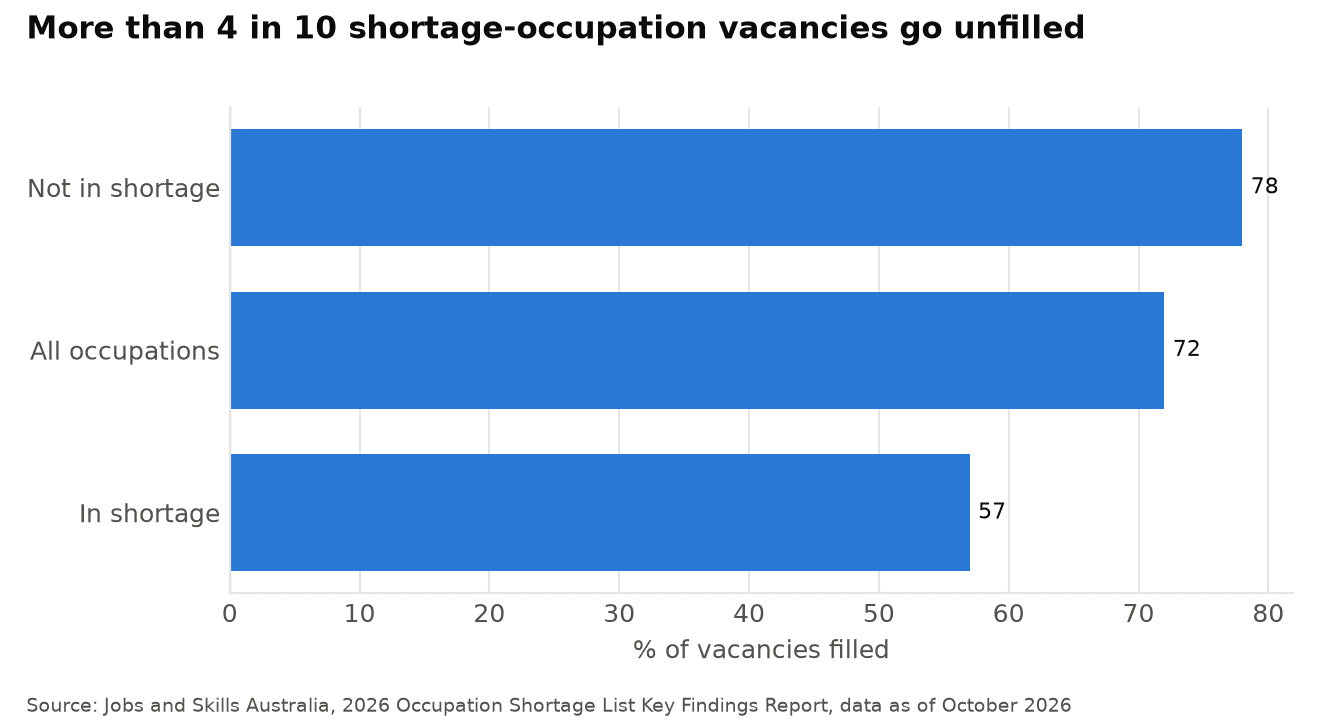
Put simply, about 43 in every 100 shortage-occupation vacancies were not filled. A regional business that waits for the tide to bring a fitter or nurse is betting against those odds.
So what: for a persistent-shortage role, sponsorship planning can run alongside local advertising, not after it.
Where could shortages go by the 2027 list?
Scenario, not prediction. The shortage share has fallen by 2 to 4 points a year since 2023. The table projects the share for the next Occupation Shortage List, expected around October 2027, under three sets of assumptions.
Scenario | 2027 shortage share | Assumptions | What it means for regional employers |
|---|---|---|---|
Low | about 24–25% | Job ads keep softening, and training completions in trades rise | More local applicants for general roles, while persistent trades stay tight |
Base | about 26% | The recent trend of about 1–2 points a year continues | Little change for the 127 persistent roles, and slightly easier hiring elsewhere |
High | about 28–29% | Infrastructure, housing and care demand picks up faster than supply | Shortages widen again, and earlier sponsors keep their workers |
In all three scenarios the persistent group barely moves. A five-year 494 position covers more than one list cycle, so the decision rests on the rocks, not the waves.
What would change this view:
A sharp rise in trade apprenticeship completions, which JSA's drivers analysis ties to supply limits
A change to the occupation lists or income thresholds used for employer-sponsored visas
A regional downturn in a single industry, such as mining or agriculture, that frees up local workers
How do you decide if a 494 nomination is right for your role?
Work through these six checks before you lodge anything. Each one comes from the Migration Act 1958 or the Migration Regulations 1994 as in force in November 2026.
Occupation fit. Check whether the role is in the 127 persistent shortages, newly in shortage, or out of shortage in the 2026 Occupation Shortage List.
Position test. The position must be genuine, full-time and likely to exist for at least five years (Migration Regulations, reg 2.72C(12)). The contract must not expressly rule out extending the employment.
Salary test. Pay must be at least the annual market salary rate for the occupation and not below the temporary skilled migration income threshold (reg 2.72C(15)). Our guide to 482 salary requirements and market salary rates explains how employers set the market rate.
Labour market testing. Standard business sponsors must test the local market within the period set by the Minister, which cannot start more than four months before you lodge the nomination. Advertising must run for at least four weeks (Migration Act s140GBA). Use our labour market testing service or read how labour market testing works.
Levy and refund planning. Each nomination attracts the Skilling Australians Fund levy, and the rate depends on whether annual turnover is under $10 million. If the worker leaves within the first year, the levy may be refunded. The refund keeps back $600 for businesses with turnover under $10 million and $1,000 for others (reg 2.73C(9)).
Retention path. The 494 is a qualifying visa for the Regional Provisional Visas stream of the subclass 191 permanent visa. Plan the role, the training and the location around that timeline.
Watch out: Sponsorship obligations start when the nomination is approved, or when the visa is granted if that comes later. Throughout the 494, the worker's earnings must stay at least at the level stated in the nomination. They must also be no less than an Australian citizen or permanent resident earns for equivalent work at the same location (reg 2.79A). Moving the worker to another site, cutting hours or quietly freezing pay can breach this obligation. Check with a registered migration agent before you change the role.
Frequently asked questions
Is the 494 visa still worth it if shortages are easing?
For persistent-shortage roles, usually yes. The national shortage share fell to 27% in 2026, but 127 occupations have been short every year since 2021. A 494 is a five-year commitment, so what matters is your occupation's long-term pattern, not one year's headline.
Do regional employers still need labour market testing for a 494?
Yes, in most cases. Under section 140GBA of the Migration Act, standard business sponsors must test the Australian labour market before they nominate. Testing must fall within the period set by the Minister, which cannot start more than four months before lodgement. Advertising must run for at least four weeks, and some international trade obligations create exemptions.
Is hiring harder in regional areas than in cities?
A little. In August 2026, 47% of recruiting employers outside the capital cities reported difficulty, compared with 44% in the capitals. Regional-only shortages fell to 15 occupations in 2026, so your occupation matters more than your postcode.
What happens to the levy if the sponsored worker leaves early?
If the worker leaves within one year of starting, you can ask for a levy refund. Home Affairs keeps back $600 when annual turnover is under $10 million and $1,000 otherwise. A refund is also possible if the worker never starts in the position.
Can a 494 worker move to permanent residence?
The 494 is listed as a qualifying visa for the Regional Provisional Visas stream of the subclass 191 permanent visa. Eligibility depends on the worker meeting that visa's own requirements, so plan the role and the location with that pathway in mind.
The takeaway: The Genuine Take: Don't sponsor because shortages make the news. Sponsor because your role keeps showing up on the list. A falling tide doesn't move the rocks, and a regional business built on persistent-shortage trades should plan for five years, not one hiring round.
Sources and method
Source | What it gave | Data date |
|---|---|---|
Jobs and Skills Australia, news release: Occupation shortages continue to ease | 27% shortage share, 2025 and 2023 comparisons, persistent shortages | 21 Oct 2026 |
279 of 1,021 occupations, 127 persistent, fill rates, regional-only shortages, 28 new and 42 removed | Oct 2026 | |
Main drivers of persistent shortages | Oct 2026 | |
2025 share (29%) and 2024 comparison (33%) | Oct 2025 | |
2024 share (33%) | Oct 2024 | |
Recruitment difficulty, capital cities vs rest of state, July and August 2026 | Aug 2026 | |
Recruitment difficulty, April and June 2026 | Apr–Jun 2026 | |
Direction of the regional difficulty gap | 29 Oct 2026 | |
494 position, salary, refund and equivalent-terms rules; 191 qualifying visas | Compilation 291, in force 3 Nov 2026 | |
Labour market testing condition (s140GBA) | Compilation 172, in force 8 Oct 2026 |
Method and limits: the 2023 figure comes from the 2023 Skills Priority List, the predecessor to the Occupation Shortage List, and JSA cites it as the comparison point. The recruitment difficulty series shows only the months confirmed in published reports, so May 2026 is not included. The 2027 forecast is a scenario range based on the 2023–2026 trend and the stated assumptions. It is not a JSA projection.
Disclaimer: This article provides general information only and is not migration, legal or financial advice. Visa rules, fees, thresholds and occupation lists change. Check the current requirements with the Department of Home Affairs and get advice from a registered migration agent before you make sponsorship decisions.
Talk to Genuine Solutions about regional sponsorship
If your business is outside a capital city and a key role keeps going unfilled, Genuine Solutions can help you work out whether the role is a persistent shortage and whether the 494 visa fits. We can also help you plan labour market testing and understand your sponsorship obligations before you commit. Explore our workforce solutions or contact our team to discuss your next hire.