


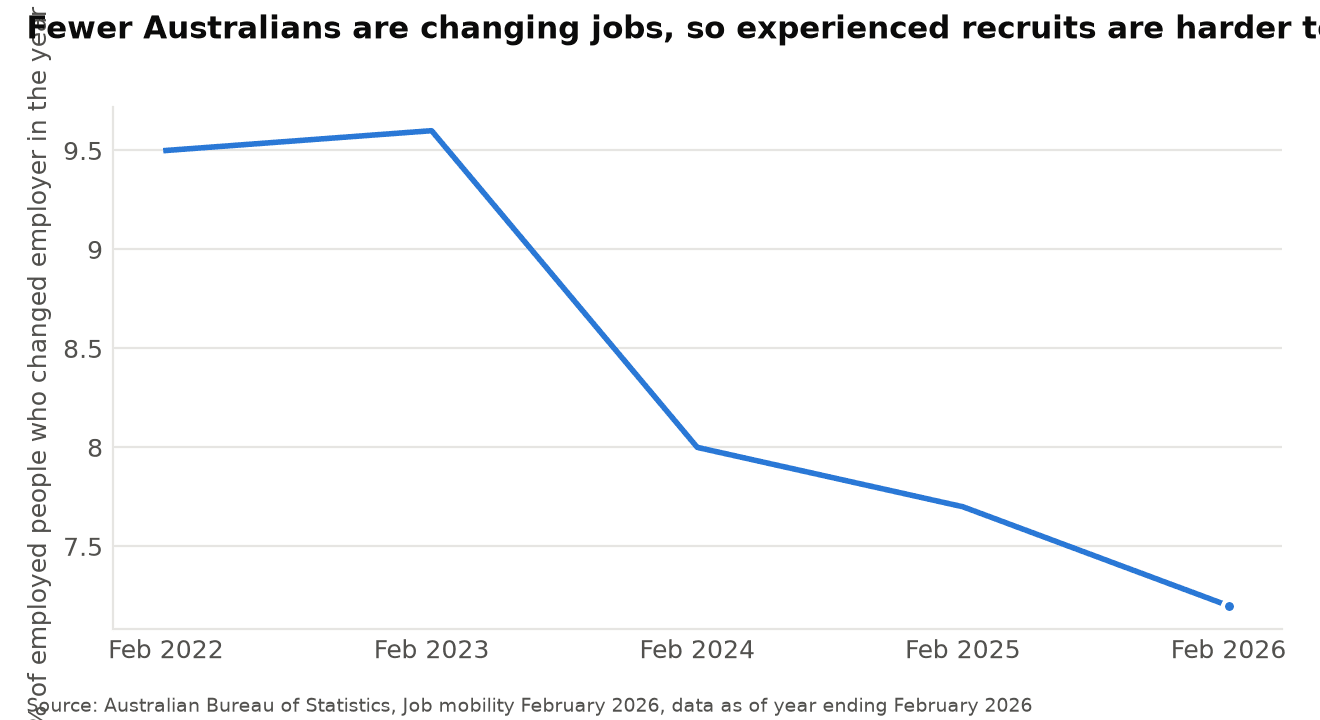
Australia's Core Skills Income Threshold (CSIT) rose to $79,423 on 1 July 2026 (Migration Regulations 1994; Move to South Australia, 2 July 2026). In the same period, only 7.2% of employed people changed employer in the year to February 2026, the lowest rate in the last five years of ABS job mobility data. Some employers would rather let a good sponsored worker go than pay the threshold. The data suggests that is a costly mistake.
7.2%
Share of employed people who changed employer or business in the year to February 2026
Source: ABS, Job mobility, released 31 July 2026
At a glance
The Core Skills Income Threshold and the Temporary Skilled Migration Income Threshold have both been $79,423 since 1 July 2026.
Only 7.2% of employed people (just over 1.0 million) changed employer in the year to February 2026, down from 7.7% a year earlier (ABS).
Full-time adult average weekly ordinary time earnings were $2,083.70 in May 2026, about $108,352 a year (ABS).
Wages rose 3.5% in the year to the September quarter 2026 (ABS Wage Price Index).
Unemployment was 4.9% in October 2026 (ABS Labour Force).
Why does $79,423 look like the wrong number to argue about?
Many employers are stuck on the threshold. They compare it with what they paid last year, or with an award rate, and they hold back the 186 nomination or the new 482 nomination. Meanwhile the worker who already knows the business starts looking elsewhere.
Fair point: $79,423 is a real cost. But it is not an optional premium on top of a cheaper alternative. If you replace that worker with another overseas hire in the 482 Core Skills stream, the new nomination must also meet the CSIT and the annual market salary rate (Migration Regulations, reg 2.72). A 186 Temporary Residence Transition nomination requires the same threshold (reg 5.19). A local hire must be paid at least the award and the going market rate. The threshold follows the role, not the person, so letting the person go does not make the cost go away.
Think of it this way: refusing the threshold is like changing the locks and paying to have a stranger trained to use them.
What most people see | What a calm employer sees |
|---|---|
"$79,423 is too high for this role" | It is about 73% of average full-time ordinary earnings ($108,352 a year, ABS May 2026) |
"We'll just hire someone else" | Any new 482 Core Skills or 186 TRT nomination must meet the same $79,423 |
"There are plenty of candidates now unemployment is 4.9%" | Only 7.2% of workers changed employer in the year, so experienced people are staying put |
"Loyalty means they won't leave" | A sponsored worker can look for a new sponsor while their visa runs, and competitors know it |
When the flip is wrong. If the role's genuine market rate in your area sits well below $79,423, and you can fill it locally at the award rate without sponsorship, keeping the sponsored arrangement may not pay off. The same applies if the worker's performance is weak, or if your business cannot show it can pay the market salary each year. Either can sink the nomination whatever you decide about pay.
What does the law actually require you to pay?
For a 482 Core Skills nomination, and for a 186 Temporary Residence Transition nomination, the worker's annual earnings must be at least the annual market salary rate. Earnings excluding non-monetary benefits must also be at least the CSIT, currently $79,423 (Migration Regulations 1994, regs 2.72 and 5.19, Compilation 292 in force 12 November 2026).
Requirement | Rule | Source |
|---|---|---|
Income threshold (CSIT and TSMIT) | $79,423 from 1 July 2026 | Migration Regulations reg 1.03; Move to South Australia notice, 2 July 2026 |
Market salary | Pay no less than an Australian doing equivalent work at the same location | Reg 2.72 |
Capacity to pay | The business can pay at least the market salary each year | Regs 2.72(17A), 5.19 |
Non-monetary benefits | Excluded when testing the threshold | Regs 2.72(15)(f), 5.19 |
DAMA concession (SA example) | 10% concession, equal to $71,480.70 | Move to South Australia, 2 July 2026 |
So what: the $79,423 floor applies to the position. Our guide to 482 visa salary requirements, CSIT, SSIT and market salary explains how the market salary test works alongside it.
How does $79,423 compare with what Australians earn?
The threshold sits well below average full-time earnings. Full-time adult AWOTE was $2,083.70 a week in May 2026, about $108,352 a year. The CSIT is about 73% of that figure.
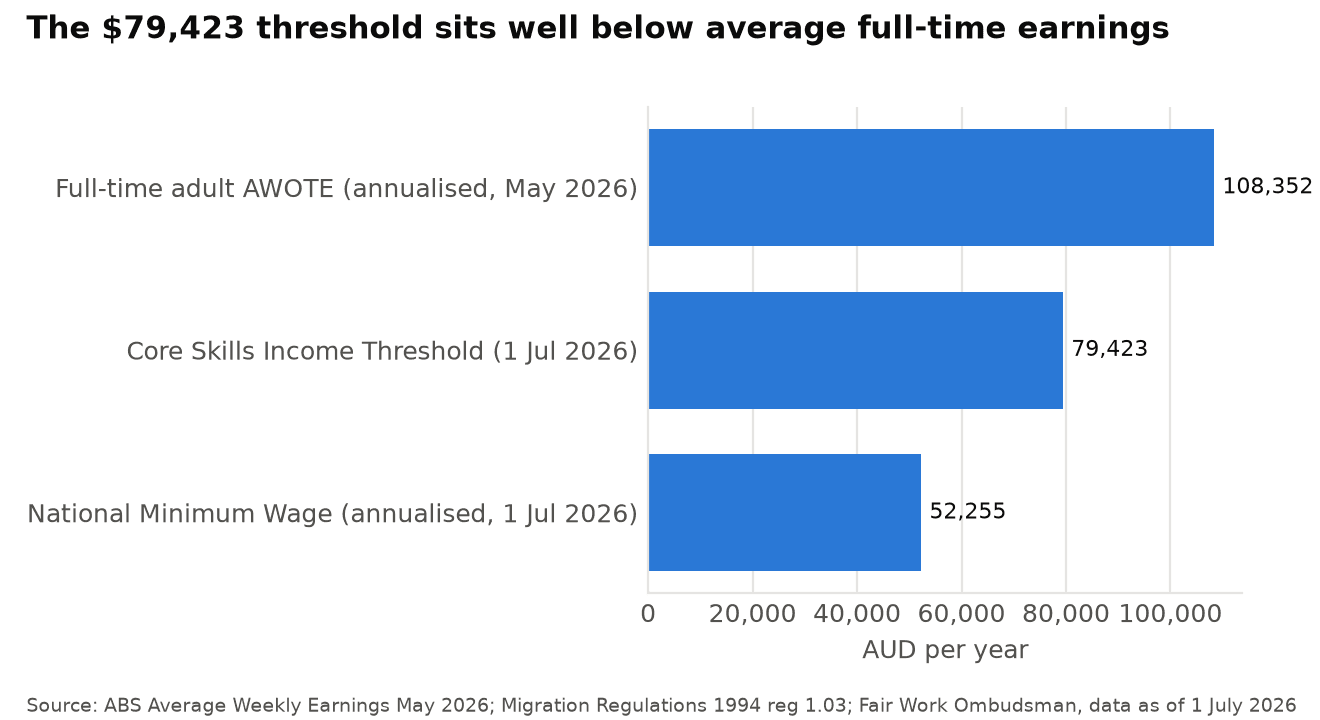
The National Minimum Wage has been $1,004.90 a week since 1 July 2026 (Fair Work Ombudsman), about $52,255 a year. Award wages rose 4.75% on the same date.
So what: for most skilled roles on the core skills list, a fair market salary is already near or above $79,423. If an offer falls well short, the market salary test is usually the bigger problem.
Why is replacing a loyal worker harder in 2026?
Fewer people are moving between jobs. ABS data shows the job mobility rate fell from 9.6% in the year to February 2023 to 7.2% in the year to February 2026, about 1.0 million people. A shrinking pool of job-switchers means fewer experienced candidates who are ready to move.
Year ending February | Job mobility rate |
|---|---|
2022 | 9.5% |
2023 | 9.6% |
2024 | 8.0% |
2025 | 7.7% |
2026 | 7.2% |
Rising unemployment, 4.9% in October 2026, does add candidates. But they are not always experienced in your occupation, your systems or your region. Jobs and Skills Australia reported on 29 October 2026 that employers outside major cities face more recruitment activity and greater difficulty finding staff.
Replacing a sponsored worker with an overseas hire also means a fresh process: labour market testing, a new nomination, visa processing and onboarding. During that time the role sits empty or is covered by overtime.
So what: the worker you already have is the scarce resource, more than the $79,423 salary.
What compliance risk comes with letting a sponsored worker go?
If a sponsored worker stops working for you, you must tell the Department within 28 days of the date their employment ends (Migration Regulations reg 2.84). Under their visa conditions, a 482 holder may stop working for their sponsor for up to 180 consecutive days, and no more than 365 days in total over the visa period (Schedule 8).
So a worker you will not nominate does not disappear. They have up to 180 days to find a sponsor who will pay the threshold, and that sponsor may be your competitor.
So what: before you refuse to pay, check that your exit process is compliant and that the person who would leave is not your best operator.
Where could the threshold be on 1 July 2027?
The CSIT is indexed each 1 July in line with full-time adult AWOTE, using December-quarter figures (Migration Regulations reg 5.42A). The latest AWOTE annual growth was 3.7% (May 2026). Scenario, not prediction:
Scenario | Assumed AWOTE growth to Dec 2026 | Implied CSIT from 1 July 2027 |
|---|---|---|
Low | 3.0% | about $81,806 |
Base | 3.7% | about $82,362 |
High | 4.5% | about $82,997 |
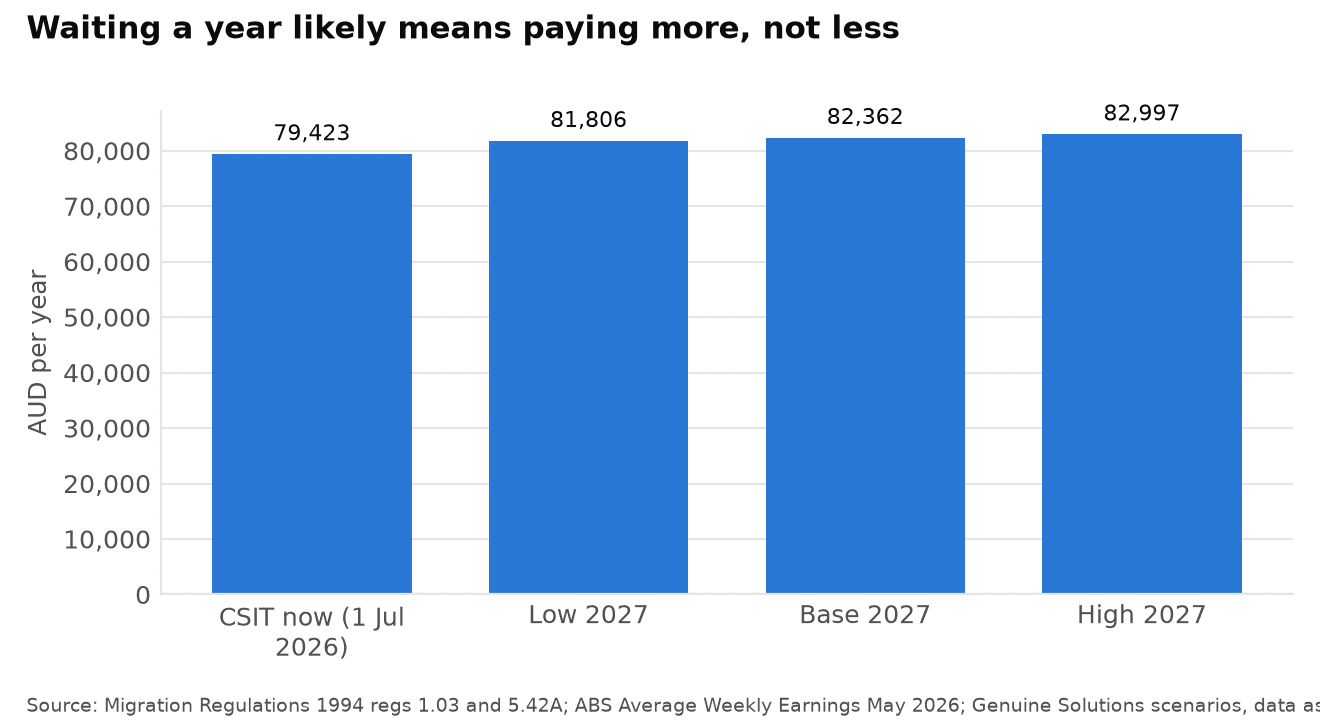
The threshold that applies is the one in force when the nomination is lodged. If you delay a 186 nomination past 1 July 2027 to avoid paying $79,423, you are likely to face a figure of about $82,000 instead. If you defer, the bar rises while you wait.
What would change this view: a government decision to pause or freeze indexation, a change to the AWOTE method, AWOTE growth outside the 3–4.5% range, or a new instrument changing the threshold for particular occupations or regions.
What should employers do before deciding?
Price the role properly. Find the annual market salary rate for the occupation and location. If it is already near $79,423, the threshold is not the real gap.
Price the vacancy. Estimate the weeks of overtime, lost output and training a replacement would need, using your own payroll and rosters.
Check timing. Lodge any 186 TRT or new 482 nomination before the next 1 July indexation if the worker is eligible.
Check the package. Only monetary earnings count towards the threshold. Move salary-sacrificed or in-kind items into base pay if needed.
Check your region. A DAMA may offer an income concession for some occupations. Our DAMA and regional options review can confirm whether it applies.
Plan the exit if you do say no. Notify the Department within 28 days and keep records of the end date.
Watch out: Paying below the market salary to "fit" the threshold, or counting non-monetary benefits towards the $79,423, can lead to a refused nomination and a breach of sponsorship obligations. Never ask a worker to repay any part of their salary or sponsorship costs. Get advice from a registered migration agent before you lodge.
If your business is weighing up whether to keep, transition or replace a sponsored worker, Genuine Solutions can help you review the market salary, the threshold and the workforce options available to your business.
FAQ
What is the Core Skills Income Threshold in 2026?
The CSIT has been $79,423 since 1 July 2026, the same as the Temporary Skilled Migration Income Threshold. It applies to 482 Core Skills nominations and 186 Temporary Residence Transition nominations. Earnings must also meet the annual market salary rate for the occupation.
Do I have to raise an existing 482 worker's pay to $79,423?
The threshold is tested when a nomination is lodged. But you must keep paying the nominated salary and terms no less favourable than an Australian doing the same work. Any new nomination, such as a 186 TRT or a change of position, must meet the threshold in force at that time.
Can non-monetary benefits count towards the $79,423?
No. The regulations exclude non-monetary benefits when testing the CSIT for 482 Core Skills and 186 TRT nominations. Accommodation, meals or a car may form part of the total package. Only monetary earnings count towards the threshold.
What happens if my sponsored worker leaves?
You must notify the Department within 28 days of the employment ending. Under their visa conditions, a 482 holder can stop working for their sponsor for up to 180 consecutive days while they look for a new sponsor or another visa.
Will the threshold go up again?
The CSIT is indexed each 1 July in line with full-time adult AWOTE. With AWOTE growing 3.7% a year as of May 2026, our base scenario puts it near $82,362 from 1 July 2027. This is a scenario, not a prediction.
Is a DAMA cheaper?
Some DAMAs offer an income concession for listed occupations. In South Australia, a 10% concession equals $71,480.70 under the current threshold. Concessions depend on the agreement, occupation and region, so check eligibility first.
The takeaway: The $79,423 threshold is the price of the role, not the price of the person. Employers who refuse to pay it still face it on any replacement, now without the experienced worker. In 2026, keeping a sponsored worker who already knows the business is usually cheaper than replacing them.
Sources and method
Source | What it gave | Data date |
|---|---|---|
TSMIT $79,423 (reg 1.03); CSIT rules for 482 (reg 2.72) and 186 TRT (reg 5.19); indexation (reg 5.42A); 28-day notification (reg 2.84); 180/365-day rule (Sch 8) | Compilation 292, in force 12 Nov 2026 | |
TSMIT and CSIT $79,423 from 1 July 2026; SA DAMA 10% concession $71,480.70 | 2 Jul 2026 | |
Job mobility 7.2%, 1.0 million people; 2022–2025 series | Year to Feb 2026, released 31 Jul 2026 | |
ABS media release: Job mobility continues to decline into 2026 | Confirms 7.2% and 7.7% previous year | 31 Jul 2026 |
Full-time adult AWOTE $2,083.70, +3.7% a year | May 2026 | |
Wages +3.5% a year | Sep quarter 2026 | |
Unemployment 4.9% | Oct 2026 | |
National Minimum Wage $1,004.90 a week; awards +4.75% | 1 Jul 2026 | |
Jobs and Skills Australia: Hiring difficulties persist as recruitment eases | Regional employers report greater recruitment difficulty | 29 Oct 2026 |
Method: Annual figures are weekly ABS and Fair Work rates multiplied by 52. The 2027 CSIT scenarios apply assumed AWOTE growth rates to $79,423 and ignore rounding in the official indexation formula. Home Affairs web pages could not be accessed for this article, so threshold rules are cited to the Migration Regulations and a state government notice.
Disclaimer: This article is general information only and is not migration, legal or financial advice. Visa rules, thresholds and fees change, so check the current requirements with the Department of Home Affairs and get advice from a registered migration agent about your circumstances before acting.