

ChatGPT reaches 1.2 billion people each week, OpenAI said on 10 November 2026 when it launched Businesses in ChatGPT in beta. That launch gives businesses a Business Hub where they can claim their profile, correct their details and see how often ChatGPT mentions them. For Australian SMEs, the first job isn't to buy anything. It's to check what that shopfront already says about you.
1.2 billion
People who use ChatGPT each week, per OpenAI
Source: OpenAI, 10 Nov 2026
At a glance
OpenAI launched Businesses in ChatGPT in beta on 10 November 2026. On 19 November 2026 it said ecommerce and online service businesses outside the US can now claim their business and publish agents.
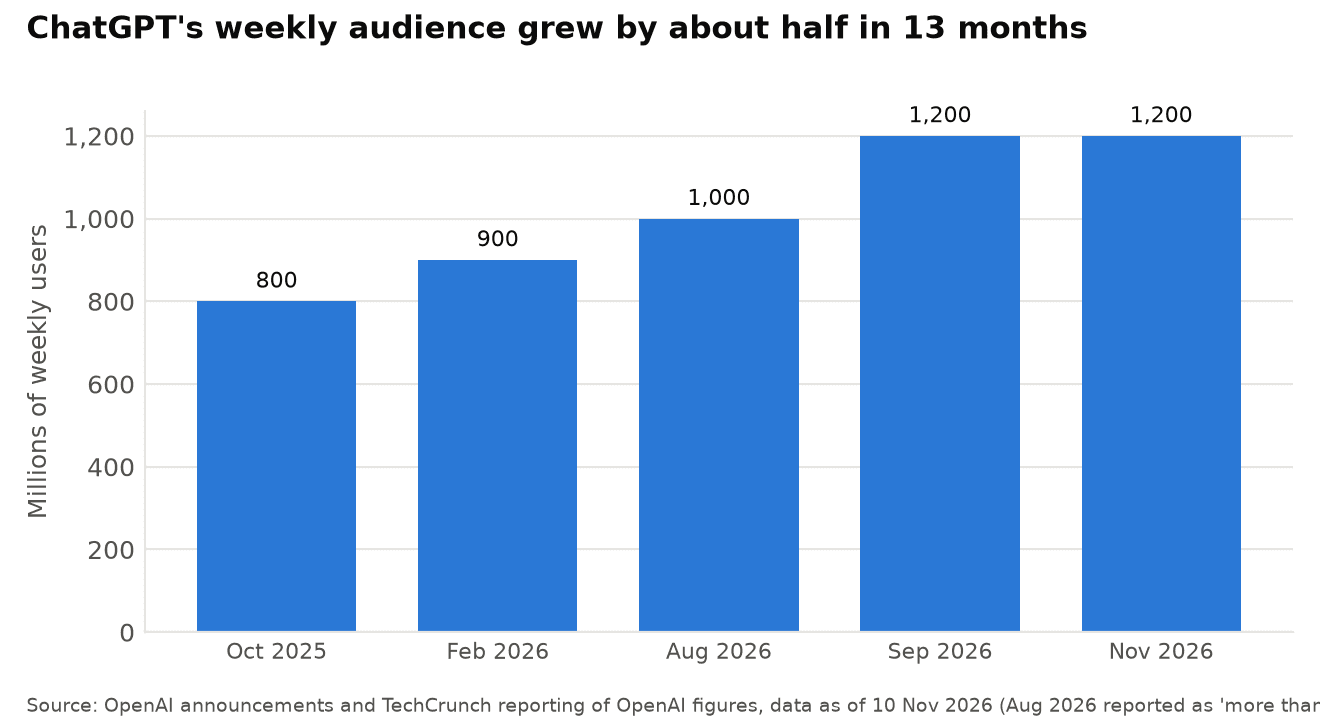
OpenAI reported 800 million weekly ChatGPT users in October 2025 and 1.2 billion by September 2026.
Google says AI Overviews has over 2.5 billion monthly users and AI Mode has passed 1 billion (May 2026).
As of 31 August 2026, Google had rolled out Search Console insights on AI features to all websites worldwide.
Australia had 2,814,778 actively trading businesses at 30 June 2026, and about 89% had fewer than five employees (ABS).
Should every SME rush into AI search?
Right now the market is loud. Agencies are selling "AI visibility" packages, owners keep hearing that SEO is dead, and every product launch gets treated like an emergency. Fair point: the audience is real. ChatGPT's weekly audience grew from 800 million to 1.2 billion in about a year, on OpenAI's own figures.
Look at what OpenAI actually shipped, though. Business Hub works more like a familiar listing than a new ad channel. You claim the business, verify it, update key details and read aggregated insights on mentions and website clicks. The word OpenAI uses is "claim", and that tells you something: ChatGPT already talks about businesses using what it finds on the web. You're correcting a shopfront that is already open, not building a new one.
What most people see | What a calm business owner sees |
|---|---|
A new platform to spend on before competitors do | A profile to claim and correct, much like a business listing |
"SEO is dead, AI answers everything" | AI answers cite websites, so your website still feeds the answer |
Pressure to buy an AEO package now | Measure first: Business Hub and Search Console now report AI exposure |
A US-only experiment | Claiming is open wherever ChatGPT is available, and Australia is on that list |
When the flip is wrong. If you sell online and your buyers already research products in chat assistants, this deserves more than a quick admin pass. OpenAI's 19 November update opened Business Agents to eligible ecommerce and online service businesses outside the US, so for you this may become a working sales channel. The calm reading also fails if your website is thin or out of date, because no profile can make up for weak source material.
What does Business Hub actually give an Australian business?
Business Hub gives you control over your details and a view of how ChatGPT uses them. OpenAI says verified businesses can "update key details and add self-service product feeds with pricing and availability". It also reports mentions, profile views, website clicks and the top "discovery topics", which are themes from conversations where your website is cited.
There are two limits worth knowing. OpenAI says insights are aggregated and "only available when there are enough conversations or interactions to meet certain thresholds", so a small local business may see little data at first. OpenAI also says it doesn't share users' conversations with businesses.
Feature | Who can use it (as of 26 Nov 2026) |
|---|---|
Claim and verify a business profile | Eligible businesses wherever ChatGPT is available, including Australia |
Edit details, add product feeds | Verified businesses |
Insights (mentions, clicks, discovery topics) | Verified businesses that meet volume thresholds |
Business Agent (customer chat inside ChatGPT) | Eligible ecommerce and online service businesses, now including outside the US |
So what: most SMEs need only one step from this table, and that step is the first row.
Is Google still the bigger front door?
Yes, by Google's own numbers. At Google I/O in May 2026, Google said AI Overviews had over 2.5 billion monthly active users and that AI Mode had passed 1 billion. AI Mode has been available in Australia in English since 8 October 2025.
AI answer surface | Reported reach | Measure | Date |
|---|---|---|---|
Google AI Overviews | Over 2.5 billion | Monthly users | May 2026 |
ChatGPT | 1.2 billion | Weekly users | Nov 2026 |
Google AI Mode | Over 1 billion | Monthly users | May 2026 |
These figures use different measures, so they can't be ranked against each other. The practical point is that both platforms now let website owners measure their AI exposure. Google says Search Console now shows "which pages appear in AI responses and in what countries". It also added a control to opt out of generative AI features, but warns that opted-out sites "will not receive traffic or impressions" from those features.
So what: before you pay anyone to "optimise for AI", read the free reports you already have access to.
Why does this matter more for small businesses?
Most Australian businesses don't have a marketing team to manage a new platform. The ABS counted 2,814,778 actively trading businesses at 30 June 2026. Of those, about 1.82 million had no employees and 689,600 had one to four.
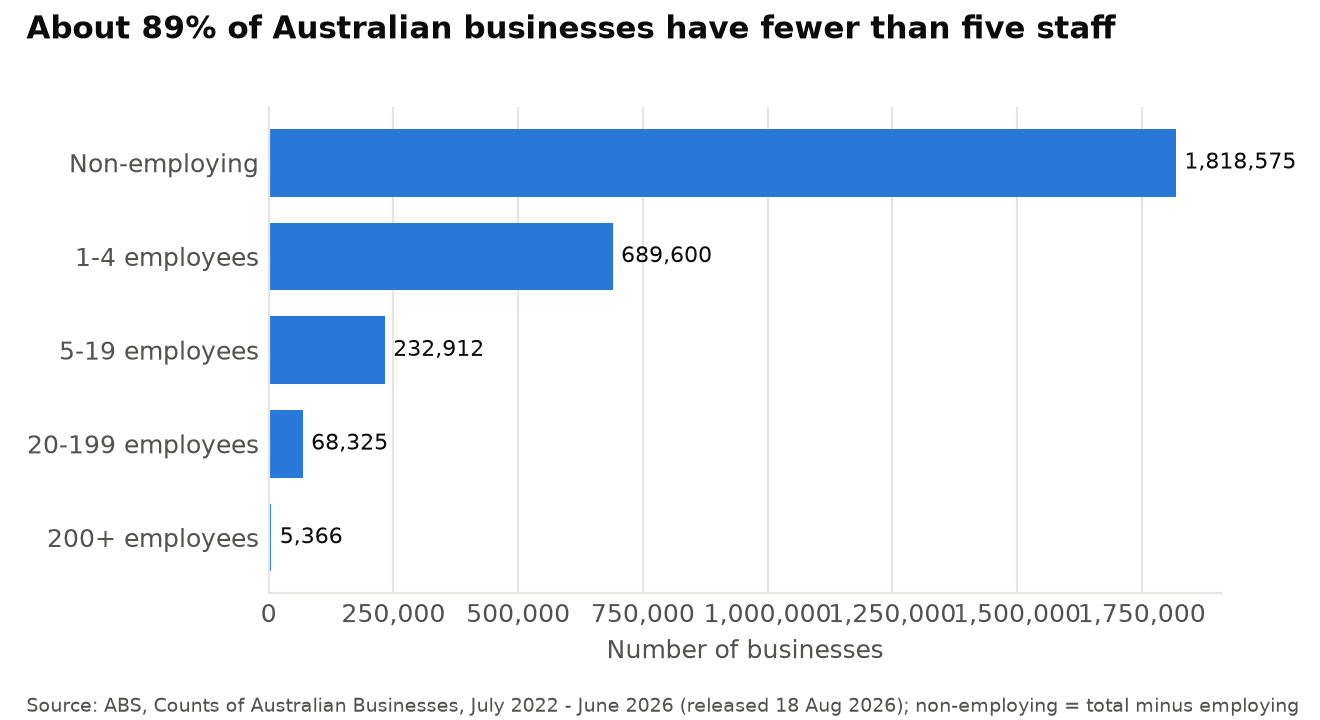
That's roughly 2.5 million businesses where the owner is also the marketer. For them, the most useful AI search task is the cheapest one: keep a clear website, correct the listing and check the numbers each month.
So what: treat AI search like routine maintenance, not a new project.
What happens next? Three scenarios to mid-2027
Scenario, not prediction. These scenarios assume OpenAI keeps the beta's current shape, ChatGPT's weekly audience stays at or above 1.2 billion, and Google keeps reporting AI features in Search Console.
Scenario | What happens | What it means for an SME |
|---|---|---|
Low | The beta stays narrow, verification is slow and thresholds hide insights for most small firms | Claiming is a quick check, and Search Console stays your main AI signal |
Base | Claiming works smoothly in Australia, insights appear for busier businesses and agents grow in ecommerce | A short monthly routine: check details, read mentions and clicks, fix website gaps |
High | Business Agents reach more categories and sponsored placements grow alongside them | Online sellers weigh agents and ads against Google spend, and service firms still focus on profile accuracy |
These things would change the view: OpenAI charging for claiming or verification, ads starting to affect ChatGPT's answers (OpenAI currently says "advertising does not influence the answers ChatGPT provides"), Australian regulatory action on AI-generated business information, or Google changing how AI Mode links to websites.
Across all three scenarios, the shopfront stays open whether or not you look after it. The only question is who keeps the window display accurate.
Your move: five checks this month
Search for your business in ChatGPT. Ask what it recommends for your service in your suburb, and write down what it gets wrong.
Claim and verify in Business Hub if your business is eligible. Correct your hours, services, location and website link.
Open Search Console's AI features insights. See which pages appear in AI responses and from which countries.
Fix the source, not just the listing. Update your service pages, pricing approach and FAQs so AI tools have accurate material to cite. A well-built website is still the foundation (see our web development services).
Track monthly. Record mentions, clicks and enquiries in one place. Our data analytics and CRM implementation teams can help you connect AI-referred visits to real leads.
Watch out: Don't sign up for any service that promises top placement in ChatGPT or Google AI answers. Neither platform publishes how it ranks businesses in AI answers, and OpenAI keeps sponsored placements labelled and separate from its responses. Also be careful about opting out of Google's AI features: Google says opted-out sites receive no traffic or impressions from them.
If you'd like help reviewing how your business appears in AI search, or setting up tracking that links visibility to enquiries, contact Genuine Solutions. We can help you work out what's worth doing now and what can wait.
FAQ
What is Businesses in ChatGPT?
Businesses in ChatGPT is an OpenAI beta launched on 10 November 2026. Through Business Hub, eligible businesses can claim and verify their profile, update key details, add product feeds and see aggregated insights such as mentions, profile views, website clicks and discovery topics. Eligible ecommerce and online service businesses can also publish a Business Agent.
Can Australian businesses claim a ChatGPT profile?
OpenAI says any eligible business located where ChatGPT is available can claim its business, and Australia is on OpenAI's list of supported countries. Eligibility still depends on OpenAI's policies and verification checks. OpenAI also notes that verification alone doesn't guarantee eligibility for Business Agents.
Does claiming a profile make ChatGPT recommend my business?
There is no published evidence that it does. OpenAI hasn't explained how ChatGPT ranks or recommends businesses. Claiming helps keep your details accurate and gives you insights, but recommendations will still depend on what ChatGPT finds about you across the web, including your own website.
Do ChatGPT ads change what ChatGPT says about businesses?
OpenAI says advertising does not influence the answers ChatGPT provides and that sponsored placements are clearly labelled and kept separate from its responses. Businesses can sponsor a Business Agent and use it as a destination for ChatGPT Ads, but this is shown as paid placement, not as an answer.
Is SEO still worth doing in 2026?
Yes. AI answers on both Google and ChatGPT cite websites, and OpenAI's discovery topics are based on conversations where your website is cited. Google also reports AI Overviews and AI Mode exposure in Search Console. A clear, accurate and well-structured website still feeds AI visibility.
Should I opt out of Google's AI Overviews?
For most SMEs that want enquiries, probably not. Google says sites that opt out will not receive traffic or impressions from its generative AI features. Opting out may suit businesses with strong reasons to restrict how their content is used, but you should weigh that against the visibility you would lose.
The takeaway: The Genuine Take: AI search isn't a new gold rush for small businesses. It's an old shopfront in a new street, and someone has already put up a sign for you. Read the sign, fix it, and spend your budget on the website it points to. Claim the listing before you buy the package.
Sources and method
Source | What it gave | Data date |
|---|---|---|
1.2 billion weekly users; Business Hub features; insights thresholds; 19 Nov update on businesses outside the US | 10 Nov 2026, updated 19 Nov 2026 | |
1.2 billion weekly users; statement that advertising does not influence answers | 5 Oct 2026 | |
1.2B weekly users | 29 Sep 2026 | |
More than 1 billion weekly active users | 31 Aug 2026 | |
900 million (Feb 2026) and 800 million (Oct 2025) figures reported by OpenAI | 27 Feb 2026 | |
Verification does not guarantee agent eligibility | 10 Nov 2026 | |
Australia listed as supported | Checked 26 Nov 2026 | |
Independent confirmation of launch, features, thresholds and 1.2 billion figure | 11 Nov 2026 | |
AI Overviews over 2.5 billion monthly users; AI Mode over 1 billion | 19 May 2026 | |
Google: New opportunities, control and insights for website owners | Search Console AI insights and opt-out control; worldwide rollout | 3 Jun 2026, updated 31 Aug 2026 |
AI Mode launch in Australia | 8 Oct 2025 | |
Business counts by employment size | 30 Jun 2026 (released 18 Aug 2026) |
User figures come from the platforms themselves and use different measures (weekly and monthly), so they show scale rather than a like-for-like ranking. The August 2026 bar in the hero chart shows OpenAI's "more than 1 billion" figure as 1 billion. The non-employing business count is our calculation (ABS total minus employing businesses), and the forecast is a scenario table based on the assumptions stated above.
This article provides general information about digital marketing platforms as at 26 November 2026. It is not legal, financial or professional advice. Platform features, eligibility and policies change often, so check current terms with each provider before you act. Results from any marketing activity are not guaranteed.