

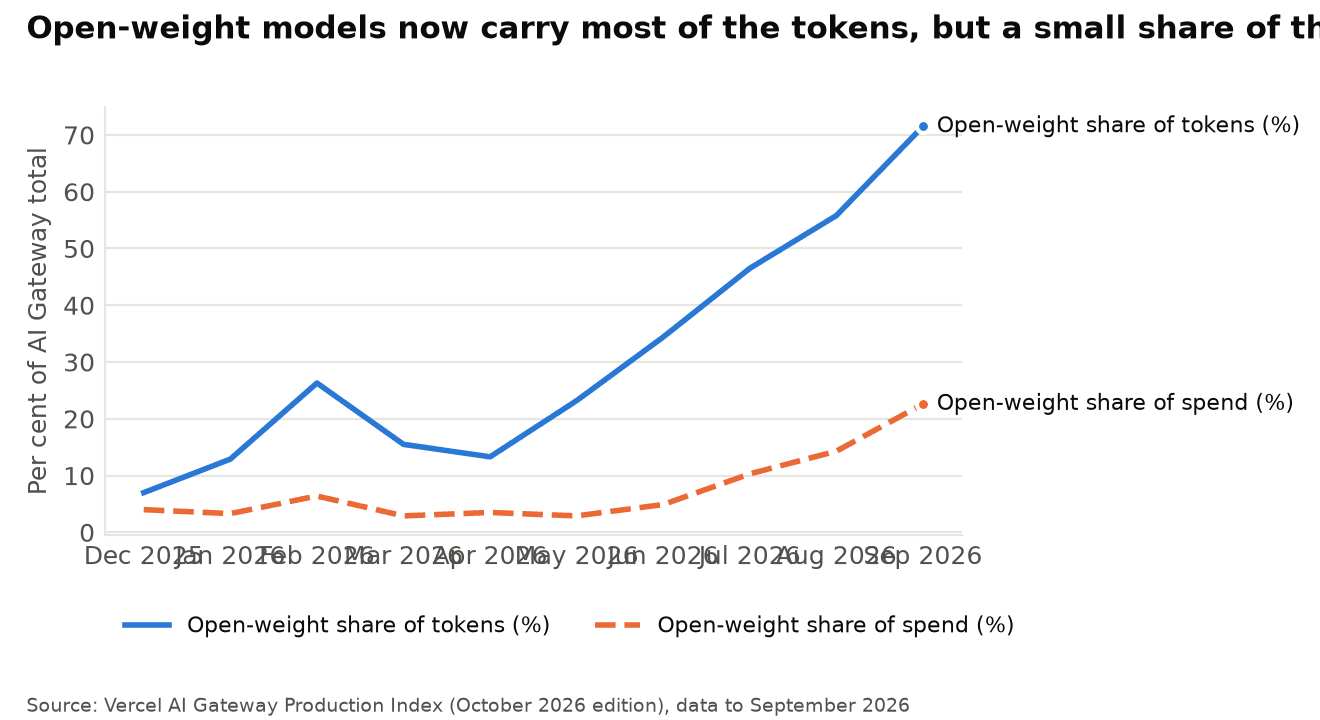
Open-weight AI models handled 71.5% of the tokens on Vercel's AI Gateway in September 2026, but only 22.6% of the spend, according to Vercel's production index of 15 October 2026. Microsoft announced its answer on 17 November 2026: MAI Licensed Weights, which lets a business customise a Microsoft model with its own data. It has no published price yet.
71.5%
Share of AI tokens on Vercel's AI Gateway handled by open-weight models, September 2026 (spend share: 22.6%)
Source: Vercel AI Gateway Production Index, 15 Oct 2026
At a glance
17 Nov 2026: At Ignite 2026, Microsoft announced seven new MAI models and MAI Licensed Weights. Licensed Weights is "coming soon" through Microsoft's Frontier Company engagements.
No price, release date or region list has been published for Licensed Weights (checked 26 Nov 2026).
Sep 2026: Open-weight models carried 71.5% of tokens on Vercel's AI Gateway, up from 7.0% in Dec 2025, but only 22.6% of spend.
18 Nov 2026: Palo Alto Networks agreed to buy Applied Compute, a platform for tuning open-weight models, in an all-stock deal valued at US$4.5 billion.
10 Dec 2026: New Privacy Act transparency rules on automated decisions start, 14 days from the date of this article.
Is "owning your AI model" the real opportunity?
Mostly not. The real opportunity is the data you would put into the model. The headlines frame Licensed Weights as a key: take a frontier Microsoft model, customise it with your proprietary data, and run it in your own Azure environment. That sounds like the moment every business gets its own AI, and many are already asking their IT providers whether they should sign up.
Fair point: control matters. But a key only helps if you own a house. For most Australian businesses, the house is the customer records, job notes, quotes and emails that would train a custom model. Today those are usually spread across five systems, partly duplicated, and full of personal information. Microsoft's own page says your data and adaptations "remain yours". It does not say they are ready.
What most people see | What a calm business owner sees |
|---|---|
"Microsoft will give us our own AI model." | Licensed Weights is not yet available, and access runs through Microsoft account teams. |
"Open-weight models are taking over." | They are taking over the cheap, high-volume work. The expensive judgement work still runs on paid frontier models. |
"Custom equals better." | A custom model is only as good, and as safe, as the data you train it on. |
"We need to move now or fall behind." | The step to take now costs little: sort, label and permission your data. That work pays off whichever model you pick. |
When the flip is wrong. If your business already has clean, well-governed data and a high-volume task that is specific to your trade, such as classifying thousands of support tickets or drafting technical quotes in your own house style, a customised model could beat a general one on both cost and accuracy. In that case, register your interest early. Bear in mind that the Vercel figures describe developers on one global gateway, not Australian businesses in general.
What exactly did Microsoft announce, and what is still missing?
Microsoft has announced the idea and the terms of access, but not the commercial details. In its 17 November announcement, Microsoft says Licensed Weights brings its frontier MAI models "into your own Azure environment", where "you control who can access it". It says it will use your data to train its own models only with your express agreement.
Item | What Microsoft has published (as of 26 Nov 2026) |
|---|---|
What it is | A frontier MAI model you can customise with your own data |
Where it runs | Your own Azure environment |
Your data | Stays yours. Microsoft trains on it only "with your express agreement" |
How to get it | "Coming soon" through Frontier Company engagements, via your Microsoft account team |
Price | Not published |
Release date | Not published |
Australian region | Not stated |
The same Ignite launch included seven new MAI models, covering coding, security, images and voice. For a closer look at one of them, read our breakdown of Microsoft's MAI Code 2 pricing for Australian businesses.
So what: until there is a price and a region, Licensed Weights is something to note in your planning, not something to budget for.
Why are businesses moving towards models they control?
Because the volume work is cheaper on open models, while the high-value work stays with paid frontier models. Vercel's figures show open-weight models' share of tokens rising from 7.0% in December 2025 to 55.8% in August 2026, then 71.5% in September. Their share of spend reached only 22.6%.
That gap is the useful signal. Developers send large volumes of routine work, such as summarising, sorting and extracting, to cheaper models they can control. The smaller volume of work that needs real judgement still goes to paid frontier models.
The money is following the same pattern. On 18 November 2026, Palo Alto Networks announced an all-stock deal valued at US$4.5 billion to buy Applied Compute. Its announcement says "a large share of enterprises will run on open-source and open-weight models tuned to their own data, cost, and control needs."
So what: the market is not choosing open models over closed ones. It is splitting the work between them, and Licensed Weights is Microsoft's attempt to offer the "control" half of that split.
What happens to your data when you customise a model?
It becomes a training asset, and a target. You can reach that conclusion without any speculation. Fireworks AI, a US platform that hosts and fine-tunes models for other companies, disclosed in November 2026 that attackers had accessed account and billing information and, for a limited group of customers, "secrets, datasets and incomplete model weights". The intruders got in through a third-party cloud provider. Notion warned at least one customer that some of its AI chat sessions may have been exposed.
If the Privacy Act covers your business, three Australian Privacy Principles apply directly whenever personal information goes into a model:
Before data goes into a model, ask | The principle behind the question |
|---|---|
Was this information collected for this purpose, or do we need consent? | APP 6: use or disclosure of personal information |
Will it be stored or processed offshore, and by whom? | APP 8: cross-border disclosure |
Who can access the training data and the tuned model? | APP 11: security of personal information |
The timing also matters. From 10 December 2026, Schedule 1, Part 15 of the Privacy and Other Legislation Amendment Act 2024 starts. It requires privacy policies to explain when computer programs use personal information to make decisions that significantly affect people. Our guide to AI regulation for Australian small businesses covers what changes.
So what: the risk sits in the data, not the model. Running the model in "your own environment" helps only if that environment is locked down.
Where could this go in 2027?
Scenario, not prediction. These scenarios rest on three assumptions: Microsoft keeps Licensed Weights inside Frontier Company engagements at first, the token-versus-spend split continues, and Australian privacy settings stay as legislated.
Scenario | What it looks like by late 2027 | What would have to happen |
|---|---|---|
Low | Licensed Weights stays an enterprise-only offer through account teams. Open-weight token share on gateways falls back towards 50%. | A capable new frontier model pulls volume back to paid models, or a major open-model security incident slows adoption. |
Base | Microsoft publishes pricing and regions for larger customers. Smaller firms reach custom models through partners and standard Azure tools. Open-weight share holds between 60% and 75% of tokens, still well under half of spend. | The current split between cheap volume work and expensive judgement work holds. |
High | A self-serve version appears with an Australian hosting option, and custom models become an ordinary purchase for mid-sized firms. | Microsoft prices for volume, and competitors match it with similar "your weights, your cloud" offers. |
What would change this view: a published Licensed Weights price list, an Australian region announcement, new OAIC guidance on training models with customer data, or a sharp drop in frontier-model prices that narrows the cost gap.
The gateway data has one quirk worth noting. Open-weight share jumped to 26.3% in February 2026 and then fell back to 15.5% in March. Vercel also says it has broadened its definition of open-weight models over time, so month-to-month swings should be read with care.
What should your business do now?
Start with the work that is useful whichever model you end up choosing.
Map your data. List where customer, job and financial records live, and who owns each system.
Label what is personal. Flag fields that contain personal or sensitive information before any AI project touches them.
Check purpose and consent. Confirm each dataset can be used for AI under the purpose it was collected for.
Pick one high-volume task. Choose something repetitive and measurable, such as ticket triage or quote drafting, and measure today's cost and error rate.
Test a general model first. If an off-the-shelf model with good prompts does the job, you may not need a custom one.
Ask your vendors three questions. Where is the data processed, who can access the tuned model, and is our data used for training?
Update your privacy policy if any automated decision significantly affects customers before or after 10 December 2026.
Our AI and automation services and data analytics team can help with steps 1 to 5. Our cybersecurity services cover step 6.
Watch out: Customising a model concentrates your most valuable data in one place. Before any training run, confirm where the data and the tuned model will be stored, who can access them, how the vendor reports a breach, and how you would delete or move both if you change providers. No vendor claim replaces your own checks.
If your business is weighing up custom AI, open-weight models or Microsoft's new offers, Genuine Solutions can help you sort your data, test a sensible first use case and choose a setup that fits your budget and privacy obligations. Talk to our team.
FAQ
What is MAI Licensed Weights?
MAI Licensed Weights is a Microsoft offer announced on 17 November 2026. It lets an organisation take a frontier Microsoft AI model, customise it with its own data, and run it in its own Azure environment. Microsoft says it is "coming soon" through Frontier Company engagements arranged by your Microsoft account team.
How much does MAI Licensed Weights cost?
As of 26 November 2026, Microsoft has not published a price, a release date or a list of hosting regions for Licensed Weights. Any figure you see quoted elsewhere is an estimate. Ask your Microsoft account team or partner for written pricing before you include it in a budget.
Is an open-weight model the same as Licensed Weights?
Not quite. Anyone can download and run open-weight models under their licence terms. Licensed Weights is Microsoft's own model, licensed for use inside your Azure environment, with access controlled through Microsoft. Both aim to give you more control over customisation and over where your data is processed.
Can a small business customise an AI model with its data?
Yes, but most small businesses get better value by first testing a general model on one clear task, using clean data. Customisation makes sense when you have a large, repetitive, business-specific workload and data you are allowed to use for that purpose under privacy law.
Does the Privacy Act apply to training AI on customer data?
If the Privacy Act covers your business, using personal information to train or tune a model engages APP 6 (use and disclosure), APP 8 (offshore disclosure) and APP 11 (security). From 10 December 2026, privacy policies must also explain certain automated decisions. Get advice on your specific situation.
Should we wait for Licensed Weights before starting with AI?
No. The groundwork, which means mapping, labelling and permissioning your data, is the same whichever model you choose. Businesses that do this now can switch between general models, open-weight models or a licensed custom model later without starting again.
The takeaway: The model is the key. Your data is the house. Microsoft is cutting keys at a price it hasn't named yet, and the house is the part only you can build. Get it in order first, and every key that comes later will fit.
Sources and method
Source | What it gave | Data date |
|---|---|---|
What Licensed Weights is, data terms, "coming soon" access through Frontier Company | 17 Nov 2026 | |
Seven new MAI models; Licensed Weights summary | 17 Nov 2026 | |
Independent confirmation of the model count and Licensed Weights description | 18 Nov 2026 | |
Monthly open-weight token and spend shares, Dec 2025 to Sep 2026 | 15 Oct 2026 | |
7% (Dec 2025), 13% (Apr 2026), 56% (Aug 2026) token share | 17 Sep 2026 | |
IT Brief Australia: open-weight models take majority of Vercel traffic | Confirmation of the Aug 2026 token and spend shares | 2 Oct 2026 |
IT Brief Australia: Vercel AI spending soars as customers switch models | Confirmation of the Sep 2026 shares | Oct 2026 |
US$4.5 billion all-stock deal for Applied Compute; quote on open-weight models | 18 Nov 2026 | |
The Register: Palo Alto Networks opens wallet for open-weight training biz | Confirmation of the deal value and rationale | 19 Nov 2026 |
Scope of the incident: datasets and incomplete model weights for a limited group of customers | Nov 2026 | |
Confirmation of the entry point through a third-party cloud provider | 10 Nov 2026 | |
Privacy and Other Legislation Amendment Act 2024 (legislation.gov.au) | Royal Assent on 10 Dec 2024; Schedule 1, Part 15 starts 10 Dec 2026 | Act as made |
Method and limits. The token and spend shares come from one global developer gateway and do not measure Australian business adoption. Vercel says it has broadened its definition of open-weight models, so earlier months may be revised. Microsoft has not published prices or regions for Licensed Weights, so this article does not estimate them. The forecast is a set of scenarios built on stated assumptions, not a projection from a model.
This article is general information only and does not constitute legal, privacy or financial advice. Product details, prices and availability can change; check current information with the provider and seek advice for your circumstances before making decisions.
If your business is exploring custom AI models or getting its data ready for AI, Genuine Solutions can help you understand the options, the privacy obligations and the practical next steps. Contact us to start the conversation.