


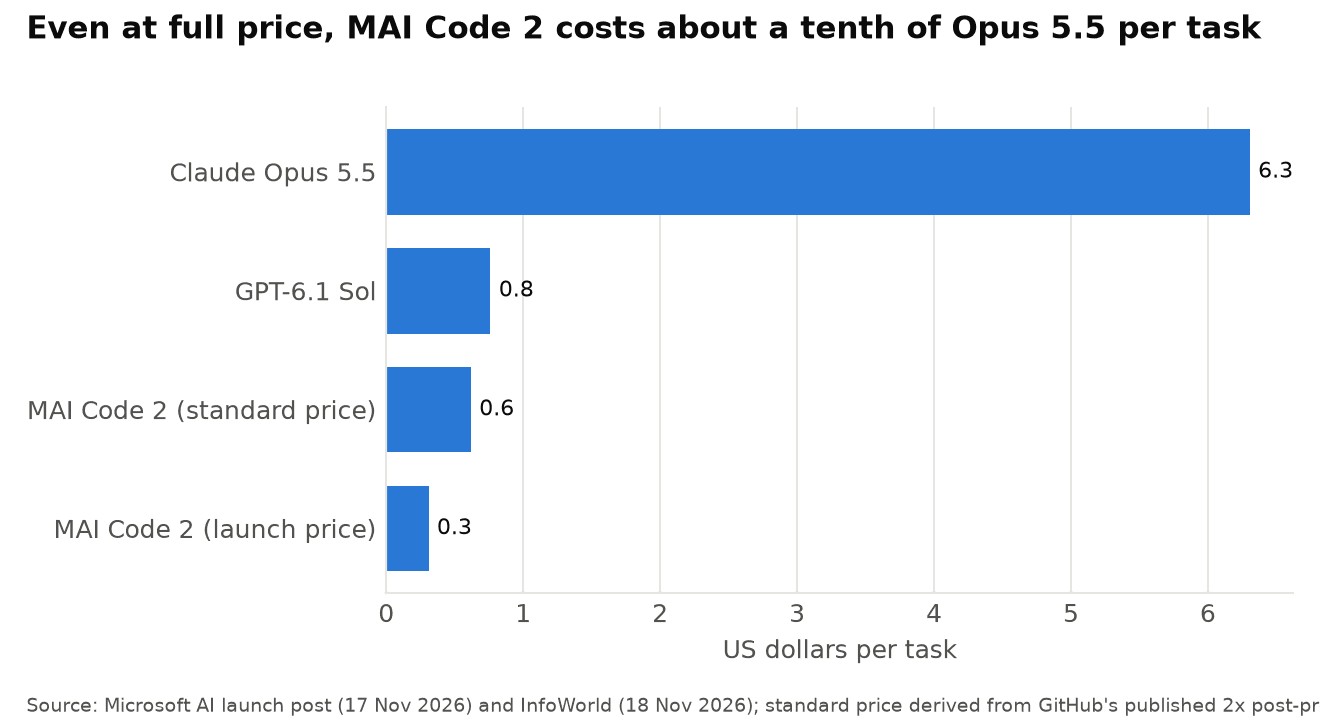
Microsoft says MAI Code 2 costs 5% as much per coding task as Claude Opus 5.5 and scores 96% as well on its benchmarks (Microsoft AI, 17 Nov 2026). That cost figure uses a 50% launch price, which GitHub says ends on 17 May 2027. At the standard price the cost is closer to 10% of Opus. That is still a big saving, but it is not the headline number.
17 May 2027
Date the 50% launch discount on MAI Code 2 ends in GitHub Copilot
Source: GitHub Copilot models and pricing, checked 25 Nov 2026
At a glance
MAI Code 2 averaged 63.2% across four coding benchmarks. Claude Opus 5.5 averaged 65.3% and GPT-6.1 Sol 64.1% (Microsoft figures, 17 Nov 2026).
The launch price in GitHub Copilot is US$0.50 per million input tokens and US$2.50 per million output tokens. Both double on 17 May 2027 (GitHub, checked 25 Nov 2026).
On Microsoft's own numbers, MAI Code 2 Flash will cost more per task than GPT-6 Luna once the discount ends.
Microsoft's cloud prices in Australian dollars fall by 4% from 1 January 2027 (Microsoft Partner Center, 11 Nov 2026).
On 10 Nov 2026 the Australian Government proposed mandatory safety rules for frontier AI companies, enforced by a new regulator (PM release).
Is MAI Code 2 really 5% of the cost?
Partly. The 5% is real, but it rests on two conditions most headlines left out. It uses a half-price launch rate, and it is an average across four benchmarks that Microsoft picked.
Microsoft's own footnote says the cost is shown "at its 50% promotional price". GitHub's pricing page sets the end date: from 17 May 2027, MAI Code 2 goes from US$0.50 to US$1.00 per million input tokens and from US$2.50 to US$5.00 per million output tokens. If a task uses the same number of tokens, its cost doubles. That moves the comparison with Opus 5.5 from about 5% to about 10%, and with GPT-6.1 Sol from about 40% to about 81%.
So what: the real advantage over Opus is large and lasting. The advantage over GPT-6.1 Sol mostly ends when the discount does.
The Flip
Ignite headlines treated this as a price war that businesses should join right away. Many teams will either switch every developer to the new model this week or dismiss it as Microsoft marketing. Both reactions miss what the sale tag shows. Microsoft has put a model in front of you at half price with a clear end date, so you have six months to test it on your own code at low cost.
Used that way, the end date helps you. By 17 May 2027 you can know your own cost per task and acceptance rate, so you aren't relying on Microsoft's numbers. Most businesses will not do that measuring. The ones that do can decide with evidence, while the rest react to the next launch.
What most people see | What a calm business owner sees |
|---|---|
"5% of the cost of Opus" | About 10% at standard price, on benchmarks Microsoft chose |
A reason to switch now | A six-month window to test cheaply |
Microsoft against OpenAI and Anthropic | One more model to route work to, not a platform decision |
A cheaper option for everything | Microsoft says it is "not yet tuned" for very long agentic work |
When the flip is wrong. If your developers already spend a lot each month on Opus-class models for everyday edits, waiting six months to compare costs you real money. In that case, move routine tasks to MAI Code 2 now and keep measuring as you go. The flip also matters less if you never pay per token, for example if your team only uses Copilot features bundled in a plan.
How close is the performance gap?
Close on average, with wider differences on individual tests. Across DeepSWE 1.1, Terminal-Bench 2.1, SWE-Atlas and FrontierCode v1.1, Microsoft reports 63.2% for MAI Code 2, 64.1% for GPT-6.1 Sol and 65.3% for Claude Opus 5.5.
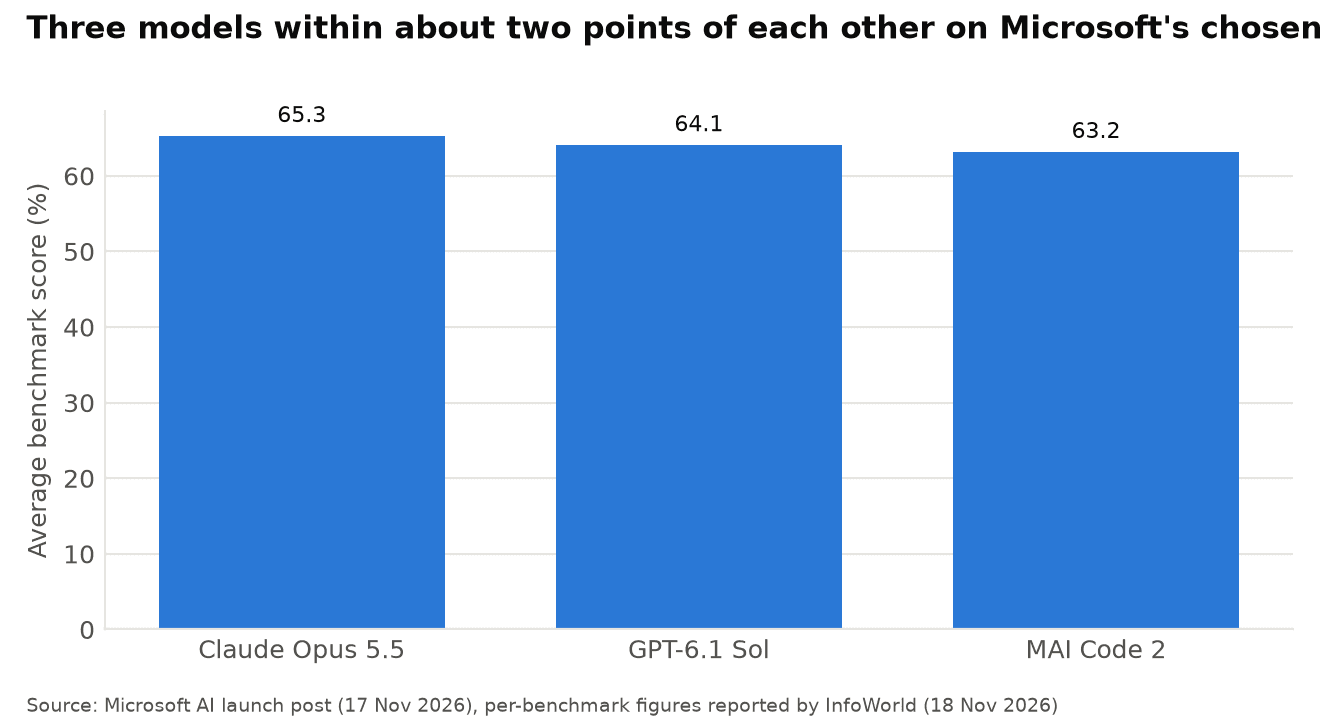
The averages hide differences between tests. On SWE-Atlas, InfoWorld's breakdown of Microsoft's data puts MAI Code 2 at 43.1 and Opus 5.5 at 57.5. On Terminal-Bench 2.1, MAI Code 2 scores 84.6 and Opus 78.7. Microsoft also says the coding models are "not yet tuned" for fundamental science research or very long-horizon agentic work.
So what: test MAI Code 2 on your own kinds of tasks, because a two-point average gap can hide a 14-point gap on the work you care about.
What about the cheaper Flash model?
This is where the sale tag matters most. Microsoft's Foundry update puts MAI Code 2 Flash at about 61% on three benchmarks for about 5 cents per task, against 55% at 8 cents for GPT-6 Luna, on promotional pricing.
Model | Avg score (3 benchmarks) | Cost per task, launch price | Cost per task, from 17 May 2027 |
|---|---|---|---|
MAI Code 2 Flash | 61% | US$0.052 | about US$0.104 |
GPT-6 Luna | 55.1% | US$0.080 | US$0.080 (no promotion) |
Claude Haiku 5.5 | 53.9% | US$0.319 | US$0.319 (no promotion) |
GitHub lists Flash at US$0.05 input and US$0.25 output per million tokens until 17 May 2027, then US$0.10 and US$0.50. After that date, on Microsoft's own task costs, Flash costs about 30% more per task than Luna while scoring about six points higher.
So what: Flash is a quality choice, not simply the cheap option, once the launch window closes.
What else from Ignite matters in Australia?
Two things matter, and neither is a new model. First, Microsoft's Partner Center notice of 11 Nov 2026 cuts commercial cloud prices in Australian dollars by 4% from 1 January 2027. Microsoft now resets local-currency prices every January, so the AUD price can rise as well as fall in future years. GitHub lists the MAI model prices in US dollars, so the AUD change does not affect those per-token rates.
Second, availability and location. GitHub says MAI Code 2 is available on Copilot Pro, Pro+, Max, Business and Enterprise plans, and Flash on those plans plus Free and Student. In Microsoft Foundry, MAI Code 2 is "coming soon" and Flash is in limited-access preview. "Licensed Weights", which lets a business customise a Microsoft model and run it in its own Azure environment, is also "coming soon" through Microsoft's Frontier Company program. None of Microsoft's launch pages mention an Australian data-processing location for these models, as of 25 Nov 2026.
On policy, the Prime Minister's 10 Nov 2026 release proposes six mandatory obligations for frontier AI companies, including rapid incident notification. A new regulator would enforce them. These duties fall on model makers, not on businesses that use their tools, but they show what Canberra now expects of AI vendors.
So what: check where your code is processed before you route client or sensitive repositories to any new model.
What happens after 17 May 2027?
Scenario, not prediction. The table models a hypothetical team running 1,000 agent coding tasks a month at Microsoft's published average cost per task. Your token use per task will differ from these benchmark averages.
Scenario | Assumption | MAI Code 2 monthly cost | Compared with GPT-6.1 Sol (US$761) |
|---|---|---|---|
Low | Microsoft extends the launch price or cuts list prices | US$309 | about 40% of Sol |
Base | Standard price applies from 17 May 2027 as published | US$618 | about 81% of Sol |
High | Standard price, and your tasks use 50% more tokens than the benchmark average | US$927 | about 22% more than Sol |
The same 1,000 tasks on Claude Opus 5.5 would cost about US$6,306 at Microsoft's figure. So the saving over Opus holds in every scenario. The saving over GPT-6.1 Sol depends on the scenario and can disappear.
Several things would change this view. Rival price cuts would. So would independent benchmark results, since Microsoft's figures are self-reported and no independent validation had been published when we checked. An Australian data-processing option in Foundry would change it for businesses with client confidentiality obligations. The January 2028 AUD reset matters for anything billed in Australian dollars.
What should your business do now?
List your AI coding spend. Record how much your team spent on model usage last month, by model and by plan.
Pick 20 to 50 real tasks. Use routine bug fixes, front-end changes and test writing from your own repositories, not benchmark-style puzzles.
Run them on MAI Code 2 and your current model. Track cost per task, time taken and whether a developer accepted the change without rework.
Set a model policy. Copilot Business and Enterprise admins can control which models staff can use. Approve new models before they go into client work.
Check data location and contracts. Confirm where prompts and code are processed, and whether client agreements limit offshore processing.
Put 17 May 2027 in the calendar. Make the keep, route or drop decision by early May, using your own numbers.
Review Microsoft renewals against 1 January 2027. Ask your reseller whether the 4% AUD change applies at your next renewal.
Watch out: Benchmarks are self-reported by Microsoft and averaged across tests it chose. Prices double on 17 May 2027. Microsoft says the models are not yet tuned for very long agentic tasks. No Australian data-processing location had been stated for these models as of 25 Nov 2026. Do not route sensitive client code to any new model until you have checked these points.
If you want help setting up a fair model trial, routing policy or cost dashboard, our AI automation services team can design it with your developers. For the security side, see our cybersecurity services.
Frequently asked questions
What is Microsoft MAI Code 2?
MAI Code 2 is a coding model built by Microsoft AI and launched at Ignite on 17 November 2026, together with a smaller MAI Code 2 Flash. Both are available in GitHub Copilot. Microsoft says MAI Code 2 reaches 96% of Claude Opus 5.5's average benchmark score and 98% of GPT-6.1 Sol's, on four coding benchmarks it chose.
How much does MAI Code 2 cost?
GitHub lists MAI Code 2 at US$0.50 per million input tokens and US$2.50 per million output tokens until 17 May 2027. From that date the standard price is US$1.00 and US$5.00. Flash is US$0.05 and US$0.25 until then, rising to US$0.10 and US$0.50. Prices are in US dollars.
Can Australian businesses use MAI Code 2 today?
Yes, through GitHub Copilot plans that include it. MAI Code 2 is listed for Pro, Pro+, Max, Business and Enterprise, and Flash also for Free and Student. In Microsoft Foundry, Code 2 is "coming soon" and Flash is in limited preview. Microsoft had not stated an Australian processing location as of 25 November 2026.
Should we switch from Claude or GPT models?
Don't switch everything at once. Run a side-by-side trial on your own routine tasks and measure cost and accepted changes. Many teams will end up routing everyday edits to the cheaper model and keeping a premium model for complex or long-running work. Base that split on your own results, not on launch headlines.
Does Microsoft's 4% Australian price cut apply to AI models?
Microsoft's notice cuts commercial cloud prices in Australian dollars by 4% from 1 January 2027, with small differences by product. GitHub lists the MAI coding model prices in US dollars, so those per-token rates are not changed by it. Ask your reseller how the cut applies to your Azure or Microsoft 365 renewal.
Do the new Australian AI rules affect my business?
The 10 November 2026 proposal targets frontier AI companies that operate in Australia, not businesses that use their tools. Legislation details had not been released when we checked. Good practice for users is still to keep an approved-model list, check data location and record how AI-generated code is reviewed.
The takeaway: A launch discount is a free trial with an end date. Australian businesses that use the next six months to measure their own cost per task will keep the savings, and the rest will be chasing the next headline. Read the sale tag, then run the test.
Sources and method
Source | What it gave | Data date |
|---|---|---|
Performance and cost ratios, 50% promotional price footnote, limitations | 17 Nov 2026 | |
Model line-up, availability in GitHub Copilot | 17 Nov 2026 | |
Per-million-token prices, promotion end date of 17 May 2027 | Checked 25 Nov 2026 | |
Plan availability, admin model policy | 17 Nov 2026 | |
Foundry availability, Flash and Luna cost per task | 24 Nov 2026 | |
Licensed Weights status and terms | 17 Nov 2026 | |
Per-benchmark scores and average cost per task, as reported from Microsoft's data | 18 Nov 2026 | |
AUD commercial cloud price change of -4% from 1 Jan 2027 | 11 Nov 2026 | |
January price reset policy | 8 Jul 2026 | |
Prime Minister: New Australian AI safety and security protections | Proposed regulator and six obligations for frontier AI companies | 10 Nov 2026 |
Method. The standard-price cost per task is our calculation. We doubled Microsoft's promotional cost per task, in line with GitHub's published doubling of token prices, assuming each task uses the same number of tokens. The scenario table uses a hypothetical 1,000 tasks a month and is illustrative, not a quote. All benchmark results are Microsoft's own and had not been independently verified when we checked.
This article is general information about technology products and pricing, current as of 25 November 2026. It is not legal, financial or procurement advice. Prices, availability and regulations change; check the vendor's current pricing and terms and seek advice specific to your business before making decisions.
If your business is weighing up new AI coding tools, Genuine Solutions can help you test them fairly, set sensible usage policies and keep costs visible. Talk to our technology team about your next step.