


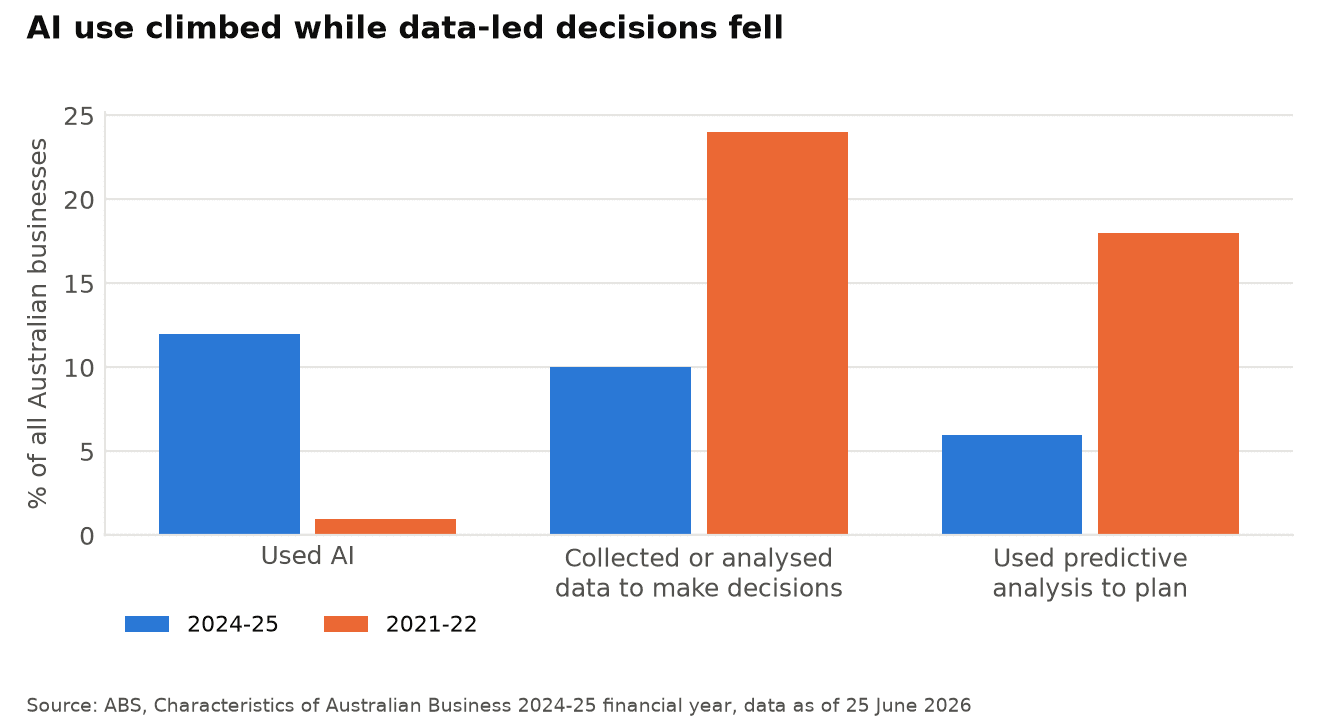
In 2024-25, 12% of Australian businesses used artificial intelligence, up from 1% in 2021-22. Over the same period, the share that actively collected or analysed data to make informed decisions fell from 24% to 10%. Both figures come from the ABS Characteristics of Australian Business release of 25 June 2026. For business process automation in Australia, that gap matters more than the AI headline.
10%
Businesses that actively collected or analysed data to make informed decisions in 2024-25, down from 24% in 2021-22
Source: Australian Bureau of Statistics, released 25 June 2026
At a glance
12% of Australian businesses used AI in 2024-25, up from 1% in 2021-22 (ABS, 25 June 2026).
10% actively collected or analysed data to make informed decisions in 2024-25, down from 24% in 2021-22.
6% used predictive analysis to plan business activities in 2024-25, down from 18% in 2021-22.
28% of businesses reported no measures in place to prevent cyber security incidents in 2024-25.
From 10 December 2026, privacy policies must disclose certain automated decisions that use personal information (OAIC).
Is your business behind on automation, or just on the wrong step?
Most of the market is chasing the tool. Vendors launch agents every week. Owners pay for "AI driving schools" because they worry about falling behind. And the adoption figure gets quoted as proof that everyone else is moving faster.
Think of automation as a tap. AI is the shiny new tap fitting. The data in your business is the plumbing behind the wall, and the ABS figures suggest that plumbing has been neglected while new fittings went on. A tap on a weak pipe gives you a trickle, or a leak.
A calm owner reads the same release and sees an opening. If only one business in ten is disciplined about using its own data, the business that cleans up its records, standardises its inputs and checks one decision metric every month is ahead of most of the market. It gets there before it automates anything.
What most people see | What a calm business owner sees |
|---|---|
AI use jumped twelvefold, so we are late | Only 10% use data to decide, so the foundations are wide open |
Buy an AI tool and automate a process | Fix the process inputs first, then automate the hand-off |
Automation saves time on day one | Automation repeats whatever the data says, mistakes included |
Privacy is a later problem | The automated-decision rules start on 10 December 2026 |
When the flip is wrong. The fall from 24% to 10% may partly reflect how businesses answer the survey rather than a real collapse in data use. The ABS notes that its technology question records which technologies a business uses, not how intensively it uses them. Accounting and booking platforms now produce reports automatically, so some owners may use data without thinking of it as "collecting or analysing" it. If your systems already give you clean, trusted numbers every week, you are not the business this flip is about. Go ahead and automate.
What did the ABS actually measure?
The ABS measured technology use, data practices and innovation across nearly 7,000 businesses. Responses were collected online between October 2025 and February 2026 and cover the 2024-25 financial year. The survey runs every two years, so 2021-22 is the comparison point for most of the technology figures.
Measure (% of all businesses) | 2021-22 | 2024-25 |
|---|---|---|
Used artificial intelligence | 1 | 12 |
Actively collected or analysed data to make informed decisions | 24 | 10 |
Used predictive analysis to plan business activities | 18 | 6 |
Measured the contribution of digital activities to performance | 3 | 7 |
The rise in measuring digital performance from 3% to 7% is a small sign of progress. It still means more than nine in ten businesses do not measure what their digital tools return.
So what: adoption of the tool has run ahead of the habit that makes the tool useful.
Why do innovating businesses get more out of AI?
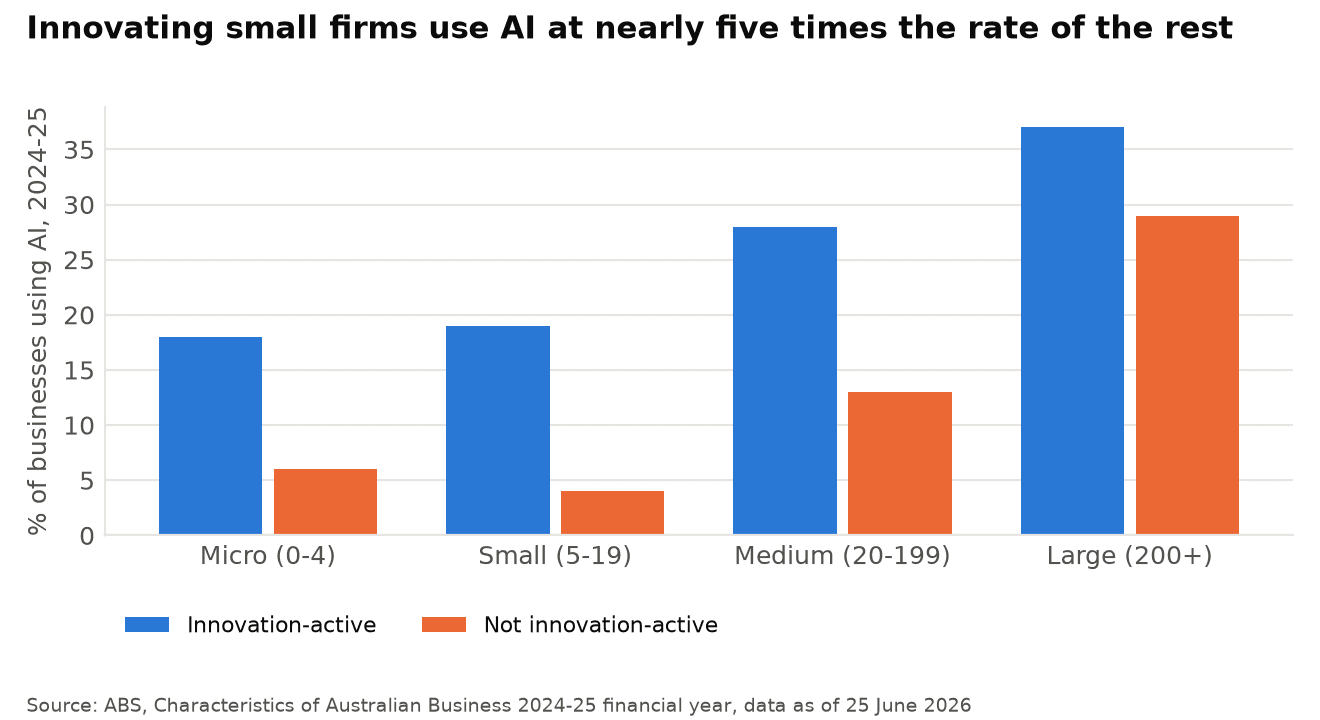
Innovating businesses use AI at much higher rates, and the gap is widest among small firms. The ABS found that 20% of innovation-active businesses used AI in 2024-25, against 6% of businesses that were not innovation-active. Among small businesses (5 to 19 people), innovators used AI at 19%, almost five times the 4% rate of non-innovators.
The useful part is the word "process". Among small businesses, 38% introduced or worked on a new process in 2024-25, according to the same release. A business that redesigns how work flows can see where structured data exists and where a rule could take over. A business that bolts a tool onto an unchanged process usually finds the data is not ready.
So what: automation follows process change. A business that has not looked at its processes is not ready to automate them.
What does weak data cost when you automate?
Weak data costs you in three places: security, skills and compliance. Automation joins systems together, so a gap in one place reaches every workflow connected to it.
Pressure point | ABS or OAIC figure | Why it matters for automation |
|---|---|---|
Cyber security incidents | 21% of businesses in 2024-25 | Automated workflows can spread compromised data faster than manual ones |
No preventive cyber measures | 28% of businesses in 2024-25 | Connecting systems without basic controls widens the attack surface |
Staff skills barrier to technology use | 16% of businesses | Someone has to own the data rules after the vendor leaves |
Uncertainty about costs and benefits | 13% of businesses | Without a baseline metric, the return cannot be shown |
Automated decision transparency | From 10 December 2026 | Privacy policies must describe certain computer-made decisions |
The privacy point has a deadline. Under amendments made by the Privacy and Other Legislation Amendment Act 2024, entities covered by the Privacy Act must explain in their privacy policy when a computer program makes, or substantially and directly informs, a decision that could significantly affect a person's rights or interests using their personal information. The OAIC confirms these obligations start on 10 December 2026. They apply to decisions made from that date, even if the automation was set up earlier.
If you want the wider picture on that change, our guide to what AI regulation changes for Australian small businesses covers it.
So what: know your data before you automate. Otherwise you cannot secure it, run it well or explain it to the regulator.
Where could business data habits head next?
The ABS has said the 2026-27 Business Characteristics Survey will include more questions on AI. That makes it the next official checkpoint. There are only two comparable data points for data-informed decisions, so the outlook below is a scenario table, not a trend line. Scenario, not prediction.
Scenario | Data-informed decisions, next ABS reading | Assumptions |
|---|---|---|
Low | About 10%, flat | AI tools are bought as add-ons. Owners rely on built-in dashboards and do not report active analysis. Cost pressure keeps budgets on survival rather than systems. |
Base | 12% to 15% | Privacy transparency rules from 10 December 2026 push businesses to document which data drives which decision. More vendors ship reporting by default, and some owners start using it on purpose. |
High | Back towards 20% or more | Firms that adopted AI in 2024-25 find that results depend on data quality. They invest in clean records, single sources of truth and monthly review, and the ABS's added AI questions capture that work more clearly. |
The ABS release also shows wider strain. In 2024-25, 42% of businesses said uncertainty about economic conditions significantly hampered their activity, up from 36% in 2021-22. That pressure works both ways. It can cut spending on systems, or it can push owners towards automation that removes repetitive admin.
Three things would change this view: a change to the survey question wording, a large government program for SME digital capability, or a major data breach that makes owners rethink connected systems.
How should you prepare your data before you automate?
Start with one workflow and get its data right before any automation goes near it. This checklist works for a trade business, a clinic, a professional practice or a distributor.
Pick one workflow with a clear hand-off. Quote to job, enquiry to booking, or invoice to payment. Write down every step and who touches it.
Find the single source of truth. Decide which system holds the master record for customers, jobs and prices. Duplicates in spreadsheets are where automation breaks.
Standardise the inputs. Use set fields, dropdowns and naming rules, so the data a rule reads is the same every time.
Set one decision metric and review it monthly. Turnaround time, error rate or days to payment. This is your baseline for showing a return.
Then automate the hand-off, not the judgement. Let software move, copy and remind. Keep people on decisions that affect customers or staff until the data has proven reliable.
Check the privacy trigger. If the automation substantially informs decisions that could significantly affect individuals using personal information, update your privacy policy before 10 December 2026.
Protect the plumbing. Apply the ACSC's Essential Eight basics, especially multi-factor authentication, restricted admin access and regular backups, before you connect systems.
Watch out: Automation copies whatever is in the source data, at speed. If customer records are duplicated, prices are out of date or access is shared across staff, an automated workflow will spread those errors and exposures across every system it touches. Test with a small batch, keep a manual override, and check the outputs weekly for the first month.
If you want help mapping a workflow and its data before you commit to a platform, our AI and automation services and data analytics services start from the process, not the tool. For the security side, see our cybersecurity services.
FAQ
Are Australian businesses behind on AI?
Not by as much as headlines suggest. The ABS found 12% of businesses used AI in 2024-25. Use was higher among large businesses and in information, media and telecommunications. Most small and micro businesses had not adopted AI yet. That gives owners time to get their data foundations right before they choose a tool. Our breakdown of the 12% AI adoption figure goes further.
Why did data-informed decision making fall from 24% to 10%?
The ABS reports the fall but does not explain it. Possible reasons include economic pressure on owners' time and changes in how businesses read the question. Another is that reporting is now built into everyday software, so owners may not count it as analysis. Whatever the cause, active use of data is now uncommon.
What is the difference between automation and AI?
Automation follows set rules, such as "when an invoice is paid, update the job and email the customer". AI makes predictions or generates content from patterns in data. Many useful small business gains come from simple rule-based automation, which depends just as heavily on clean, consistent data.
Do the automated decision-making privacy rules apply to my business?
They apply to entities covered by the Privacy Act. They are triggered when a computer program makes, or substantially and directly informs, a decision that could significantly affect a person's rights or interests using their personal information. The obligations start on 10 December 2026. Check the OAIC guidance and get advice if you are unsure.
What is the first workflow a small business should automate?
Choose a repetitive hand-off with clear inputs and a measurable result, such as enquiry to booking or invoice to payment reminder. Avoid workflows that decide outcomes for customers or staff until your data has been reliable for several months.
The takeaway: The race everyone is watching is AI adoption. The race that pays is data discipline, and only one business in ten has entered it. Fix the pipes, then fit the tap.
Sources and method
Source | What it gave | Data date |
|---|---|---|
ABS, Characteristics of Australian Business, 2024-25 financial year | AI use, data-informed decisions, predictive analysis, digital performance measurement, AI by size and innovation status, cyber incidents and measures, barriers to technology use, economic uncertainty | Released 25 June 2026; reference period 2024-25 |
ABS media release, Business adoption of Artificial Intelligence accelerates in 2024–25 | AI use (12%, from 1% in 2021-22), survey size and collection period, planned AI content in the 2026-27 survey | 25 June 2026 |
ABS, Characteristics of Australian Business, 2021-22 financial year | 2021-22 AI use (1%), cyber incidents (22%), barriers to technology use | 2021-22 reference period |
OAIC, New resources on transparency for use of AI and automated decision-making | Automated decision-making privacy policy obligations and the 10 December 2026 start date | Checked 26 November 2026 |
Federal Register of Legislation, Privacy and Other Legislation Amendment Act 2024 | Legal basis for APP 1.7 to 1.9 | Assented 10 December 2024 |
Baseline security controls referred to in the checklist | Checked 26 November 2026 |
All percentages are shares of all Australian businesses as reported by the ABS, unless a table says otherwise. The ABS technology question records which technologies a business uses, not how intensively it uses them. Some comparisons cross a change in the survey's reference period, so read movements as indicative. The forecast is a scenario table built from two official data points and stated assumptions. It is not a statistical projection.
This article provides general information only and does not constitute legal, privacy, cybersecurity or financial advice. Requirements can change and depend on your circumstances; please seek professional advice before acting.
If your business wants to automate without moving messy data faster, Genuine Solutions can help you map one workflow, tidy the data behind it and choose automation that fits. Talk to our technology team about where to start.