

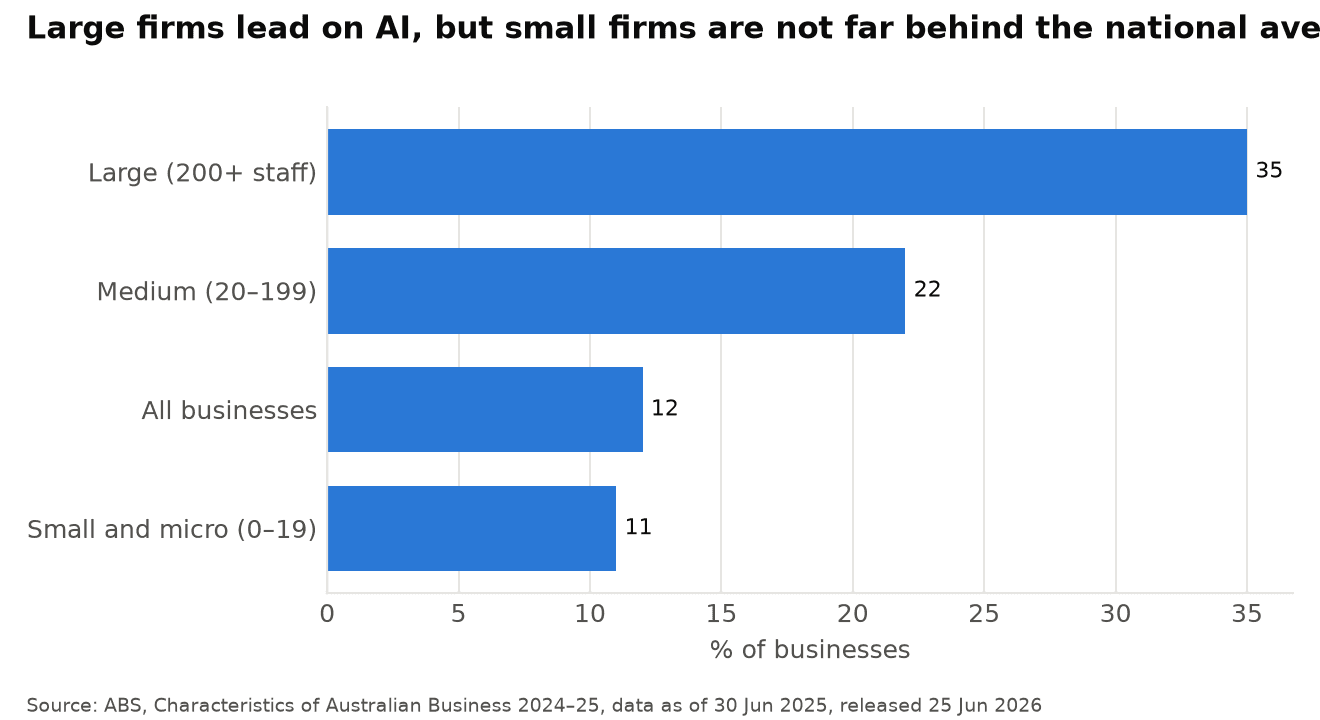
Around 12% of Australian businesses used artificial intelligence in 2024–25, according to the Australian Bureau of Statistics (ABS). The figure comes from its Characteristics of Australian Business release of 25 June 2026. For small and micro businesses, the share was about 11%. If you run an SME and feel late to automation, the official data says most of your peers have not started either.
11%
Small and micro businesses using AI in 2024–25
Source: ABS, Characteristics of Australian Business, released 25 Jun 2026
At a glance
About 12% of Australian businesses used AI in 2024–25 (ABS, released 25 Jun 2026).
Large businesses reached 35% in 2024–25, up from 9% in 2021–22.
Innovation-active businesses used AI at 20%, against 6% for those not innovating (2024–25).
The most common limits on technology use were staff skills (16%) and uncertainty about costs and benefits (13%) in 2024–25.
21% of businesses reported a cyber security incident in 2024–25.
What does the 12% figure really tell an SME owner?
It tells you that the race most headlines describe is not happening at your level yet. Vendor launches, conference talks and LinkedIn feeds make it sound as if every competitor already has an AI agent answering emails and reconciling invoices. The ABS asked nearly 7,000 businesses, and the answer for 2024–25 was about one in ten.
Fair point: adoption is rising quickly. Large firms went from 9% to 35% in three years, and that pace will reach smaller businesses. But the picture for most SMEs is a staircase, not a lift. The firms that do well will take one step they can measure, then the next.
What most people see | What a calm business owner sees |
|---|---|
"Everyone is using AI and I'm behind." | About 11% of small and micro businesses used AI in 2024–25. Most have not started. |
"I need a big AI platform." | The top barriers were skills (16%) and cost uncertainty (13%). Both shrink with one small, well-measured workflow. |
"Automation is a tech purchase." | Automation is a process change with a security footprint. 21% of businesses reported a cyber incident in 2024–25. |
"Waiting is risky." | Rushing without a business case is riskier. Starting deliberately in 2026 still puts you ahead of most peers. |
When the flip is wrong. The calm reading does not hold everywhere. In information media and telecommunications, 38% of businesses already used AI in 2024–25. Professional services and finance were both at 24%. If you compete in those sectors, or your clients are large firms that expect automated service, you may already be behind the businesses you are measured against.
Which businesses are actually using AI?
Use is concentrated in knowledge-heavy industries. In physical, site-based work it is still rare. The ABS industry table shows a wide spread, from 38% in information media and telecommunications down to 1% in transport, postal and warehousing.
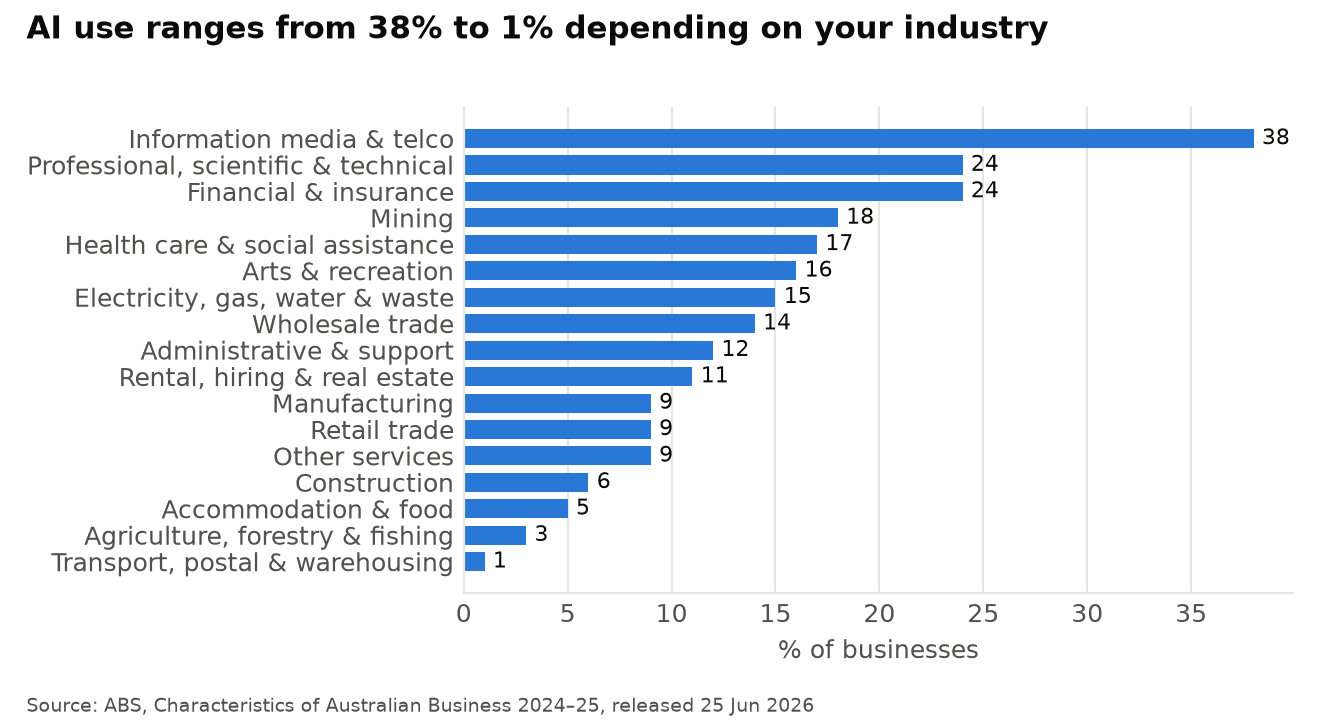
Construction sat at 6% and accommodation and food services at 5%. In these industries, a single well-built automation, such as job scheduling, supplier invoice capture or rostering, can be a real point of difference.
So what: compare yourself with your own industry, not with the tech press.
Is it business size or mindset that drives adoption?
Mindset matters at least as much as headcount. The ABS split AI use by innovation status, meaning whether a business was actively introducing or developing new products or processes. The gap at the small end is striking.
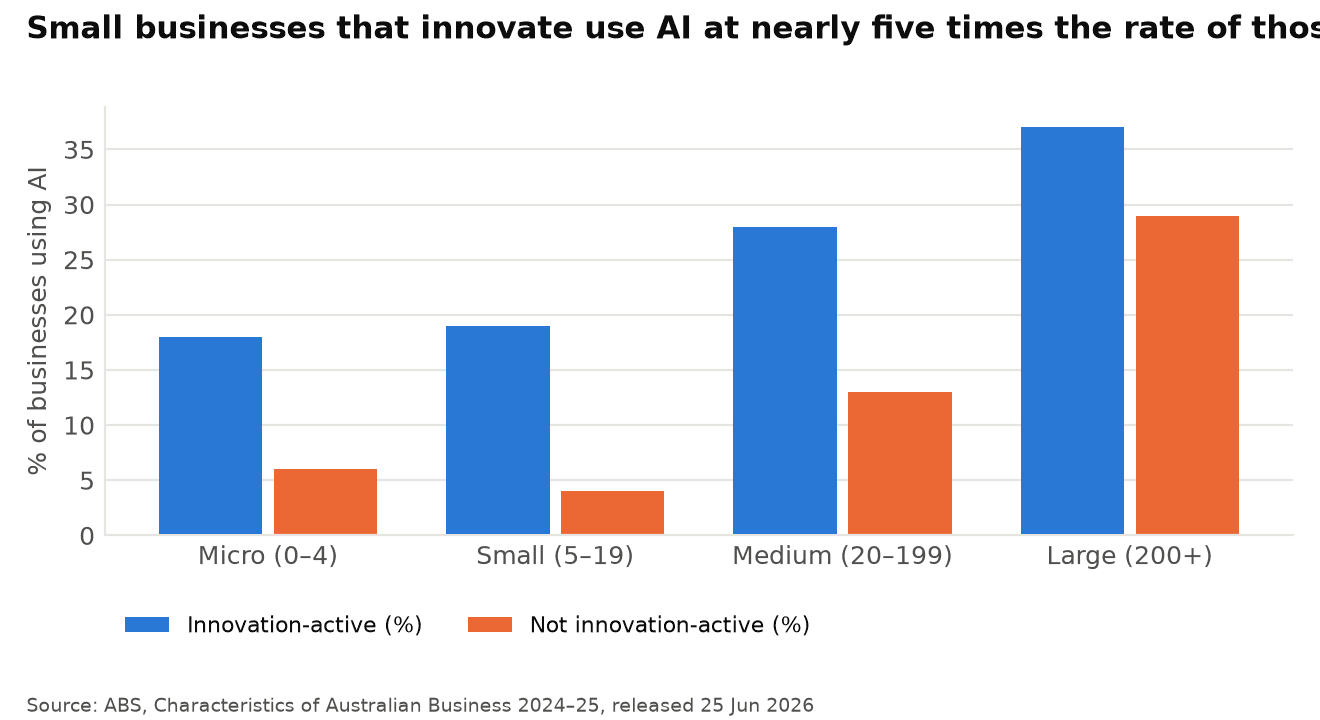
Among small businesses with five to 19 staff, 19% of innovators used AI. Among non-innovators, it was 4%. Once you reach 200 staff the gap narrows a lot, to 37% against 29%.
So what: in a small business, AI use follows a habit of improving processes. That habit costs nothing to start.
Does automation add cyber risk?
Yes. Every automation connects systems, holds credentials and moves data without a person watching each step. The ABS found 21% of businesses reported a cyber security incident in 2024–25, close to 22% in 2021–22.
Of the businesses affected, 63% reported an adverse impact. Loss of time was the most common, at 36%, followed by financial loss at 18%. Downtime of service, at 17%, matters most for automation, because a stopped integration can stop invoicing or bookings with it.
Cyber measure, ABS 2024–25 | Share |
|---|---|
Businesses reporting a cyber security incident | 21% |
Affected businesses reporting an adverse impact | 63% |
Impact: loss of time | 36% |
Impact: financial loss | 18% |
Impact: downtime of service | 17% |
Businesses with no cyber security prevention measures | 28% |
The last row is the one to act on. More than a quarter of businesses, 28%, had no prevention measures in 2024–25. Automation built on that foundation creates new ways in for attackers. Our cybersecurity services and our guide to ransomware recovery for small businesses cover the basics to get in place first.
So what: secure the foundation before you build on it.
Where could small-business AI use be by the next ABS survey?
Scenario, not prediction. The ABS runs this survey every two years, and the next cycle covers 2026–27. That gives us two clear data points, not a trend line. The table below shows the share of small and micro businesses using AI under three stated assumptions, starting from about 11% in 2024–25.
Scenario | Small and micro AI use, 2026–27 | Assumption |
|---|---|---|
Low | About 13% | Skills and cost uncertainty stay the main barriers, and adoption grows about 1 point a year |
Base | About 17% | Small firms move at half the pace medium firms showed between 2021–22 and 2024–25, about 3 points a year |
High | About 24% | Small firms match the pace medium firms showed (3% to 22% in three years), about 6 points a year |
Even the high scenario leaves three in four small businesses without AI in 2026–27. The staircase gets busier, but the stairs are still mostly empty. A business that automates one or two workflows well over the next 12 months would still be ahead of most peers in every scenario.
Several things would change this view. The ABS has said it will add new AI content to the 2026–27 survey, so its definitions may shift and make the comparison less direct. Cheaper tools bundled into accounting and CRM software could push results towards the high case. A major breach linked to AI tools, or tighter rules on automated decisions under the Privacy Act, could slow adoption towards the low case.
How do you take the first step without overspending?
Start with the two barriers the ABS measured: skills and cost uncertainty. Each step below addresses one of them, or the security gap.
Pick one workflow. Choose something repetitive, rule-based and frequent, such as supplier invoice entry, new-client onboarding, quote follow-ups or rostering. Avoid anything that needs judgement in every case.
Measure it before you touch it. Record the hours per week and the error rate for a fortnight. This is your baseline, and it answers the cost-and-benefit question with your own numbers.
Write a one-page business case. Compare hours saved times staff cost with subscription, setup and support. If it doesn't pay back within 12 months, choose another workflow.
Name an owner and train them. One person should understand how the automation works, how it fails and how to switch it off. That closes the skills gap one workflow at a time.
Secure the connection. Give the automation its own account with only the access it needs. Turn on multi-factor authentication, keep logs, and check your controls against the Australian Cyber Security Centre's Essential Eight on cyber.gov.au.
Map the personal information. List what customer or staff data the workflow touches. Confirm your obligations under the Privacy Act and the Notifiable Data Breaches scheme with the OAIC.
Plan the manual fallback. Write down how the work gets done if the tool is down for a day.
Review at 90 days. Compare against the baseline, then decide whether to extend, fix or stop.
If the workflow depends on clean reporting, our data analytics services can help you set the baseline before you automate.
Watch out: An automation runs with saved credentials and broad access, often 24 hours a day. If one integration is compromised, an attacker can reach every system it connects to. Don't connect tools to email, finance or customer records until multi-factor authentication, least-privilege access and logging are in place, and someone is responsible for reviewing them.
If your business is ready to automate a first workflow, Genuine Solutions can help you choose the right process, build the business case and set it up securely. Learn more about our AI and workflow automation services or contact our team to discuss your next step.
Frequently asked questions
How many Australian businesses use AI?
About 12% of Australian businesses reported using AI in 2024–25, according to the ABS Characteristics of Australian Business release of 25 June 2026. Use was higher in larger firms: around 35% of large businesses and 22% of medium businesses, against about 11% of small and micro businesses. The survey covered nearly 7,000 businesses.
Is my small business behind on automation?
Probably not, compared with your peers. About 11% of small and micro businesses used AI in 2024–25. The better comparison is your own industry, because rates ranged from 38% in information media and telecommunications to 1% in transport and warehousing. Measure yourself against direct competitors, not technology headlines.
What stops businesses from adopting AI and automation?
The ABS found the most common factors limiting technology use in 2024–25 were insufficient staff skills and capabilities (16%) and uncertainty about costs and benefits (13%). Both can be addressed by starting with one measured workflow, a written business case and a trained internal owner, rather than a large platform purchase.
What is the best first process to automate?
Choose a task that is repetitive, rule-based and frequent, with a clear right answer. Common examples are supplier invoice entry, client onboarding forms, quote follow-ups and rostering. Measure the current hours and errors first, so you can show whether the automation paid off after 90 days.
Does automation create privacy obligations?
It can. If an automated workflow collects, uses or shares personal information, the Privacy Act still applies, and a data breach may need to be reported under the Notifiable Data Breaches scheme. Map what personal data each workflow touches and check your obligations with guidance from the Office of the Australian Information Commissioner.
The takeaway: The 12% figure doesn't mean you're late. It shows the field is still open. Treat automation as a staircase, not a lift: one measured, secured workflow beats a platform you can't explain. The businesses that do best will be the ones whose automations they can still run by hand.
Sources and method
Source | What it gave | Data date |
|---|---|---|
ABS media release: Business adoption of Artificial Intelligence accelerates in 2024–25 | AI use overall and by size, 2021–22 comparison, innovation-status table | 2024–25, released 25 Jun 2026 |
ABS: Characteristics of Australian Business, 2024–25 financial year | AI use by industry, barriers to ICT use, cyber security incidents and impacts, prevention measures | 2024–25, released 25 Jun 2026 |
ABS: Characteristics of Australian Business methodology, 2024–25 | Sample of about 7,000 businesses, 87.9% response rate, size definitions, survey redesign | Reference year ended 30 Jun 2025 |
Essential Eight guidance (no figures used) | Accessed 25 Nov 2026 | |
Privacy Act and Notifiable Data Breaches guidance (no figures used) | Accessed 25 Nov 2026 |
All figures come from the ABS Business Characteristics Survey for 2024–25, which was redesigned as a two-yearly collection. One ABS page gives the earlier AI comparison year as 2022–23 in one place and 2021–22 in another. We used 2021–22, as stated in the ABS media release. The forecast scenarios are our own arithmetic from two ABS data points and stated growth assumptions, not ABS projections.
This article provides general information only and does not constitute legal, cyber security or financial advice. Consider your business's specific circumstances and seek professional advice before making technology or compliance decisions.