


A medium-sized Australian business now reports an average cybercrime cost of $141,300, up 45% in a year. That figure comes from the Australian Signals Directorate's (ASD) Annual Cyber Threat Report 2025–26, published on 26 October 2026. Over the same period the small business figure barely moved, at $55,400 per report.
$141,300
Average self-reported cost per cybercrime report, medium business, FY2025–26 (up 45%)
Source: ASD Annual Cyber Threat Report 2025–26, published 26 Oct 2026
At a glance
Medium businesses reported an average cost of $141,300 per cybercrime report in FY2025–26, up 45% (ASD, 26 Oct 2026).
Small businesses reported $55,400 per report in FY2025–26, close to the $56,600 recorded in FY2024–25.
Across all businesses, the average self-reported cost rose 16% to $93,500 in FY2025–26.
ASD's ACSC received more than 82,000 cybercrime reports in FY2025–26 and responded to more than 1,500 incidents, up more than 20%.
The government's release on the report names AI as the defining force in the threat landscape over the past year (26 Oct 2026).
What does the flip side of this report show?
Every October, the cyber threat report produces the same headlines. Costs are up, AI is making attackers faster and every business is a target. Most of that is true. Read the cost table by business size, though, and the story changes. Small business costs did not rise in 2025–26. Medium business costs did, by 45%.
This is the extension problem. A business adds staff, a second site, a new CRM, a payments integration and a few cloud apps, but keeps the locks it fitted when it had eight people. The building got bigger and the security stayed the same. The data points to the risk sitting less with being small than with growing faster than your controls.
What most people see | What a calm business owner sees |
|---|---|
"Cybercrime costs are up 16% for everyone" | The overall rise is driven by medium businesses; small business costs held steady |
"AI attacks mean we need an AI security product" | ASD's five recommended actions start with logging, legacy technology and suppliers |
"We're too small to be worth targeting" | Small businesses still average $55,400 per report, which is a serious loss for most owners |
"We'll fix security once we've grown" | The cost jump shows up exactly at the growth stage |
When the flip is wrong. These are averages of self-reported losses, and ASD itself calls the ReportCyber data a guide, not a complete measure. A few very large losses can pull an average up sharply. The large business figure jumped in FY2024–25 and then fell 27%, which shows how sensitive these numbers are. If your business is small and stable, your risk did not shrink just because the average held flat.
Why did medium business costs jump while small business held flat?
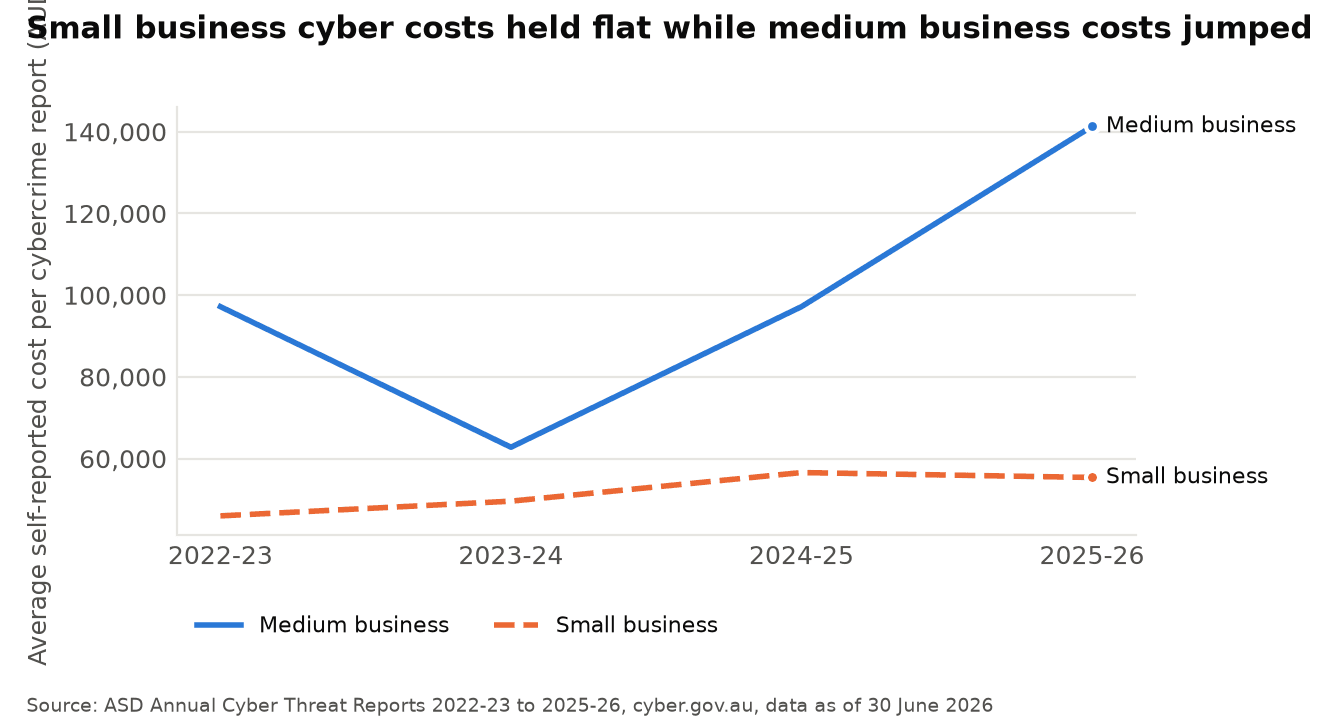
The report does not give one cause, so be careful with any explanation that claims to be the reason. What the numbers show is a widening gap. In FY2023–24, a medium business report cost about 1.3 times a small business report. By FY2025–26, it was about 2.6 times.
Financial year | Small business | Medium business | Medium ÷ small |
|---|---|---|---|
2022–23 | $46,000 | $97,200 | 2.1× |
2023–24 | $49,600 | $62,800 | 1.3× |
2024–25 | $56,600 | $97,200 | 1.7× |
2025–26 | $55,400 | $141,300 | 2.6× |
One plausible reading is that medium businesses have more money moving through more systems, so a single compromised mailbox or redirected invoice costs more. That is our interpretation, not ASD's finding.
So what: if your business is crossing from small to medium, plan security spending as part of the growth.
Where does the 2025–26 cost sit by business size?
Large businesses still report the highest average cost, but medium businesses are now close behind. The gap between them is $6,800 per report.
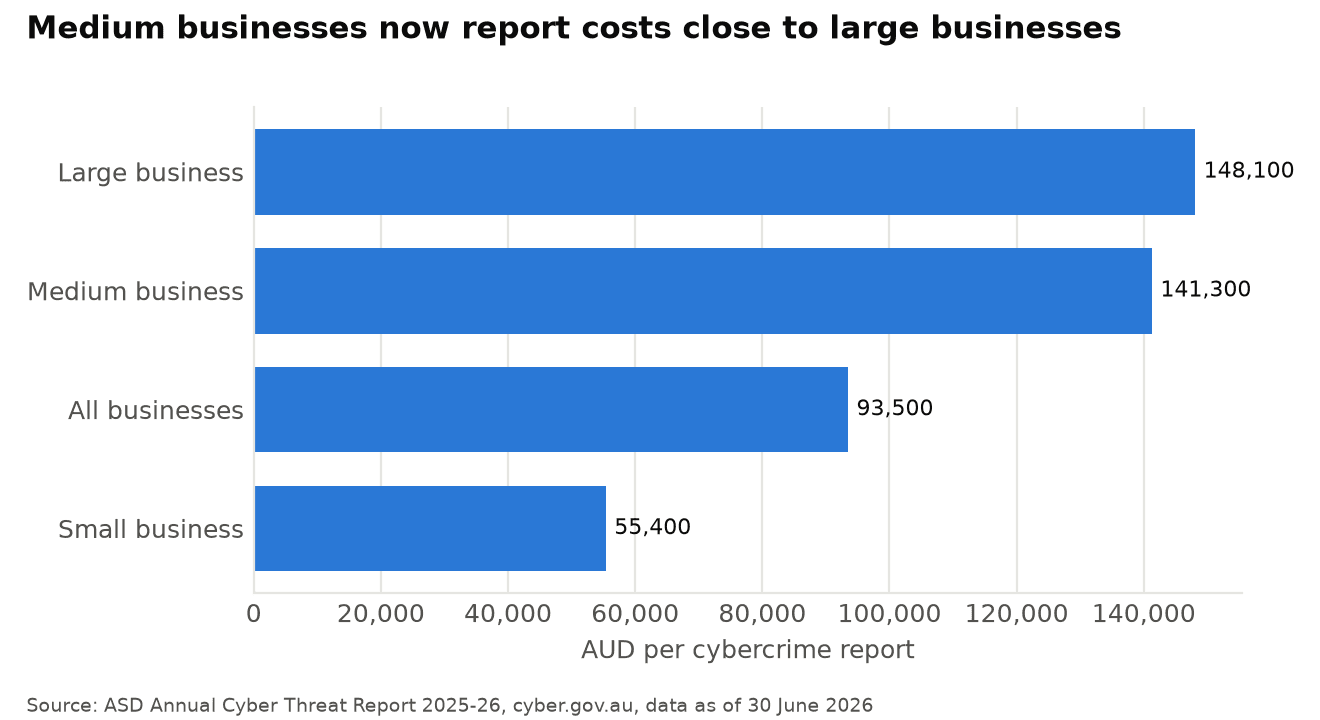
Large business fell 27% to $148,100, after the FY2024–25 report recorded $202,700. ASD noted at the time that low reporting numbers made the large business average sensitive to outliers. The same caution applies to every size band.
So what: treat these numbers as a direction of travel, not a quote for what an incident will cost you.
Is AI the main thing SMEs need to defend against?
AI matters, but ASD's own priority list starts with basics. The government's release on the report names AI as the defining force in the past year. It then lists five essential actions: logging cyber events, replacing legacy technology, managing supply chain risk, strengthening AI preparedness and preparing for quantum computing.
Fair point: AI lowers the effort attackers need to find and use weaknesses. But four of those five actions are about knowing what you run, who connects to it and what happened when something went wrong. For most SMEs, "AI preparedness" starts with knowing which AI tools staff already use and what data goes into them. Our AI and automation services begin with that same inventory step.
So what: buy visibility before you buy another tool.
What could the next report show?
Scenario, not prediction. The next Annual Cyber Threat Report will cover FY2026–27. With only four data points, a trend line would be guesswork, so the table below ties each scenario to a stated assumption.
Scenario | Assumption | Medium business average per report, FY2026–27 |
|---|---|---|
Low | 2025–26 was an outlier year; costs fall back toward the four-year average (about $99,600) | Around $95,000–$110,000 |
Base | Costs stay high as more medium businesses run cloud, payments and AI tools without matching controls | Around $125,000–$150,000 |
High | AI-assisted fraud and supply chain compromises scale up, as the report warns | Above $160,000 |
The small business figure has stayed between $46,000 and $56,600 for four years, so a sharp move would be news in itself.
What would change this view? A sharp rise in reported business email compromise losses would push us toward the high scenario. A fall in incident numbers in ASD's next report would support the low one. A change in how ReportCyber classifies business size would break comparisons with earlier years. Whatever happens, the building keeps growing, so security has to grow with it.
What should a growing SME do now?
Use this as a scorecard. If you cannot tick at least four, start with the first unticked item.
List what you run. Keep a current list of every system, cloud app and internet-facing service, including AI tools staff use.
Turn on logging and keep the logs. Make sure sign-ins, email rules and admin changes are recorded somewhere an attacker cannot easily delete.
Retire legacy technology. Replace or isolate software and devices that no longer get security updates.
Check your suppliers. Know which IT providers, payroll platforms and integrators have access to your systems, and what access they hold.
Lock down payments. Require a phone call to a known number before changing any supplier's bank details.
Test your plan. Run a short incident exercise and confirm you can restore from backup.
Our cybersecurity services and IT solutions teams work through these steps with SMEs. If you want to see your own incident and sign-in patterns, our data and analytics team can help you build a simple view.
Watch out: Average costs are self-reported and can be pulled up or down by a few large losses. No tool or provider can guarantee you will avoid an incident. If you suspect one, report it through ASD's ReportCyber at cyber.gov.au and contact your bank straight away if money has moved.
If your business has grown in the past two years and your security setup has not, Genuine Solutions can help you review your systems, close the gaps that matter most and plan upgrades alongside your growth. Talk to our team.
FAQ
What is the average cost of cybercrime for an Australian business?
ASD's Annual Cyber Threat Report 2025–26 puts the average self-reported cost per cybercrime report at $93,500 for businesses in FY2025–26, up 16%. By size, it was $55,400 for small businesses, $141,300 for medium businesses and $148,100 for large businesses. These figures come from reports made to ASD's ReportCyber.
Why did medium business cybercrime costs rise 45%?
ASD reports the increase but does not name one cause. One reasonable reading is that medium businesses run more systems and move more money than small ones, so each incident can cost more. Growth often adds staff, apps and suppliers faster than security controls are updated.
Is my small business safer because small business costs held flat?
Not necessarily. The small business average was $55,400 per report in FY2025–26, close to $56,600 the year before. That is still a significant loss for most small firms. A flat average shows that costs did not rise across the group, not that the risk to any one business has fallen.
What does ASD recommend businesses do?
The government's release on the report lists five essential actions: logging cyber events, replacing legacy technology, managing supply chain risk, strengthening AI preparedness and preparing for quantum computing. For most SMEs, the practical start is an up-to-date list of systems, logging that is turned on, supported software and clear payment-change checks.
Where can I report a cyber incident in Australia?
Report cybercrime and cyber incidents through ReportCyber on cyber.gov.au, run by ASD's Australian Cyber Security Centre. If money has been transferred, contact your bank immediately. Reporting helps you get advice, and it also feeds the data in reports like this one.
The takeaway: The data does not say small businesses are safe. It says growth is where the cost jumps. A business that adds staff, sites and apps without updating its security takes on risk with every new hire. Fit the locks while you build the extension, not after someone has walked in.
Sources and method
Source | What it gave | Data date |
|---|---|---|
Average cost per report by business size, 82,000+ cybercrime reports, 1,500+ incidents | FY2025–26, published 26 Oct 2026 | |
Confirmation of business cost figures | FY2025–26 | |
$93,500 business average, 1,500+ incidents, five essential actions, AI framing | 26 Oct 2026 | |
FY2024–25 small, medium and large business costs | FY2024–25 | |
FY2023–24 and FY2022–23 business cost figures | FY2023–24 |
Method: all cost figures are ASD's averages of self-reported losses in ReportCyber, rounded as ASD publishes them. Medium-to-small ratios, the four-year average and the forecast ranges are our own calculations from those figures. The forecast is a set of scenarios based on stated assumptions, not a prediction.
Disclaimer
This article is general information based on official sources available on 21 November 2026. It is not legal, financial or professional security advice for your circumstances. Speak with a qualified adviser before making decisions about your business's systems or security.