

From 1 December 2026, Google's standard Gemini API price for Gemini 4 Carbon and Gemini 4 Argon doubles. Input goes from US$2 to US$4 per million tokens, and output from US$10 to US$20, according to Google's Gemini API pricing page as checked on 24 November 2026. Gemini 4 Hydrogen has no listed change and stays at US$1.50 per million input tokens.
US$1.50
Gemini 4 Hydrogen input price per million tokens, unchanged on 1 December, against US$4.00 for Carbon and Argon
Source: Google Gemini API pricing page, checked 24 Nov 2026
At a glance
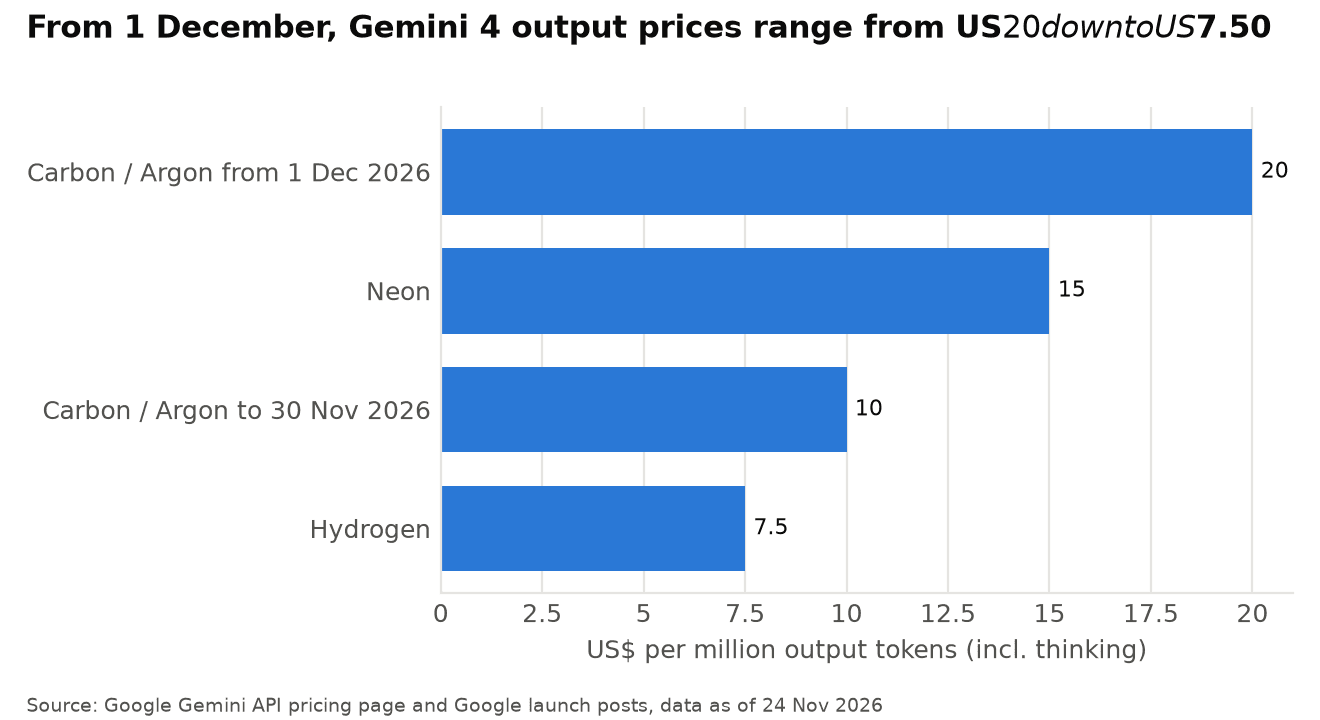
Gemini 4 Carbon and Argon standard API prices rise from US$2/US$10 to US$4/US$20 per million input/output tokens on 1 Dec 2026 (Google pricing page, 24 Nov 2026).
Gemini 4 Neon, launched 18 Nov 2026, is listed at US$3 input and US$15 output, with no scheduled change.
Gemini 4 Hydrogen, launched 12 Nov 2026, is listed at US$1.50 input and US$7.50 output, and it is the only Gemini 4 model offered on the free tier.
In our worked example, sending 80% of the work to Hydrogen keeps a December bill at US$80, the same as running everything on Carbon today.
What does the Gemini 4 price change really mean for your business?
Most coverage treats the 1 December change as proof that AI is getting more expensive. Some businesses will rush to lock in work this week, and others will pause AI projects altogether. Both responses look at the price tag and ignore how the bill is actually calculated.
Think of your AI spend as a meter, not a price tag. The meter counts tokens, and the rate depends on which model is doing the work. Over two months Google has released four Gemini 4 models, and only the two at the top of the range are getting dearer. Hydrogen and Neon have no scheduled increase. Google describes Hydrogen as its fast everyday model and Neon as a middle option that "balances depth and efficiency".
A business that thinks it through doesn't ask which model is best. It asks which model should run by default, and when a task should move up to a stronger one.
What most people see | What a calm business owner sees |
|---|---|
"AI prices are doubling." | Two of the four Gemini 4 models double. The other two have no listed change. |
"We should use the strongest model." | Drafting, summarising and sorting are the everyday work Google designed Hydrogen for. |
"Lock in before 1 December." | Six days of discount matter less than the default model you'll still be running in 2027. |
"The newest model must cost the most." | Neon arrived on 18 November and is priced below Carbon's new rate. |
When the flip is wrong. Some work needs the top model, such as long software projects that run for many steps or security analysis. Google positions Carbon for that kind of work, so for those tasks you're paying for capability you need. A cheaper model can also cost more per task if it retries or "thinks" for longer, because Google bills thinking tokens as output. If your contracts require data to be processed in Australia, check where each model runs before you look at price.
What exactly changes on 1 December?
The change applies to the standard paid tier of the Gemini API for Carbon and Argon. Google's Argon launch post says introductory pricing ends on 30 November 2026. The pricing page lists the higher rates from 1 December.
Gemini 4 model | Launched (Google blog) | Input, US$ per 1M tokens | Output, US$ per 1M tokens | Change on 1 Dec 2026 |
|---|---|---|---|---|
Argon | 13 Oct 2026 | 2.00 → 4.00 | 10.00 → 20.00 | Doubles |
Carbon | 28 Oct 2026 | 2.00 → 4.00 | 10.00 → 20.00 | Doubles |
Hydrogen | 12 Nov 2026 | 1.50 | 7.50 | None listed |
Neon | 18 Nov 2026 | 3.00 | 15.00 | None listed |
Two details are easy to miss. Until 30 November, Neon costs more per token than Carbon. From 1 December, it costs less. Each model also has a much lower cached-input rate for prompts you send repeatedly, such as Neon at US$0.15 per million tokens.
So what: if any tool you run defaults to Carbon or Argon, your cost per token for that work doubles next week unless you change the setting.
Does a cheaper model really cut the bill?
It does, if the cheaper model can do the task in a similar number of tokens. To make the arithmetic concrete, we priced one illustrative workload: 20 million input tokens and 4 million output tokens a month, roughly what a busy internal assistant handling drafting and document questions might use. These figures come from Google's list prices. They are not measured bills.
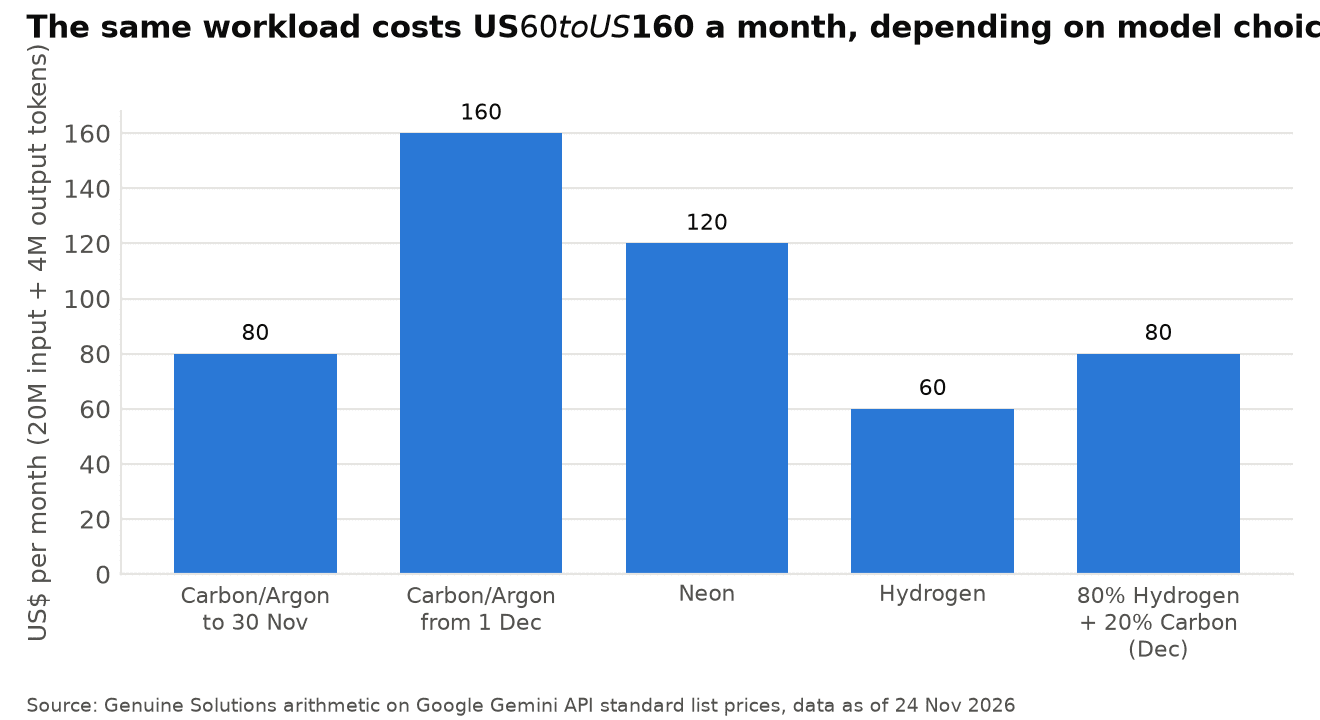
Running everything on Carbon costs US$80 today and US$160 from December. Splitting the work 80/20 between Hydrogen and Carbon brings December back to US$80. Google makes its own claim for Neon: it reports a 32% lower cost per task than Carbon in its testing. Treat that as a vendor figure to check against your own work.
So what: after 1 December, your routing rule will affect the monthly total more than which vendor you chose.
Where does your data go, and does that change the choice?
Price isn't the only difference between the tiers. Google's pricing page says content on the free tier is used to improve its products, and content on the paid tier is not. Hydrogen is the only Gemini 4 model with a free tier, which makes it easy for staff to start using it without approval.
Location matters too. As of 24 November 2026, Google's Gemini 4 getting-started documentation lists a global endpoint and US and EU multi-regions for Hydrogen and Carbon. It also lists europe-west2 and asia-southeast1 for Argon. It doesn't list an Australian region for Gemini 4.
The Office of the Australian Information Commissioner (OAIC) has published guidance on privacy and the use of commercially available AI products. Read it before customer or staff data goes into any model.
So what: pick the paid tier and confirm the region first. Then compare prices.
What could your Gemini bill look like in 2027?
This is a scenario, not a prediction. We have only four dated price points for these models, too few to plot a trend, so the table below shows three possible bills. Each uses the illustrative workload above and Google's list prices as at 24 November 2026.
Scenario | Assumptions | Illustrative monthly cost (US$) |
|---|---|---|
Low | Default to Hydrogen, escalate 20% of tasks to Carbon, usage flat | About 80 |
Base | Switch the default from Carbon to Neon, usage flat | About 120 |
High | Stay on Carbon by default and usage grows 50% as more staff adopt it | About 240 |
The gap between the low and high bills is threefold, and none of it depends on a new Google price change. It comes down to the default setting and how much your staff use the tools. Usage growth is the factor to watch, because adoption tends to spread once a tool works.
Several things would change this view:
Google changes Hydrogen or Neon pricing, or launches another model in the family.
An Australian processing region is listed for Gemini 4, which would open it up for data-sensitive work.
The Australian dollar moves against the US dollar, because these list prices are in US dollars.
Your own testing shows a cheaper model uses many more thinking tokens per task.
What should Australian businesses do this week?
Use this list before 1 December, then check again each quarter:
Find your current model. Check API logs and the settings in any software that uses Gemini. Many tools choose a model for you.
Flag Carbon and Argon work. List which workflows use them, because those costs double on 1 December.
Test on real tasks. Run 20 typical tasks through Hydrogen and Neon and compare cost per finished task, not cost per token.
Set a default and an escalation rule. For example: Hydrogen by default, and Carbon only for named complex jobs. Set the model explicitly wherever the tool allows it.
Use caching. Repeated instructions and reference documents qualify for much lower cached-input rates.
Close the free-tier gap. Keep business and personal data on paid accounts, and tell staff why.
Set a budget alert. Add a monthly spending alert in your cloud billing account so a change shows up within days.
Record the decision. Note which model you chose, why, where it runs and who reviews it.
Watch out: Cheaper models are not automatically cheaper per task. Google bills thinking tokens as output, so a model that reasons at length or needs retries can cost more than its rate suggests. Measure before you switch production work, keep a person reviewing anything sent to customers, and don't send personal information to a model until you have checked the tier, the region and your privacy obligations.
If you want help mapping which tasks should run on which model, or setting up cost and privacy controls before the new prices start, Genuine Solutions can review your current set-up through our AI and automation services. We can also build usage and cost reporting so you can see the meter, and check the security of your AI integrations. For wider systems support, see our IT solutions, or contact our team to discuss next steps.
Frequently asked questions
Does the 1 December change affect Gemini app or Google Workspace subscriptions?
This article covers the pay-per-use list prices on Google's Gemini API pricing page. That page sets out per-token rates for developers and businesses building on the API. It does not set out subscription seat pricing. If you pay for Gemini through a subscription or a reseller, check your plan terms with Google or your reseller.
Are Gemini 4 prices in Australian dollars?
No. Google lists Gemini API prices in US dollars per million tokens. What you pay in Australian dollars depends on the exchange rate, your billing account set-up and any applicable taxes. Budget with some buffer for currency movement, especially if your usage is growing.
Is Gemini 4 Neon better than Carbon?
It depends on the task. Google positions Carbon for its hardest, long-running work and Neon as a balance of depth and efficiency. It reports a 32% lower cost per task for Neon than Carbon in its own testing. That is a vendor claim, so run a fair test on your own tasks before moving production work.
Can my business use Gemini 4 Hydrogen for free?
Hydrogen is listed on Google's free tier, but the pricing page says free-tier content is used to improve Google's products. Paid-tier content is listed as not used for that purpose. For business information, and especially personal information, use a paid account with clear terms.
Is there an Australian data region for Gemini 4?
As of 24 November 2026, Google's Gemini 4 getting-started documentation does not list an Australian region. It lists a global endpoint, US and EU multi-regions, and for Argon also europe-west2 and asia-southeast1. Check the current documentation if your contracts or policies require local processing.
The takeaway: The Genuine Take: the best model is the wrong question for most Australian businesses. Choose a sensible default and a clear rule for when to escalate, then review the bill every month. On 1 December, the setting you choose will matter more than the model's name.
Sources and method
Source | What it gave | Data date |
|---|---|---|
Standard prices for all four Gemini 4 models, the 1 December change, cached-input rates, free-tier availability and data-use statements | Checked 24 Nov 2026 | |
Introductory price ending 30 Nov 2026, later price, launch date | 13 Oct 2026 | |
Introductory and later prices, positioning, launch date | 28 Oct 2026 | |
Price, positioning, availability on all AI Studio tiers | 12 Nov 2026 | |
Price, cached-input rate, positioning, Google's cost-per-task claim | 18 Nov 2026 (updated 23 Nov 2026) | |
Listed endpoints and regions | Checked 24 Nov 2026 | |
Independent report of Neon, Carbon and Argon pricing | 19 Nov 2026 | |
Reference for privacy obligations when using AI products | Current at time of writing |
Method: we multiplied Google's US-dollar list prices by one illustrative workload (20 million input and 4 million output tokens a month). These are not measured bills. Real costs depend on how many tokens each model uses per task, including thinking tokens, and on caching, batch tiers, exchange rates and taxes.
Disclaimer: This article provides general information only and does not constitute technical, legal, privacy or financial advice. Prices, features and regions are as published by the vendor at the date shown and may change. Seek advice specific to your business before making decisions.