


The Fair Work Ombudsman issued 358 infringement notices in 2025-26 to employers whose job ads offered pay below the legal minimum, according to its media release of 27 August 2026. On 17 November 2026 it started its first court case under the same law. For any business that sponsors workers, the job ad is now a compliance document.
358
Fair Work infringement notices for job ads with unlawful pay rates in 2025-26
Source: Fair Work Ombudsman, 27 Aug 2026
At a glance
Since 7 January 2023, a job ad cannot offer a pay rate that would breach the Fair Work Act or an award, agreement or other fair work instrument (Fair Work Ombudsman).
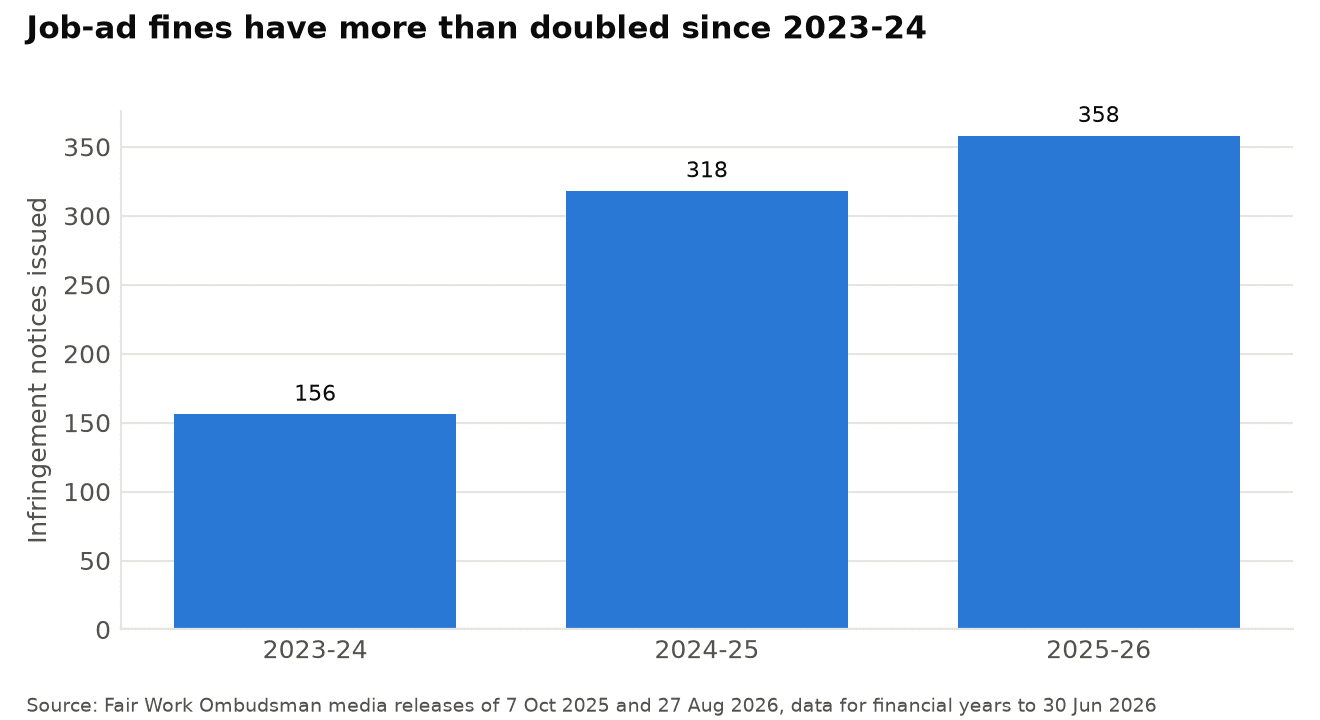
Job-ad infringement notices went from 156 in 2023-24 to 358 in 2025-26 (Fair Work Ombudsman, 27 Aug 2026).
The maximum infringement notice rose on 1 July 2026 to $10,920 per contravention for a company (Fair Work Ombudsman, 27 Aug 2026).
In its first court case, filed 17 November 2026, the Ombudsman is seeking penalties of up to $546,000 per alleged breach (Fair Work Ombudsman).
Under the Migration Act, as compiled to 8 October 2026, a Fair Work court order over a job ad can count as a "migrant worker sanction", which can lead to a prohibited employer declaration.
What is the flip for sponsoring employers?
Most employers who read about the first court case see a large penalty and a retailer in the news, then move on. The case is about two casual retail ads, and the company named in it denies nothing yet; these are allegations. But a calm sponsor reads it differently. Every 482 nomination that needs labour market testing (LMT) starts with job ads, and copies of those ads go to Home Affairs as evidence. The window you dress for local jobseekers is the same window two regulators look through.
That makes the job ad the cheapest place in the whole sponsorship file to get compliance right. A pay-rate error caught before posting costs a few minutes. The same error found after lodgement can mean an infringement notice from Fair Work, LMT evidence that doesn't line up with the salary you nominated, and in the worst case a question mark over your right to sponsor.
What most people see | What a calm employer sees |
|---|---|
A court case against one retailer | A regulator that has moved from fines to litigation on job ads |
A $546,000 maximum penalty headline | A pay-rate check that takes minutes before posting |
A Fair Work issue, separate from visas | One ad that feeds both the Fair Work rules and the LMT evidence for a nomination |
More red tape for advertising | A clean, dated record that strengthens the nomination |
When the flip is wrong. For some roles the minimum is not obvious. Casual loadings, junior rates, piece rates, enterprise agreements and roles that fall between award classifications all make the legal minimum harder to pin down. In those cases a quick check is not enough, and you need the right classification first. The flip also does less for employers whose occupation is exempt from LMT, although their ordinary job ads are still covered by the Fair Work rule.
What does the law actually ban in a job ad?
Under section 536AA(1) of the Fair Work Act, an employer must not advertise employment, or arrange for an ad, at a pay rate that would breach the Act or a fair work instrument if the job went ahead. The Fair Work Ombudsman says the benchmark is the applicable award or enterprise agreement, or the National Minimum Wage where neither applies. For pieceworker roles that also carry a periodic rate, the ad must state that rate or say that one is payable.
The first court case shows how small the gap can be on paper. The Ombudsman alleges that two Lush ads posted in July and August 2026 for seasonal casual sales assistants offered less than the General Retail Industry Award minimum, which it puts at $34.76 an hour for adults.
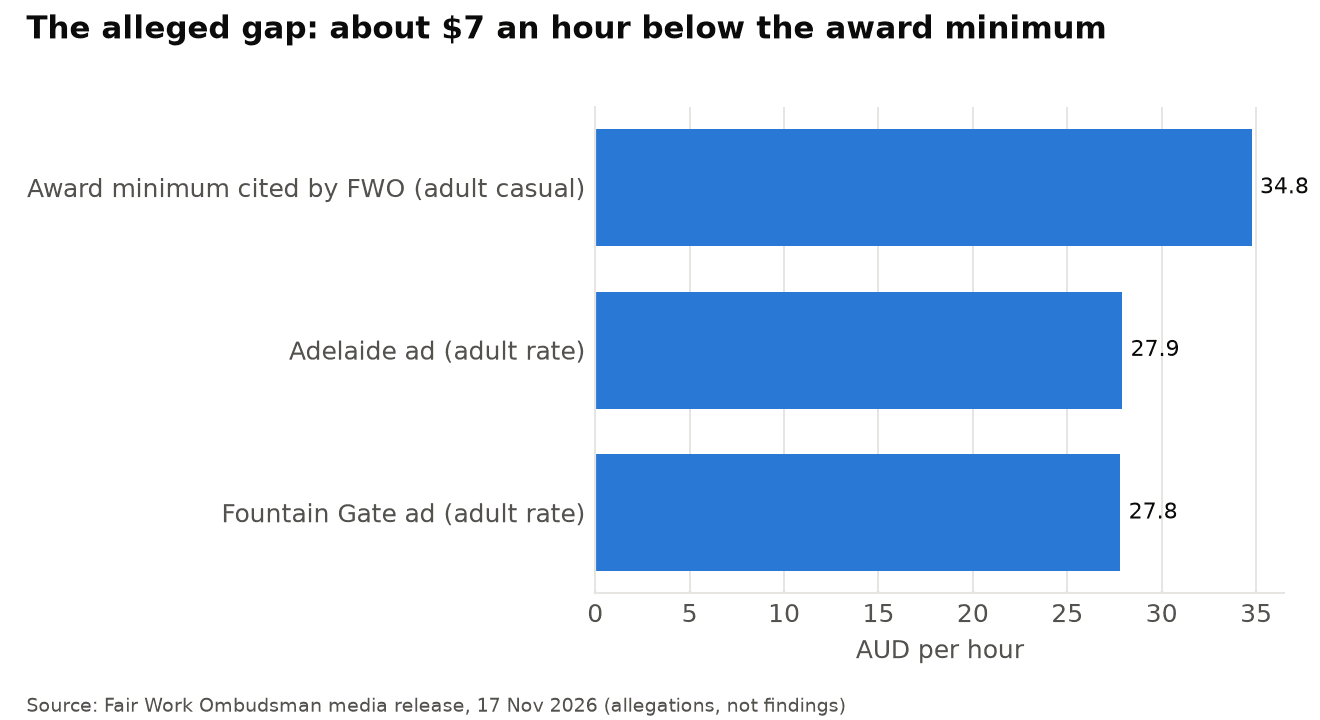
The Adelaide ad also listed $12.61 an hour for a junior under 16, according to the Ombudsman. So what: the law looks at the number printed in the ad, not at what you would have paid once someone was hired.
Why does a sponsor's job ad carry extra weight?
A sponsor's ads are often filed as evidence, and evidence gets read. Section 140GBA of the Migration Act allows labour market testing within a period of up to 4 months before the nomination is lodged. It also requires any advertising duration set by the Minister to be at least 4 weeks. Home Affairs says employers now need two valid ads, because advertising on Workforce Australia stopped being mandatory on 11 December 2023.
LMT element | What the official sources say |
|---|---|
Number of ads | At least two (Home Affairs LMT page) |
Duration | At least 4 weeks (Migration Act s140GBA(6AB); Home Affairs) |
Timing | Within the 4 months before lodging the nomination (s140GBA(4); Home Affairs) |
Salary in the ad | Must be stated if intended annual earnings are below $96,400 (LIN 18/036, 11 Dec 2023 compilation; Home Affairs) |
Evidence | Copies of the ads go with the nomination (s140GBA(6B); Home Affairs) |
A nominated worker's earnings must also be no less than the annual market salary rate under regulation 2.72 of the Migration Regulations. So what: an ad that quotes a low or unlawful rate can undermine the very salary figure your nomination relies on. Our guide to 482 visa salary requirements and market salary explains how that figure is worked out.
Can a job-ad breach affect your right to sponsor?
It can, through a chain set out in the Migration Act. Under section 245AYH, a person is subject to a migrant worker sanction if a Fair Work order has been made against them for breaching section 536AA(1) or (2). Under sections 245AYI and 245AYJ, a sanction can also follow from a broken enforceable undertaking or an ignored compliance notice about job-ad pay rates.
None of this is automatic. Under section 245AYK, the Minister may declare a sanctioned person a prohibited employer, but must first give notice, consider any submission, and weigh factors such as whether the breach was intentional and what the employer has done to fix it. For non-compliance other than an offence, the maximum declaration period is 5 years. While a declaration is in force, the employer cannot allow certain additional non-citizens to begin work.
Step | Legal trigger (Migration Act, compilation in force 8 Oct 2026) |
|---|---|
1. Court order or unresolved notice on a job ad | s245AYH, s245AYI, s245AYJ |
2. Notice of proposed declaration, 28-day submission window | s245AYK(3)–(4) |
3. Discretionary declaration, up to 5 years for this kind of non-compliance | s245AYK(8A) |
So what: an infringement notice you pay is not on this list, but an ad problem that ends in court or in an ignored compliance notice is. The record you keep of how you fixed it matters under section 245AYK(5).
How might enforcement move in 2026-27?
Scenario, not prediction. We have only three yearly data points, so the table below sets out assumptions rather than a trend line. The base case carries forward the 2025-26 growth of about 13% in notices. The low case assumes the first court case deters enough employers to bring notices back to the 2024-25 level. The high case assumes the Ombudsman adds more litigation and also issues notices faster, at about 25% growth.
Scenario | Assumption | Job-ad infringement notices, 2026-27 |
|---|---|---|
Low | Deterrence from the first court case; notices fall back to the 2024-25 level | About 320 |
Base | Growth continues at the 2025-26 rate (about 13%) | About 400 |
High | More litigation plus faster notice issuing (about 25% growth) | About 450 |
Across all three scenarios, the cost of a mistake rises even if the number of notices does not. The infringement notice cap went up on 1 July 2026, and court penalties now apply as well. Each of these would change the view:
The outcome of the case against Lush, including any penalty set by the court.
Any change to section 536AA or to Fair Work's enforcement priorities.
An update to the LMT instrument, including the $96,400 salary-disclosure threshold.
Any prohibited employer declaration based on a job-ad breach.
What should a sponsoring employer do before the next ad goes live?
Confirm the classification. Identify the award or enterprise agreement and the exact classification for the role, using Fair Work's Pay and Conditions Tool.
Check every rate in the ad. That includes junior, casual and apprentice rates, and the periodic rate for piece work. Each one must be at or above the minimum.
Align the ad with the nomination. The salary you show should match the annual market salary rate and earnings you plan to nominate, and it must be stated if the earnings are below $96,400.
Control third-party ads. Section 536AA also covers ads you "arrange", so brief recruiters and job boards in writing and review their copy before it goes live.
Keep a dated file. Store screenshots, posting dates, durations and the applicants you assessed, ready for the nomination and for any later monitoring.
If you want a second pair of eyes, our labour market testing service helps employers plan and document compliant LMT campaigns. Our guide to labour market testing for Australian employers explains the full process.
Watch out: The Lush matter is at the allegation stage, and nothing in it has been proven in court. The risk for sponsors is not this one case. It is that a single ad now feeds two separate compliance systems. Award rates change each 1 July (minimum award wages rose 4.75% from 1 July 2026, according to Fair Work), so an ad template that was compliant last year may not be compliant now.
If your business is preparing to sponsor skilled workers, Genuine Solutions can help you plan compliant advertising, run labour market testing and prepare the nomination. You can also read about the four steps employers follow to sponsor in 2026 or contact our team.
FAQ
Do job ads have to include a pay rate?
The Fair Work rule does not require every ad to show pay. It bans ads that show a rate below the legal minimum. For sponsorship, however, the labour market testing instrument requires the salary to be stated if the intended annual earnings are below $96,400, according to the Home Affairs LMT page and LIN 18/036.
What is the fine for an unlawful job ad?
From 1 July 2026, a Fair Work infringement notice can be up to $2,184 per contravention for an individual and $10,920 for a company, according to the Fair Work Ombudsman. In court, the Ombudsman is seeking up to $546,000 per alleged breach in its first case.
Does this apply to ads placed by a recruiter?
Yes, it can. Section 536AA(1) applies when an employer advertises or arranges for an ad. Brief any recruiter in writing about the correct award classification and rates, and review the final copy, because the ads may also become your labour market testing evidence.
Can a job-ad breach stop us sponsoring workers?
It can contribute. A Fair Work order over a job ad, or an ignored compliance notice, can be a migrant worker sanction under the Migration Act. The Minister may then declare the employer a prohibited employer for up to 5 years, after giving notice and considering the employer's submission.
How many ads are needed for labour market testing?
Home Affairs requires two valid ads, run for at least 4 weeks within the 4 months before you lodge the nomination. Advertising on Workforce Australia has not been mandatory since 11 December 2023. Some occupations and international trade obligations are exempt from LMT.
The Genuine Take
The takeaway: Employers usually treat the job ad as marketing and the nomination as compliance. The Fair Work Ombudsman's first court case shows the ad is compliance too. For a sponsor, it is the first page of the file and the one everyone reads. Get the window right, and the rest of the file is easier to defend.
Sources and method
Source | What it gave | Data date |
|---|---|---|
Lush allegations, advertised rates, award minimum, penalty per breach, hearing date | 17 Nov 2026 | |
358 notices and $131,836 in fines in 2025-26, new infringement notice caps | 27 Aug 2026 | |
318 notices in 2024-25 and 156 in 2023-24 | 7 Oct 2025 | |
Fair Work Ombudsman: job ads and pay secrecy, job ads and flexible work | Scope of the rule, start date of 7 Jan 2023, piece-rate rule | Checked 26 Nov 2026 |
Minimum award wages up 4.75% from 1 Jul 2026 | Updated 1 Jul 2026 | |
Migration Act 1958, compilation 172 | s140GBA (LMT), s245AYH–s245AYK (migrant worker sanctions, prohibited employers) | In force 8 Oct 2026 |
LIN 18/036 labour market testing instrument and Home Affairs LMT page | Two ads, Workforce Australia change, $96,400 salary-disclosure threshold | Compilation 11 Dec 2023; checked 26 Nov 2026 |
Method: the yearly notice counts come from Fair Work Ombudsman media releases and cover financial years. The 2026-27 figures are illustrative scenarios built on the stated growth assumptions, not official forecasts. The Lush figures are the Ombudsman's allegations and have not been tested in court.
Disclaimer: This article is general information only and is not legal, workplace relations or migration advice. Workplace and migration rules change often and depend on your circumstances. Check the current official sources, and get advice from a qualified professional or a registered migration agent before acting.