


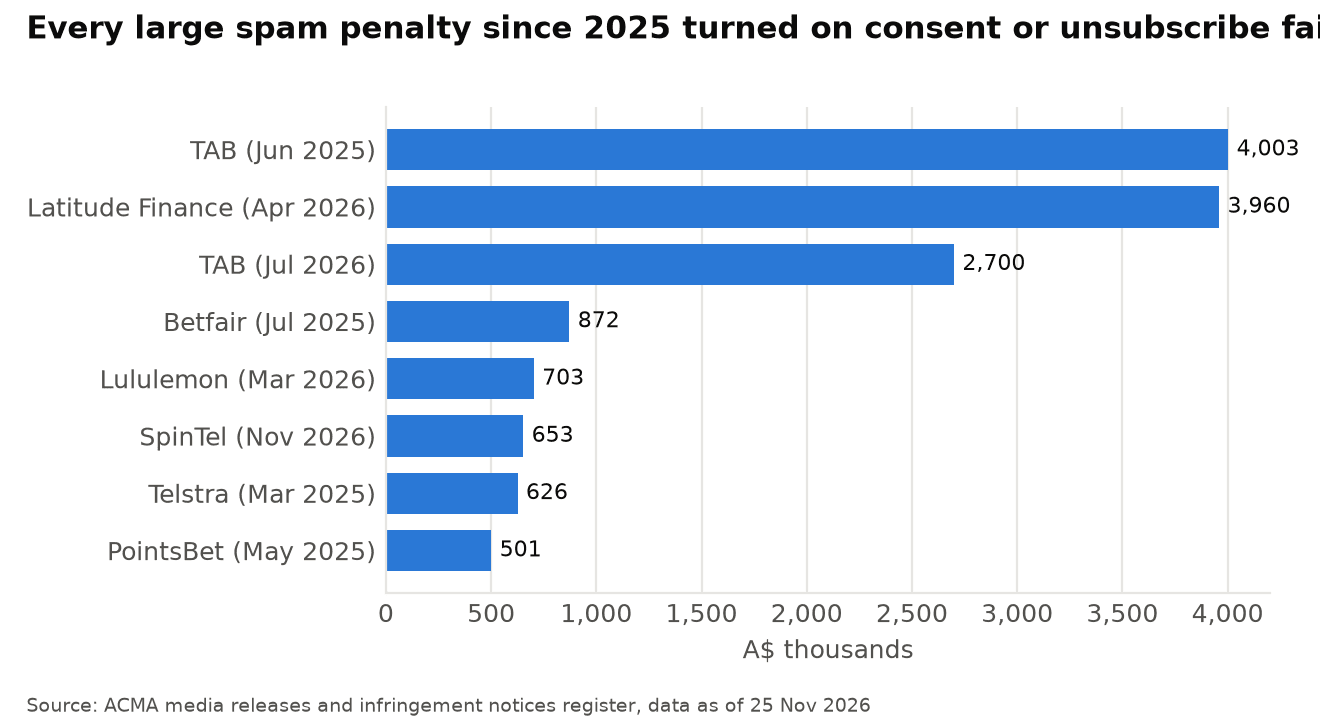
On 4 November 2026, the ACMA announced that SpinTel had paid a $653,400 penalty for emailing former customers without consent. The ACMA says businesses have paid more than $11 million in spam penalties over the last 18 months. In almost every case, the problem came down to how consent was recorded and how opt-outs were handled, not to how many messages were sent.
5 business days
The time a business has to action an unsubscribe request under the Spam Act
Source: Spam Act 2003, Schedule 2 clause 6; ACMA unsubscribe rules fact sheet, checked 25 Nov 2026
At a glance
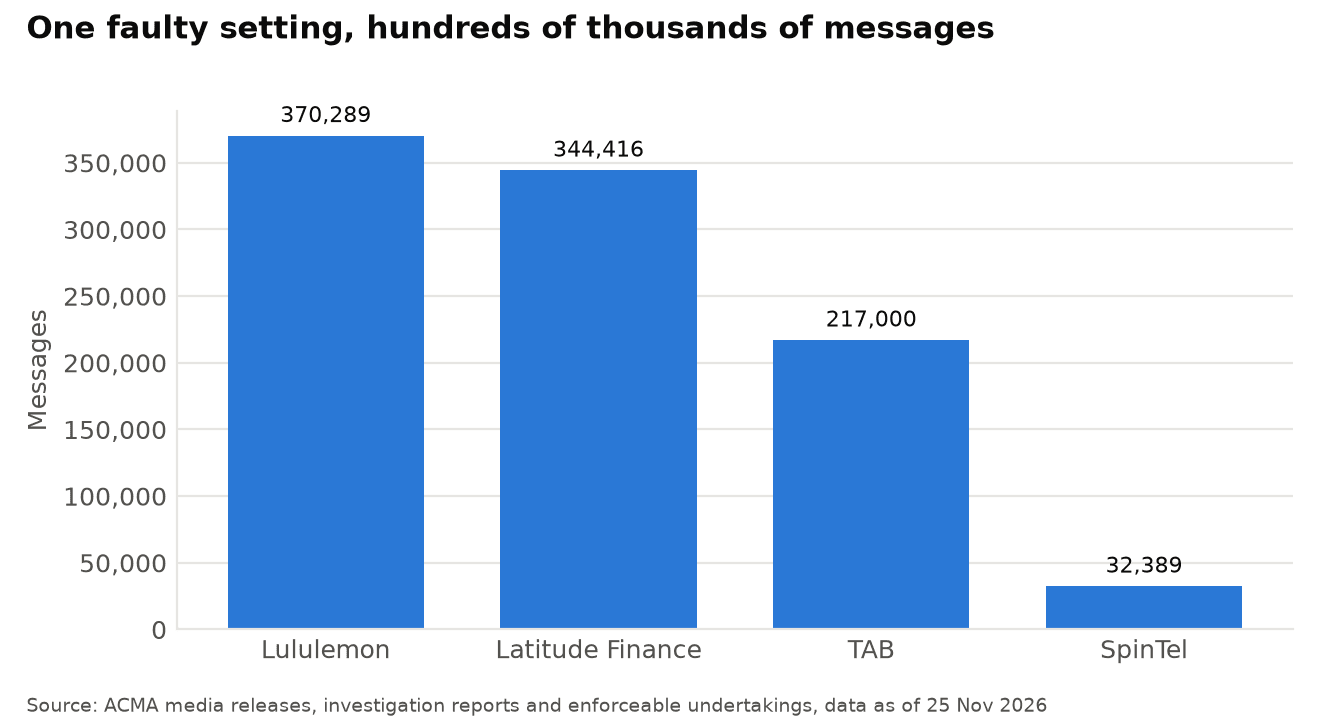
SpinTel paid $653,400 after sending more than 32,000 marketing emails to former customers without consent (ACMA, 4 Nov 2026).
Lululemon paid $702,900 over 370,289 "service" emails that carried sales content and had no unsubscribe option (ACMA, 11 Mar 2026).
Latitude Finance paid $3.96 million, including 344,416 messages without a working unsubscribe function (ACMA, 15 Apr 2026).
TAB paid more than $2.7 million, including over 217,000 emails and SMS sent to customers who had unsubscribed from those channels (ACMA, 22 Jul 2026).
Since 1 July 2026, branded SMS sent from an unregistered sender ID is relabelled "Unverified" on recipients' phones (ACMA SMS Sender ID Register).
Do Spam Act penalties mean SMEs should send less marketing?
No. The penalties are not about how often a business sends. They are about whether the exit door works. When a regulator publishes eight-figure totals, the instinct is to pull back: fewer campaigns, smaller lists, nervous approvals before every send.
Fair point, but look at what the ACMA actually penalised. SpinTel assumed that a customer relationship from years earlier still counted as consent, and some recipients had left up to 13 years before. Lululemon put promotions inside order emails and treated them as service messages. Latitude told people to reply STOP from a sender ID that could not receive replies.
None of these were volume problems. In each case, the systems behind the messages were set up wrong. For an SME, that is good news, because those settings sit inside the CRM and can be checked in an afternoon.
What most people see | What a calm business owner sees |
|---|---|
"$11 million in fines, so email marketing is risky" | Each fine traces back to one fixable setting: consent, unsubscribe or sender details |
"Big brands get fined, so small firms are next" | The rules are the same for every business, and an audit costs less than one campaign |
"Former customers are fair game" | Past dealings do not automatically count as consent, and the ACMA has said so |
"Order emails are not marketing" | Any promotional content makes a message commercial |
When the flip is wrong. If your list was bought, scraped or built from business cards with no record of how each address was collected, the problem is not plumbing. It is the source of the list, and the honest fix may be to rebuild it from scratch through an opt-in. The calm reading only applies to businesses that collected contacts legitimately and now need to prove it.
What did the ACMA actually penalise in 2026?
In 2026, the ACMA penalised four failures: consent inferred from old relationships, promotions placed inside service emails, unsubscribe options that did not work, and opt-outs that were not actioned. Each 2026 case lines up with one of these, and the message counts show how quickly one bad setting compounds across a list.
Business (announced) | The failure | Penalty |
|---|---|---|
Lululemon (Mar 2026) | Order and delivery emails with sales content, no unsubscribe | $702,900 |
Latitude Finance (Apr 2026) | "Reply STOP" sent from an alphanumeric sender ID that cannot receive replies | $3.96m |
TAB (Jul 2026) | Marketing sent to customers who had unsubscribed from those channels | $2.7m+ |
SpinTel (Nov 2026) | Consent inferred from old customer relationships | $653,400 |
The lesson is that a single template or automation rule repeats its error on every send. Fixing that rule once also prevents the error on every later send.
Does an old customer relationship still count as consent?
Not automatically. Under the Spam Act, consent is either express or reasonably inferred from the relationship and conduct. The ACMA rejected SpinTel's argument that past dealings were enough.
SpinTel's court-enforceable undertaking records at least 32,389 emails sent without inferred consent. It also records at least 5 messages sent more than 5 business days after consent had been withdrawn. The undertaking runs for 3 years and requires an independent compliance review.
For SMEs, this applies most to lists that have built up over years: past quote requests, lapsed members and one-off buyers. If your CRM cannot show where a contact came from and when they last engaged, treat that contact as unconfirmed. A well-structured CRM implementation stores the consent source and date on every record, so the question can be answered on the day it is asked.
Are transactional emails and SMS covered?
They are covered once they include a promotion. ACMA member Samantha Yorke said any promotional or sales content makes a message commercial "regardless of whether the message has any other purpose". That finding cost Lululemon $702,900.
SMS has a second change. From 1 July 2026, branded sender IDs that are not on the ACMA's SMS Sender ID Register display as "Unverified" and are grouped into one thread. The ACMA has warned that customers may ignore or delete these messages. Businesses register through each SMS provider they use.
Message type | Needs consent? | Needs unsubscribe? |
|---|---|---|
Pure order or booking confirmation | No | No |
Confirmation with a discount code or "you might also like" | Yes | Yes |
Appointment reminder with a promotion | Yes | Yes |
Branded SMS from an unregistered sender ID | Depends on content | Depends on content, and the message shows as "Unverified" |
The practical point is to keep service templates and marketing templates separate, with an owner for each.
What happens next? Three scenarios
Scenario, not prediction. This view rests on public ACMA material available on 25 November 2026. The ACMA has published spam penalties steadily through 2025 and 2026, and its 2026–27 compliance priorities name spam as an ongoing focus.
Scenario | Assumption | What it means for an SME |
|---|---|---|
Low | Enforcement continues at the 2025–26 pace and stays focused on large senders | Audits help mainly with deliverability and customer trust |
Base | Enforcement continues and more cases arise from complaints about automated journeys, old lists and SMS sender IDs | A complaint from one customer can open an investigation, so consent records matter |
High | Repeat offenders and new SMS rules lead to more frequent action and more court-enforceable undertakings | Businesses without consent records face penalties plus multi-year independent audits |
Three things would change this view: a published shift in the ACMA's 2027–28 priorities, amendments to the Spam Act, or an ACMA penalty against a small business that becomes a reference case. Whichever scenario plays out, a working exit door costs the same.
Your Spam Act checklist: eight checks for this month
Pull your list sources. Every contact should have a recorded source (form, purchase, event) and a date.
Separate lapsed contacts. Contacts with no recorded consent or recent engagement go into a re-permission campaign, not your main sends.
Audit every automated template. That includes welcome series, abandoned carts, order confirmations and appointment reminders. If a template promotes anything, it needs an unsubscribe option.
Test the unsubscribe on each channel. Click it, reply STOP and confirm the contact is suppressed across the CRM, the email platform and the SMS tool.
Time the suppression. Opt-outs must take effect within 5 business days, and the link must work for at least 30 days after sending.
Remove friction. No log-in, no fee and no extra personal details to unsubscribe.
Check sender details. Every message must identify your business accurately and say how to contact you.
Register SMS sender IDs. Confirm with each SMS provider that your branded sender ID is registered and that your ABR contact details are current.
Workflow automation can sync opt-outs across tools instantly. Analytics dashboards can show unsubscribe rates and consent coverage over time.
Watch out: Integrations are where opt-outs most often get lost. A contact who unsubscribes in your email platform but stays "subscribed" in your CRM or SMS tool can be messaged again the next time lists sync. Test the full path end to end after every platform change, and do not rely on one tool's settings alone.
FAQ
Do the Spam Act rules apply to small businesses?
Yes. The Spam Act 2003 applies to commercial electronic messages with an Australian link, whatever the sender's size. The ACMA's 2024 research found that about 42% of SMEs run e-marketing, and some wrongly believed the rules only applied to large businesses. Consent, sender identification and a working unsubscribe option are required for every commercial message.
How long do I have to process an unsubscribe request?
Under Schedule 2 of the Spam Act, withdrawal of consent takes effect within 5 business days of the request. The unsubscribe facility must also keep working for at least 30 days after each message is sent. Automating suppression across every tool is the safest way to meet both timeframes.
Can I email past customers who never opted in?
Only if consent can reasonably be inferred from your relationship and their conduct. In the SpinTel case, the ACMA said a previous business relationship did not automatically provide consent, and some recipients had left years earlier. If you cannot show a basis for consent, run a re-permission campaign or remove the contact.
Does "reply STOP" count as an unsubscribe option?
Only if replies actually reach you. Latitude Finance told customers to reply STOP from an alphanumeric sender ID that could not receive replies, which contributed to a $3.96 million penalty. If you send from a branded sender ID, include an opt-out link or number that works.
What is the SMS Sender ID Register?
It is an ACMA register of branded SMS sender names. Since 1 July 2026, messages from unregistered branded sender IDs display as "Unverified" and are grouped into a single thread, where customers may ignore them. Registration is done through each SMS provider you use. Messages sent from ordinary phone numbers are not affected.
The takeaway: The Genuine Take: The ACMA is not penalising marketing. It is penalising unsubscribe options that do not work, and an SME that tests its own opt-outs every quarter can keep marketing without the risk shown in this year's cases. Test your unsubscribe before a customer has to.
Sources and method
Source | What it gave | Data date |
|---|---|---|
ACMA: SpinTel pays $653K penalty for spamming former customers | SpinTel penalty, message count, consent finding, $11m 18-month total | 4 Nov 2026 |
Penalty, 344,416 messages, STOP/sender ID finding | 15 Apr 2026 | |
Penalty, 370,289 emails, service-message finding | 11 Mar 2026 | |
Penalty, 217,000+ messages after channel unsubscribes | 22 Jul 2026 | |
ACMA: Infringement notices and Investigations into spam and telemarketing | 2025 penalties (Telstra, PointsBet, TAB, Betfair) and cross-check of 2026 amounts | Checked 25 Nov 2026 |
"Unverified" labelling from 1 July 2026, registration through providers | Checked 25 Nov 2026 | |
ACMA: Small and medium-sized businesses: marketing messages and unsubscribe rules | 42% of SMEs conduct e-marketing | Aug 2024 |
ss16–18 and Schedule 2: consent, sender details, 30-day unsubscribe, 5 business days | Checked 25 Nov 2026 |
Penalty amounts and message counts come from ACMA media releases and were cross-checked against the ACMA's infringement notices register, investigation reports or enforceable undertakings. Dates in the chart are announcement dates; the ACMA's register sometimes shows the earlier date the infringement notice was issued. The $11 million total is the ACMA's own 18-month figure and is not a sum of the penalties shown here.
This article is general information about Australian marketing rules as of 25 November 2026. It is not legal advice. For decisions about your own marketing practices, seek advice from a qualified professional and check the ACMA's current guidance.
If your email and SMS marketing runs across several tools that do not share consent and opt-out data, Genuine Solutions can help. We can map where your consent records live, connect your CRM and messaging platforms, and set up automation that actions unsubscribes in every tool, so you can keep marketing with records you can stand behind. Talk to our team about a CRM and marketing automation review.