


Australia's unemployment rate rose to 4.9% in October 2026 (ABS, released 19 November 2026). Jobs and Skills Australia's 2026 Occupation Shortage List found 27% of assessed occupations in national shortage, down from 36% in 2023. Even so, 127 occupations have been in shortage every year from 2021 to 2026, and permanent employer-sponsored places for 2026–27 rose to 58,040.
127
Occupations in national shortage in every year from 2021 to 2026
Source: Jobs and Skills Australia, 2026 Occupation Shortage List, October 2026
At a glance
Unemployment was 4.9% in October 2026 (seasonally adjusted), up from 4.3% in October 2025 (ABS, 19 Nov 2026).
279 of 1,021 assessed occupations (27%) were in national shortage in 2026, down from 29% in 2025 and 36% in 2023 (JSA, Oct 2026).
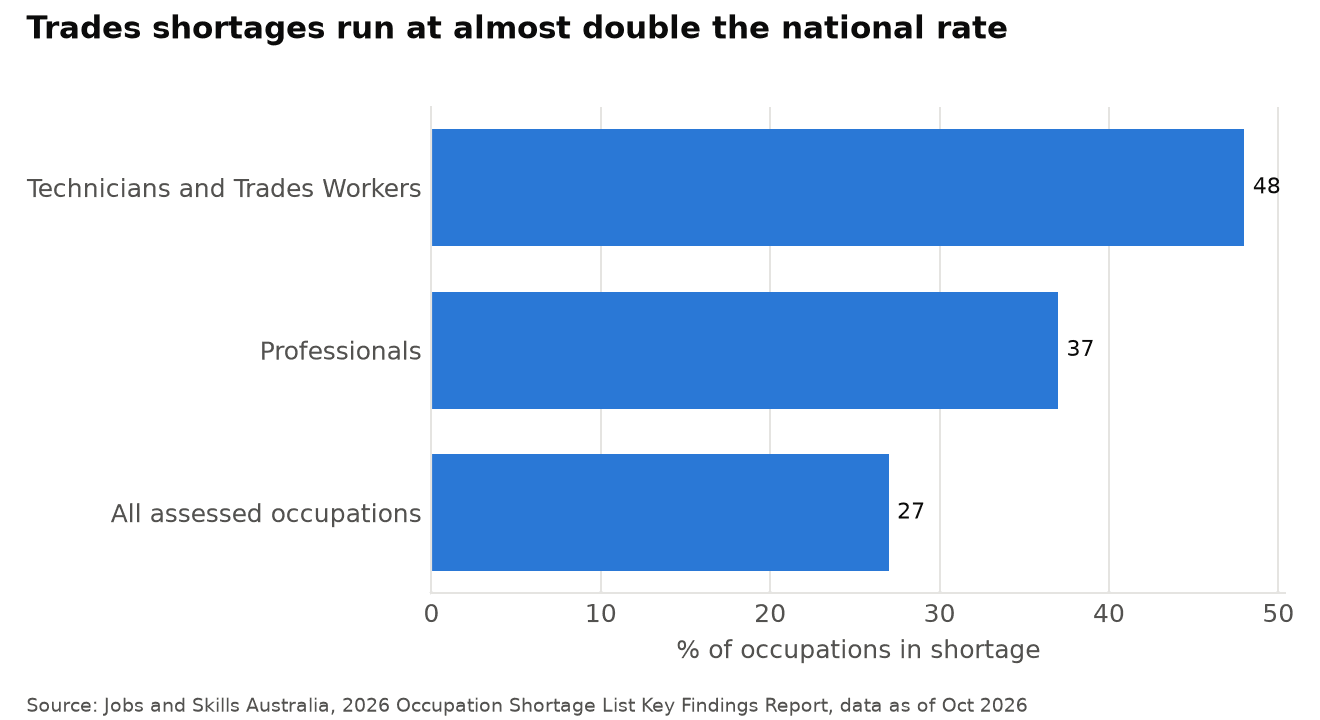
Almost half of Technicians and Trades Workers occupations (48%) and 37% of Professionals occupations were in shortage in 2026 (JSA, Oct 2026).
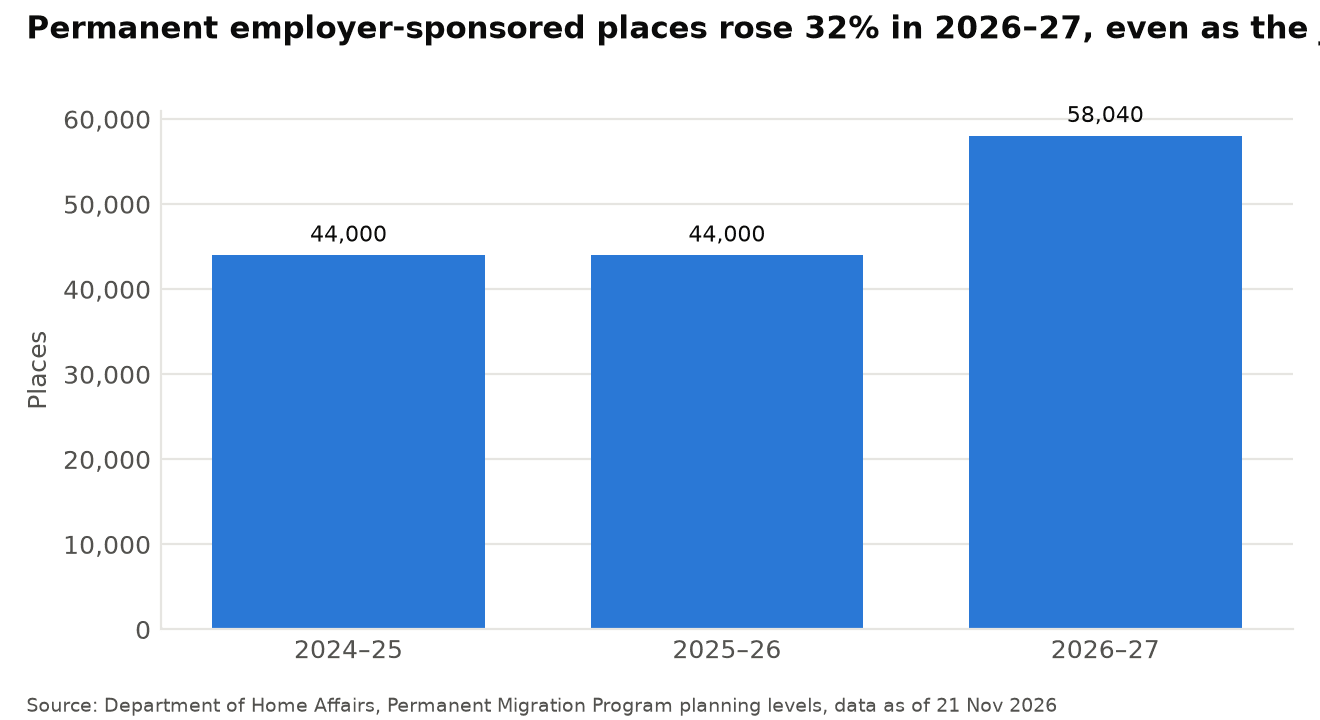
The permanent Employer-Sponsored planning level is 58,040 places for 2026–27, up from 44,000 in 2025–26 (Home Affairs, as of 21 Nov 2026).
Labour market testing still needs at least two advertisements, open for at least 4 weeks, within the 4 months before you lodge a nomination (LIN 18/036, compilation in force from 7 Dec 2024).
The Flip: is a cooling job market a reason to stop sponsoring?
No. A cooling market makes your sponsorship decisions clearer, and it doesn't end the need for sponsorship. Many employers are doing the same thing right now. They read the 4.9% unemployment headline, pause every overseas recruitment plan, and wait for local applicants to turn up.
Think of the labour market as a tide. When the tide goes out, the shallow water drains first, and the rocks underneath become easy to see. The 2026 shortage list shows that pattern. Shortages fell across the board, but 127 occupations stayed in shortage through every list since 2021. Most of them are in trades and professional roles.
The Government's own settings point the same way. It kept the permanent program at 185,000 places and raised the employer-sponsored share by 14,040 places. A calm employer doesn't stop sponsoring. They work out which of their roles sit on the rocks and which sit in water that is now draining.
What most people see | What a calm employer sees |
|---|---|
Unemployment at 4.9%, so local candidates must be easy to find | More applicants for general roles, while the hard-to-fill trades stay hard to fill |
Shortages down to 27%, so sponsorship is over | 127 occupations in shortage for six years running, and these are the ones to plan around |
Migration is being tightened | Permanent employer-sponsored places up 32% to 58,040 for 2026–27 |
Labour market testing is a box to tick | More applications now come in, so testing can show which roles you can fill locally |
When the flip is wrong. If your role is not in a persistent shortage, the cooling market may solve your problem without sponsorship. Sales, administration and many entry-level roles are where more local applicants usually show up first. In those roles, a well-run local campaign is often faster and cheaper than sponsoring, and your labour market testing may find a suitable Australian worker. Sponsorship is a tool for the shortages that are still there. It is not a default.
Which shortages are still there in 2026?
Trades and professional roles. In Jobs and Skills Australia's 2026 list, 48% of Technicians and Trades Workers occupations were in national shortage, which was the highest of any major group. Professionals followed at 37%, against 27% across all assessed occupations.
The long-running gaps are even more concentrated. JSA reports that Technicians and Trades Workers and Professionals together make up 90% of the 127 occupations in shortage every year from 2021 to 2026. Those gaps span construction, engineering, electrotechnology and telecommunications trades, health, early childhood education and science.
So what: if you hire in these fields, the rise in unemployment probably won't fill your vacancies. Check each role against the list before you change your workforce plan. Our skills shortage assessment maps your positions to current shortage data.
How cool is the job market, really?
It has cooled, but it hasn't collapsed. The seasonally adjusted unemployment rate rose from 4.3% in October 2025 to 4.9% in October 2026, which the ABS describes as the highest since October 2021. Over the same 12 months, 83,500 more people were employed.
Indicator (seasonally adjusted) | October 2025 | October 2026 |
|---|---|---|
Unemployment rate | 4.3% | 4.9% |
Change in employed people over the year | n/a | +83,500 |
Participation rate, October 2026 | n/a | 66.6% |
Source: ABS, Labour Force, Australia, October 2026 (released 19 Nov 2026).
So what: more people are looking for work, and the economy is still adding jobs. For employers, the practical change is a larger applicant pool for roles that don't need hard-to-find skills. That is good news for any campaign you run, including the advertising you do for labour market testing.
Why did the Government raise employer-sponsored places?
The Government wants sponsored workers already in Australia to have a clear path to permanent residence. The Home Affairs planning-levels page says the higher Employer Sponsored level "supports timely transitions to permanent residence" for temporary migrants filling skills gaps. The permanent program also sets aside 129,590 places for people already living in Australia.
Permanent Program category | 2025–26 | 2026–27 | Change |
|---|---|---|---|
Employer-Sponsored | 44,000 | 58,040 | +14,040 (+32%) |
Skilled Independent | 16,900 | 21,090 | +4,190 |
State/Territory Nominated | 33,000 | 35,500 | +2,500 |
Regional | 33,000 | 14,110 | −18,890 |
Total Skilled Migration Program | 132,200 | 132,240 | +40 |
Source: Department of Home Affairs, Permanent Migration Program planning levels (as of 21 Nov 2026).
So what: if you already sponsor someone on a temporary visa, the permanent employer-sponsored pathway now has more room. That makes a long-term retention plan for a good sponsored worker more realistic in 2026–27 than it was in 2025–26.
Forecast: what happens to hiring conditions over the next six months?
Scenario, not prediction. The figures below extend the ABS unemployment series to April 2027 under three stated assumptions. They are not ABS forecasts.
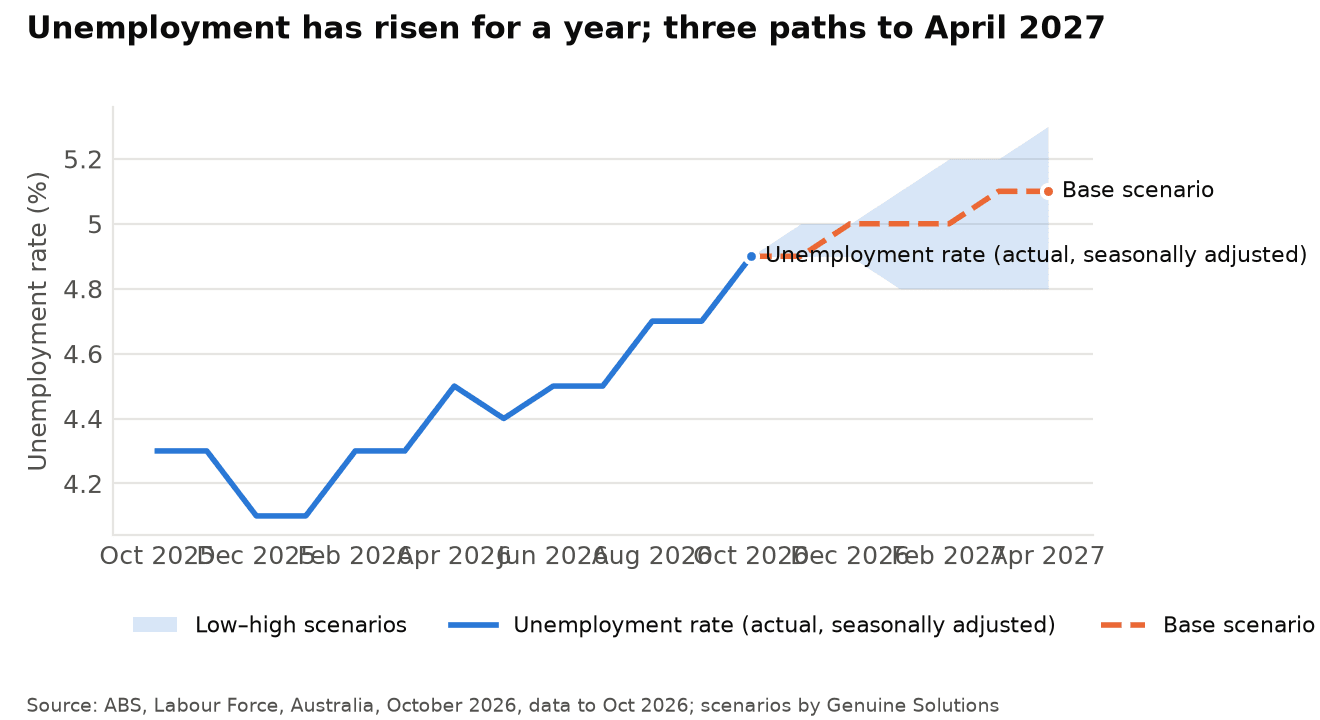
Scenario | Assumption | Unemployment, April 2027 | What it means for employers |
|---|---|---|---|
Low | The rate settles back towards the ABS trend estimate of 4.8% | 4.8% | Hiring conditions stay similar to today, and persistent shortages remain |
Base | The rate keeps rising at half the pace of April–October 2026 | 5.1% | More local applicants for general roles, while trade and health gaps narrow only slowly |
High | The April–October 2026 pace (+0.4 points in six months) continues | 5.3% | Labour market testing is more likely to find local candidates, so sponsor only where the evidence shows a gap |
In every scenario the tide keeps going out. That changes how many people apply for roles that don't need scarce skills. It doesn't quickly fill an occupation that has been short for six years, because training a qualified electrician or engineer takes years, not months.
What would change this view: a sharp jump in unemployment in the November or December ABS releases, a revised Occupation Shortage List, or any change to the Employer-Sponsored planning level or to labour market testing rules.
Your move: a six-point sponsorship scorecard
Check each role against the 2026 shortage list. Mark it "persistent", "eased" or "not in shortage". Our guide to the Occupation Shortage List and employer visa pathways explains how to read it.
Run local recruitment properly first. With unemployment at 4.9%, a well-written ad can attract more applicants than it did a year ago.
Plan your labour market testing window. Under LIN 18/036 you need at least two advertisements, with applications open for at least 4 weeks, within the 4 months before you lodge the nomination. If the salary is below $96,400 a year, it must be shown in the ad. See our labour market testing service.
Keep the evidence. You must lodge copies of the advertising material with the nomination, and record why each applicant was or wasn't suitable.
Plan for retention, not only arrival. With 58,040 permanent employer-sponsored places in 2026–27, include a permanent residence pathway in your offer for key roles.
Price the whole process. Include fees, salary obligations and time for every step. Our four-step employer sponsorship guide sets out the sequence.
Watch out: Advertising that misses the rules on timing, the number of ads or what each ad must include can make the nomination fail, and you would have to run the test again. In a cooling market, your testing is also more likely to turn up suitable Australian applicants. If it does, you need to deal with those applicants genuinely, and you shouldn't treat the testing as a formality.
FAQ
Does higher unemployment make it harder to sponsor a worker?
Not directly. The legal requirements, including labour market testing, are the same. What changes is the evidence. With more people looking for work, your advertising may attract suitable Australian applicants, especially for roles that are not in shortage. For trades and professional roles in persistent shortage, the effect is likely to be much smaller.
What is the 2026 Occupation Shortage List?
It is Jobs and Skills Australia's yearly assessment of which occupations are in national shortage. The 2026 list, released in October 2026, found 279 of 1,021 assessed occupations (27%) in shortage. Employers use it to judge how hard a role will be to fill locally and to plan their recruitment.
How many employer-sponsored permanent places are there in 2026–27?
The Department of Home Affairs lists a planning level of 58,040 places for the Employer-Sponsored category in 2026–27. That is up from 44,000 in each of 2024–25 and 2025–26. The overall Permanent Program stays at 185,000 places.
What does labour market testing involve right now?
Under the current compilation of LIN 18/036, you must advertise the position in Australia in at least two advertisements. Applications must be open for at least 4 weeks, and the testing must happen within the 4 months before you lodge the nomination. Each ad needs the job title, the skills required and the sponsor's or recruiter's name. If the salary is below $96,400 a year, the ad must show it.
Should I pause sponsorship plans until the market settles?
Only for roles where local applicants are now realistic. Pausing sponsorship for persistent-shortage roles risks leaving work undone while the gap stays open. Look at each role separately and don't make one decision for the whole business.
The takeaway: The Genuine Take: A cooling market is the best time to look closely at your workforce plan. When the tide goes out, you can see which shortages are real. Sponsor where the shortage is real, and recruit locally where applicants are now coming in.
Sources and method
Source | What it gave | Data date |
|---|---|---|
Monthly unemployment rate Oct 2025–Oct 2026, employment growth, participation | Released 19 Nov 2026 | |
4.9% rate, highest since October 2021, trend 4.8% | 19 Nov 2026 | |
27%, 29% and 36% shortage shares; persistent shortages | 21 Oct 2026 | |
279 of 1,021 occupations; 48% trades, 37% professionals; 127 persistent occupations | Oct 2026 | |
DEWR ministerial release: Occupations in shortage continue to drop | Confirmation of the 27%, 29% and 36% figures and the 127 persistent occupations | 21 Oct 2026 |
Planning levels 2024–25 to 2026–27; 129,590 onshore places | As of 21 Nov 2026 | |
Labour market testing period, advertisement rules, evidence | Compilation in force from 7 Dec 2024 | |
Confirmation of the two-advertisement, four-week requirement | As of 21 Nov 2026 |
All figures were checked against the official pages listed above on 21 November 2026. The forecast extends the ABS seasonally adjusted series using three stated assumptions. It is a scenario exercise, not an ABS or Government projection. Shortage shares are national. Shortages in a particular state or region can differ, so check your own location.
Disclaimer: This article provides general information only and is not legal or migration advice. Visa and sponsorship requirements change and depend on individual circumstances. Check the current requirements with the Department of Home Affairs or get advice from a registered migration agent before acting.
Talk to Genuine Solutions
If your business is deciding which roles to sponsor and which to fill locally in a cooling market, Genuine Solutions can help. We can map your positions to current shortage data, run compliant labour market testing and plan the sponsorship pathway from the first advertisement to permanent residence. Explore our workforce solutions or contact our team to discuss your hiring plans.