


As of the end of August 2026, the Australian Taxation Office (ATO) counted 6,012,297 eInvoices sent over Australia's Peppol network. From 1 January 2027, the Department of Finance replaces the five-day payment term for eInvoices with a single 10-business-day maximum for every invoice. The speed perk is going. What eInvoicing actually does for a business stays.
6,012,297
eInvoices transmitted on Australia's Peppol network
Source: ATO eInvoicing news and statistics, data to end of August 2026
At a glance
6,012,297 eInvoices had been transmitted on the network by the end of August 2026 (ATO).
436,371 ABNs were registered on the network in August 2026 (ATO).
5 calendar days is the current maximum payment term for Commonwealth eInvoices. Other invoices get 20 calendar days (Department of Finance, RMG 417).
10 business days becomes the single maximum for all invoices to non-corporate Commonwealth entities from 1 January 2027 (Finance, PGPA Newsletter 120, 16 Nov 2026).
$27–$30 is the ATO's estimate for processing a paper or PDF invoice. For an eInvoice, its estimate is under $10.
Is eInvoicing still worth it once the five-day perk goes?
Yes. The perk was only ever a reason to start. Most small businesses treat eInvoicing like a fast lane for getting paid by government. They see the lane closing and decide to stay with emailed PDFs.
Look at it as plumbing and the picture changes. An emailed PDF has to be opened, read, keyed in and checked by a person at both ends. On Peppol, the invoice goes as structured data from one accounting system to another through accredited access points, so it lands in the buyer's software ready to process. The five-day rule rewarded that plumbing for one kind of customer. The savings on cost and handling apply to every customer on the network.
Finance says it is moving to one payment timeframe partly to "help drive broader uptake of eInvoicing". Once eInvoicing is the default for government buyers, it stops being an extra.
What most people see | What a calm business owner sees |
|---|---|
"Government will no longer pay eInvoices faster, so why bother?" | Under the ATO's estimate, each invoice costs under $10 to process instead of $27–$30 |
"Only big companies use Peppol." | 436,371 ABNs were registered by August 2026, and the ATO says most are small businesses |
"It's a government thing." | Over 250,000 eInvoices a month now move on the network between businesses and government |
"We'll wait until it's mandatory." | Commonwealth agencies must be able to send and automatically process eInvoices by December 2026 |
When the flip is wrong. For a sole trader who sends a handful of invoices a month to customers not on Peppol, the change may save almost nothing. The ATO's per-invoice figures are estimates of processing cost, mostly on the receiving side, and your own result depends on your volumes and software. If your current software cannot send Peppol invoices, switching only for this reason may not pay off yet.
How fast is the eInvoicing network actually growing?
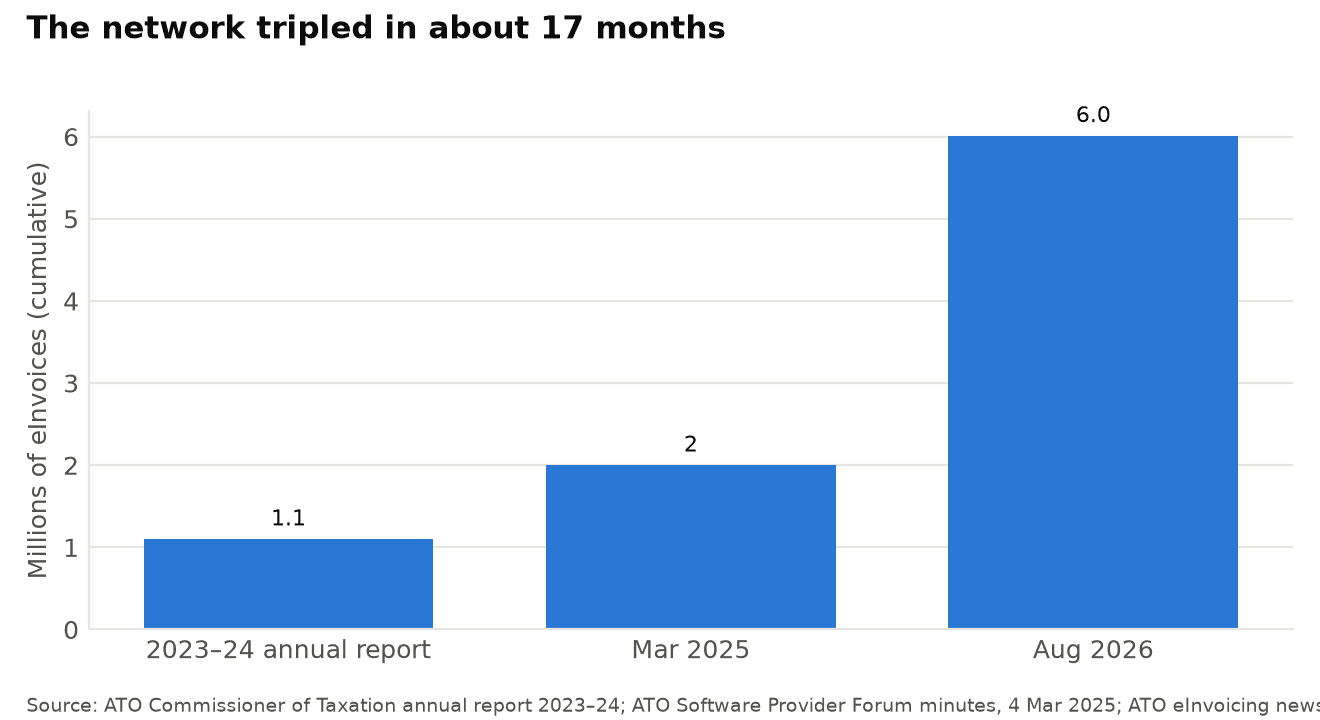
Faster every year. The ATO says the first million eInvoices took four years. The latest million took under four months.
The ATO's 2023–24 annual report put the running total at more than 1.1 million. ATO Software Provider Forum minutes from 4 March 2025 recorded more than 2 million. By the end of August 2026 the count was 6,012,297, and the ATO reports more than 250,000 eInvoices a month.
Milestone | Cumulative eInvoices | Source |
|---|---|---|
2023–24 annual report | More than 1.1 million | ATO annual report 2023–24 |
March 2025 | More than 2 million | ATO Software Provider Forum minutes, 4 Mar 2025 |
End of August 2026 | 6,012,297 | ATO eInvoicing news and statistics |
The ATO also lists 53 accredited Peppol service providers and 48 "eInvoicing Ready" software products, and says more than 300 state, territory and local government organisations use eInvoicing.
So what: many of your customers and suppliers can probably receive eInvoices already, even if nobody has asked you to send one.
What exactly changes on 1 January 2027?
Agencies get one deadline instead of two. Under the Supplier Pay On-Time or Pay Interest Policy (RMG 417), non-corporate Commonwealth entities currently have to pay eInvoices within 5 calendar days and all other invoices within 20 calendar days. The five-day term applies only where both sides can send and receive eInvoices over Peppol and have agreed to use them.
From 1 January 2027, the maximum is 10 business days for all invoice types under contracts covered by the Commonwealth Procurement Rules. Finance's Procurement Policy Note says the policy is mandatory for non-corporate Commonwealth entities, and corporate Commonwealth entities are strongly encouraged to apply it. Until that date, the current terms continue.
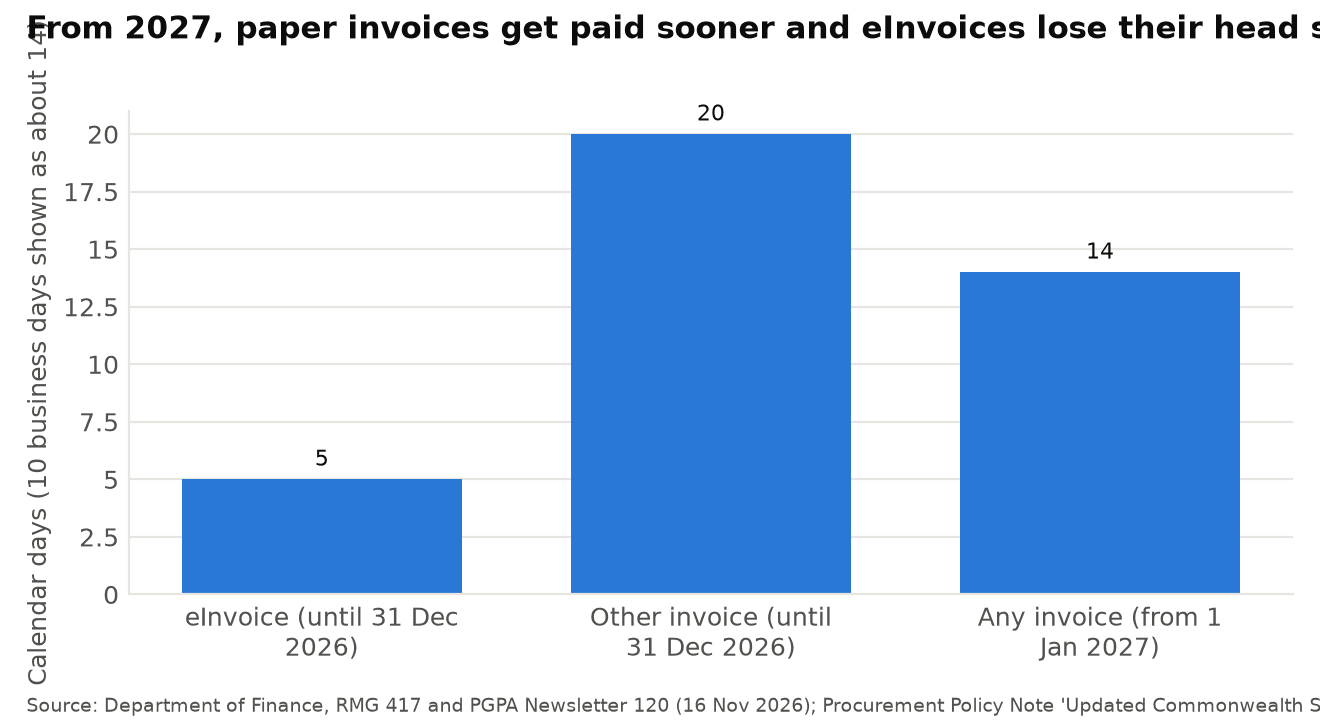
In a normal fortnight without public holidays, 10 business days comes to about 14 calendar days. The clock starts the day after the agency receives a correctly rendered invoice and confirms satisfactory delivery. That rule is unchanged.
So what: if you supply government, mark January 2027 in your cash-flow forecast. Eligible eInvoices could be paid up to about nine days later than now, and other invoices could be paid about six days sooner.
Where does the real saving sit for a small business?
In handling. The ATO estimates that a paper or emailed PDF invoice costs between $27 and $30 to process, and an eInvoice less than $10, because nobody has to handle each invoice by hand. The ATO also says your usual checks before payment still apply.
Invoice type | ATO processing-cost estimate | What drives the cost |
|---|---|---|
Paper or emailed PDF | $27–$30 per invoice | Opening, keying in, matching and chasing errors by hand |
Peppol eInvoice | Under $10 per invoice | Structured data goes straight into the accounting system |
The network is still small compared with the economy. The ABS counted 2,814,778 actively trading businesses at 30 June 2026. Set against the 436,371 registered ABNs, that is roughly one in six, though the two counts measure slightly different things.
So what: a smaller network means less congestion for early adopters, and suppliers who can already send eInvoices are easier for large buyers to onboard.
What could the network look like by August 2027?
Scenario, not prediction. Each case starts from 6,012,297 eInvoices at the end of August 2026 and assumes a steady monthly volume for 12 months.
Scenario | Assumption | Cumulative eInvoices by end of Aug 2027 |
|---|---|---|
Low | Volume holds at about 250,000 a month, the ATO's current "more than" figure | About 9.0 million |
Base | Average of about 300,000 a month, as agencies start sending eInvoices from December 2026 | About 9.6 million |
High | Average of about 400,000 a month once eInvoicing becomes the government default and large buyers push their suppliers to join | About 10.8 million |
The base case assumes the flow keeps rising but no new mandate arrives for business-to-business invoicing. The pace from March 2025 to August 2026 averaged about 235,000 a month, and the ATO says recent months have run above 250,000.
Four things would change this view:
A federal decision to make eInvoicing mandatory between businesses, which would move the outlook above the high case.
Agencies missing the December 2026 deadlines for automatic processing and sending, which would point towards the low case.
Large accounting platforms making Peppol sending a default setting, which would lift small-business volumes.
A slowdown in government procurement, which would reduce invoice volumes overall.
Your move: a six-step eInvoicing checklist
Check your software. Look for "eInvoicing Ready" status or a Peppol send-and-receive setting in your accounting platform. Many popular platforms already include it.
Register your ABN on the network through your software or an accredited Peppol service provider.
List your top 20 customers and suppliers and check whether they are on the network. Most providers let you look up a Peppol ID by ABN.
Set 1 January 2027 in your cash-flow forecast if you invoice Commonwealth agencies, and update debtor-day assumptions to 10 business days.
Run a short pilot with one customer and one supplier. The ATO says a typical pilot takes two to three months.
Automate the next step. Once invoices arrive as data, approval routing, purchase-order matching and payment runs can be automated too. That is where workflow automation for small businesses saves the most time.
Watch out: eInvoicing reduces handling, but it does not replace payment controls. Keep checking any request to change bank details through a separately sourced phone number, because invoice fraud often arrives by email around the invoice itself. Review your cybersecurity controls for finance teams and your ransomware recovery plan before you connect new systems.
If your business wants to move from PDF invoices to an automated invoice-to-payment workflow, Genuine Solutions can help you review your current accounting setup, connect Peppol-capable systems and automate the approval steps around them. Talk to our team about practical IT solutions for your business.
Frequently asked questions
What is Peppol eInvoicing in Australia?
Peppol is an international framework for sending invoices as structured data between accounting systems through accredited service providers. The ATO is Australia's Peppol Authority. It accredits service providers and publishes network statistics. By August 2026, 436,371 ABNs were registered and more than six million eInvoices had been sent.
Is eInvoicing mandatory for Australian businesses?
No mandate covers business-to-business invoicing as of November 2026. Non-corporate Commonwealth entities have had to be able to receive Peppol eInvoices since July 2022. They must enable automatic processing and sending by December 2026, when eInvoicing becomes the default method for Australian Government procurement.
Will government still pay eInvoices within five days?
Only until 31 December 2026. From 1 January 2027, non-corporate Commonwealth entities must pay all invoices under contracts covered by the Commonwealth Procurement Rules within 10 business days, whatever the invoice type. The clock starts after a correctly rendered invoice is received and delivery is confirmed as satisfactory.
How much can eInvoicing save per invoice?
The ATO estimates that processing a paper or emailed PDF invoice costs $27 to $30, and an eInvoice less than $10. Your own saving depends on volumes, current software and how much of your process is still manual. The ATO publishes a value assessment questionnaire to help you estimate it.
Do I need new software to send eInvoices?
Often not. Many accounting platforms are listed as "eInvoicing Ready", and the ATO counted 48 such products alongside 53 accredited service providers. Check your platform's settings or ask your provider. If your system cannot connect, a service provider can act as your access point.
The takeaway: Treat the end of the five-day perk as the point eInvoicing becomes standard practice, not a reason to drop it. The perk only covered government invoices. The savings apply to every invoice your business sends or receives.
Sources and method
Source | What it gave | Data date |
|---|---|---|
6,012,297 eInvoices; 436,371 ABNs; 250,000+ per month; first and latest million; 53 providers; 48 Ready products; 300+ state, territory and local government organisations | End of August 2026 | |
More than 430,000 businesses on the network | Checked 24 Nov 2026 | |
Receiving mandate since July 2022; December 2026 deadlines for processing and sending; eInvoicing as default | Checked 24 Nov 2026 | |
$27–$30 vs under $10 processing cost per invoice | Checked 24 Nov 2026 | |
Typical pilot of 2–3 months | Checked 24 Nov 2026 | |
More than 2 million eInvoices | 4 Mar 2025 | |
Current 5-day and 20-day terms; when the clock starts | Current policy, checked 24 Nov 2026 | |
Department of Finance: Updated Commonwealth Supplier Payment Terms | 10 business days from 1 Jan 2027; scope; link to eInvoicing default | Checked 24 Nov 2026 |
Confirms new terms and current terms | 16 Nov 2026 | |
2,814,778 actively trading businesses | 30 Jun 2026 (released 18 Aug 2026) |
Method: the "one in six" comparison divides registered ABNs by actively trading businesses. Because the two counts measure slightly different things, treat it as a rough guide. The calendar-day equivalent of 10 business days assumes a fortnight with no public holidays. Forecast scenarios apply a flat monthly volume to the August 2026 total and are not ATO projections.
Disclaimer: This article is general information only and does not constitute financial, legal, tax or procurement advice. Government policies and payment terms can change, so check the current official guidance or get professional advice before making decisions for your business.