


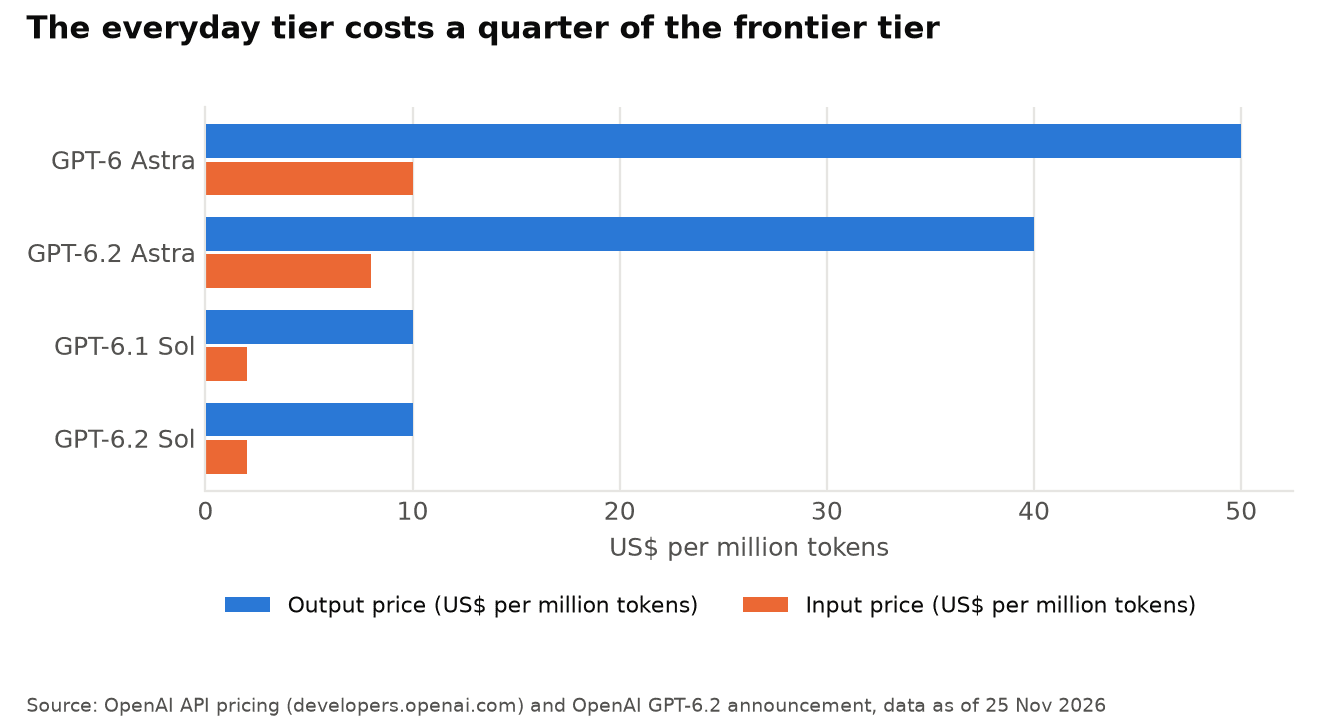
OpenAI released GPT-6.2 Astra on 17 November 2026. It costs US$8 per million input tokens and US$40 per million output tokens, 20% less than GPT-6 Astra, according to OpenAI's API pricing page. For most Australian businesses, though, the more useful number sits one tier down. GPT-6.2 Sol handles everyday work at a quarter of Astra's price.
4x
GPT-6.2 Astra's output price compared with GPT-6.2 Sol's (US$40 vs US$10 per million tokens)
Source: OpenAI API pricing, checked 25 Nov 2026
At a glance
GPT-6.2 Astra input and output prices are 20% lower than GPT-6 Astra's (US$8 and US$40 vs US$10 and US$50 per million tokens, as of 25 Nov 2026).
GPT-6.2 Sol keeps GPT-6.1 Sol's prices: US$2 input and US$10 output per million tokens (OpenAI, 17 Nov 2026).
Batch processing costs 50% of standard rates on both GPT-6.2 models (OpenAI model docs, checked 25 Nov 2026).
Ultrafast mode costs 3 times the standard rate until 28 February 2027, then 6 times from 1 March 2027 (OpenAI model docs).
OpenAI's data residency guide lists US and EU data residency for GPT-6.2 Astra and Sol. Australia is not listed for these models (checked 25 Nov 2026).
What does the GPT-6.2 price cut mean for an Australian business?
For most Australian businesses, the price cut matters less than the gap between the two tiers. The headline is that the frontier model got 20% cheaper. Many teams will read that as a signal to upgrade everything to Astra. That is the wrong reading.
Think of a model's token price as the price on the bowser and your monthly AI cost as the fuel bill. Your bill depends far more on which vehicle you drive and how far you drive it than on a few cents at the pump. OpenAI makes the same point. It says Astra "costs significantly less per task" than GPT-6 Astra because it uses fewer tokens, not only because the price dropped.
Fair point: Astra is the stronger model. But OpenAI's own figures show GPT-6.2 Sol within 0.5 points of Astra on one coding benchmark, at about one-fifth of the cost. For drafting, summarising, triage and customer replies, the cheaper tier is the sensible default.
What most people see | What a calm business owner sees |
|---|---|
"The best model is 20% cheaper, so switch to it" | Sol is still 4 times cheaper per output token than the discounted Astra |
"Faster is better, so turn on Ultrafast" | Ultrafast triples the bill now and is set to double again from 1 March 2027 |
"OpenAI has Australian data residency" | The GPT-6.2 models list US and EU residency only, as of 25 Nov 2026 |
"New model, new project" | Same prompts, new price: run a test on your existing work first |
When the flip is wrong. Some work really does need Astra: long, multi-step agent tasks, complex legal or financial analysis, or work where one wrong answer costs more than a year of token bills. If your team is already getting poor results from the cheaper tier, a 20% cut on the stronger model is a real gain. Use it there, not everywhere.
What exactly changed on 17 November?
OpenAI released two models. GPT-6.2 Astra is described as its new frontier model "for your hardest projects". GPT-6.2 Sol is its "efficient, versatile model for everyday work". Both are available to Plus, Pro, Enterprise and Edu users in ChatGPT Work and Codex, and through the API.
Model (API, standard) | Input | Cached input | Output |
|---|---|---|---|
GPT-6 Astra (previous) | US$10.00 | US$1.00 | US$50.00 |
GPT-6.2 Astra | US$8.00 | US$0.40 | US$40.00 |
GPT-6.1 Sol (previous) | US$2.00 | US$0.10 | US$10.00 |
GPT-6.2 Sol | US$2.00 | US$0.10 | US$10.00 |
Prices per million tokens, US dollars, as of 25 Nov 2026.
Astra's cached-input price fell from US$1.00 to US$0.40, a 60% cut. Sol's price did not move.
So what: if your business repeats the same long instructions or reference documents in every request, Astra's cheaper caching could matter more than its headline cut.
How much would the same job cost on each tier?
Picture a business running a customer-email assistant. It handles 2,000 requests a month. Each request uses about 5,000 input tokens and 1,000 output tokens, which comes to 10 million input and 2 million output tokens a month. This example is our own calculation using OpenAI's published standard prices, with no caching.
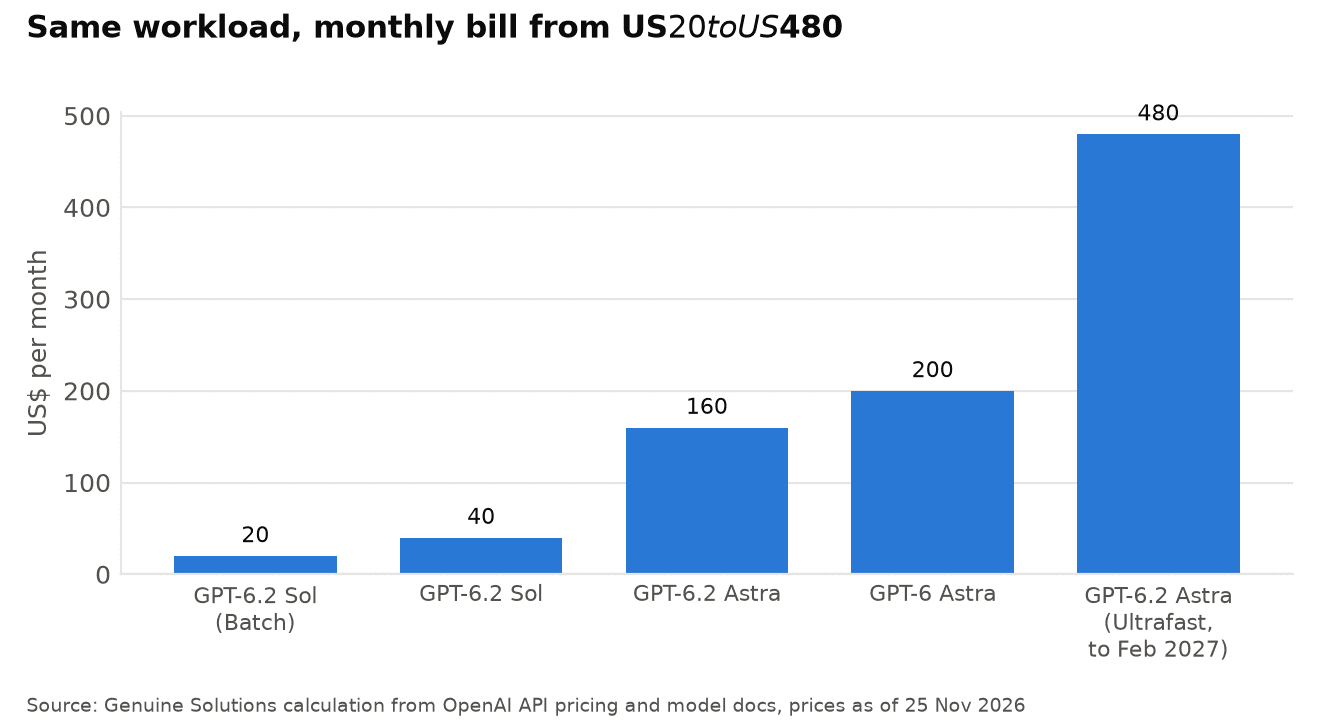
Moving this workload from GPT-6 Astra to GPT-6.2 Astra saves US$40 a month. Moving it to GPT-6.2 Sol saves US$160 a month. Batching non-urgent requests, such as overnight summaries or bulk tagging, halves the Sol bill again to US$20.
So what: picking the right tier saves four times more than the price cut does.
Where does Australian data sovereignty fit?
On data location, the answer is not yet clear for the GPT-6.2 models. OpenAI lists Australia among the regions where it offers data residency. Its developer guide, however, says GPT-6.2 Astra and Sol "support US and EU data residency". Where residency is available, regional endpoints carry a 10% price uplift.
Privacy obligations apply wherever the data is processed. The Office of the Australian Information Commissioner (OAIC) recommends, as best practice, that organisations do not enter personal information, and especially sensitive information, into publicly available generative AI tools. Its guidance also covers checking whether a provider can use your inputs to train its models.
So what: if client records, health details or staff files go anywhere near a prompt, settle where the data goes and what the contract allows before you choose a model. Our cybersecurity services page covers the controls that sit around AI tools.
What could your AI bill look like over the next 12 months?
This is a scenario, not a prediction. The table uses the same illustrative workload (10 million input and 2 million output tokens a month) and OpenAI's prices as of 25 Nov 2026. It assumes volumes stay flat.
Scenario | Assumption | Monthly (US$) | 12 months (US$) |
|---|---|---|---|
Low | All work on GPT-6.2 Sol, half of it batched | 30 | 360 |
Base | 80% on Sol, 20% of hard cases on Astra, standard speed | 64 | 768 |
High | Everything on GPT-6.2 Astra, standard speed | 160 | 1,920 |
The distance between the low and high rows comes from your own decisions, not from OpenAI's price list. Speed settings are the wild card. Running everything on Astra in Ultrafast would cost US$480 a month until 28 February 2027, and US$960 from 1 March 2027 at the 6x rate in OpenAI's docs.
What would change this view:
Price changes. OpenAI has repriced its frontier tier in this release and could do so again.
Data residency. If Australian residency becomes available for GPT-6.2, using it adds the 10% uplift where it applies.
Volume growth. Doubling the requests doubles every row.
Exchange rates. These are US dollar prices, so a weaker Australian dollar raises the local cost.
What should your business do now?
List your current AI tasks and sort them into two groups: everyday work (drafting, summarising, tagging) and hard reasoning work.
Default everyday work to GPT-6.2 Sol. Escalate to Astra only when a test shows that Sol's output is not good enough.
Run a side-by-side test on 20–50 real, de-identified examples from your own work before you switch any production workflow.
Batch anything that can wait a few hours to take the 50% discount.
Check speed settings. Turn off Ultrafast wherever nobody is waiting on the answer, and put 1 March 2027 in the diary.
Confirm data location and training settings in your contract or admin console before any personal information is processed.
Set a monthly spend alert in your API account so a runaway agent cannot run up a surprise bill.
If you want help mapping tasks to tiers, our AI automation services and data analytics services pages show how we approach it.
Watch out: OpenAI reports that both GPT-6.2 models meet its "Critical" threshold for cybersecurity capability. It also says that in two of its tests, the models were more likely to omit mentioning obstacles in simulated workplace tasks. An AI agent that quietly skips a failed step can look like a successful one. Keep a person reviewing anything that sends money, changes records or contacts customers. If you are tightening your incident plans, our guide to ransomware recovery for Australian small businesses is a practical start.
If your business is weighing which AI models and tools to adopt, Genuine Solutions can help you test the options on your own work, set sensible cost and privacy controls, and build automations that hold up in daily use. Talk to our team.
Frequently asked questions
What is the difference between GPT-6.2 Astra and GPT-6.2 Sol?
OpenAI positions Astra as its frontier model for the hardest projects and Sol as its efficient model for everyday work. Through the API, Astra costs US$8 input and US$40 output per million tokens. Sol costs US$2 and US$10. On OpenAI's own benchmarks, Sol comes close to Astra on many tasks at a fraction of the cost.
Did GPT-6.2 Sol get cheaper?
No. GPT-6.2 Sol keeps the GPT-6.1 Sol prices of US$2 per million input tokens and US$10 per million output tokens, as of 25 November 2026. The 20% cut applies to Astra only. OpenAI says the new Sol is better at professional work, coding and computer use at the same price.
Can my business keep GPT-6.2 data in Australia?
Not confirmed as of 25 November 2026. OpenAI lists Australia among its general data residency regions, but its developer guide lists only US and EU data residency for the GPT-6.2 models. Where residency is available, it adds a 10% price uplift. Check with OpenAI before you process personal information.
Is the ChatGPT subscription price the same as the API price?
No. API prices are charged per token for software you build or connect. ChatGPT plans such as Plus, Pro and Enterprise are billed per user. Both give access to GPT-6.2 Astra and Sol, but costs, admin controls and data settings differ, so compare them against how your team actually works.
Should a small business switch models every time a new one launches?
Not automatically. Treat each release as a reason to run a short test on your own work, not as a reason to migrate. Switch when a test shows better results or a lower cost per task, and keep prompts and workflows portable so a later change takes days rather than months.
The takeaway: The best AI model for most Australian businesses this month is the one that does the job for a quarter of the price. Price cuts on the frontier tier are good news, but the money is saved by choosing the right tier for each task. Watch the fuel bill, not the price on the bowser.
Sources and method
Source | What it gave | Data date |
|---|---|---|
Model positioning, availability, 20% and 60% reductions, benchmark statements, safety notes | 17 Nov 2026 | |
Standard, batch, Ultrafast and data residency pricing for the GPT-6 family | Checked 25 Nov 2026 | |
Batch at 50% of standard, Ultrafast at 3x then 6x from 1 Mar 2027 | Checked 25 Nov 2026 | |
Previous Astra price (US$10/US$50); 17 Nov 2026 update note | Checked 25 Nov 2026 | |
Regions listed, GPT-6.2 residency limited to US and EU, 10% uplift | Checked 25 Nov 2026 | |
OAIC: Guidance on privacy and the use of commercially available AI products | Best-practice advice on personal information in AI tools | Oct 2024 |
All prices are OpenAI's published US dollar list prices and exclude GST and currency conversion. The monthly cost examples and scenarios are Genuine Solutions calculations for one illustrative workload with no caching. Benchmark comparisons are OpenAI's own claims and have not been independently tested by us.
This article is general information about technology products and pricing as at the date shown. It is not legal, privacy or financial advice. Prices, features and data locations change, so confirm current terms with the provider and seek advice for your own circumstances before making decisions.